
Happy New Year
On hope at the Spring equinox and the start of the year 1405 in Iran

Today at exactly 10:46 am Eastern time, 6:16 pm in Iran the sun crosses the equator, allowing both hemispheres to receive the same amount of sunlight. Day and night will become equal, each lasting 12 hours. Nowrouz would have arrived.
Nowrouz is a big deal. Growing up, there were a number of non-negotiables for it. You had to clean the house. You had to lay out the Haft Sin spread: 7 items that start with S (apples, vinegar, coins, garlic, sumac, hyacinths, sprouted lentils or mung beans) plus a mirror to reflect light. You had to wear new clothes head to toe, inside out. You had to be sitting with the family next to the Hast Sin spread. The idea being that whatever you were doing when the sun crossed the equator is what you’ll be doing the whole year: Clean underwear and family rank high here.
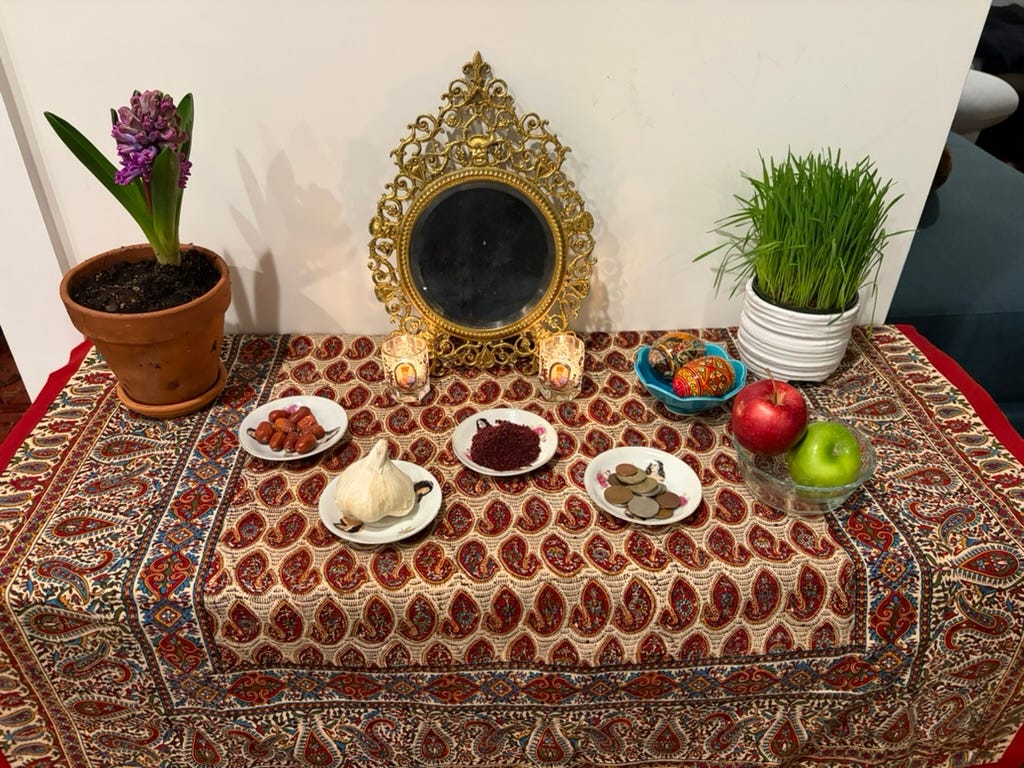
Then once the new year came (its arrival on the radio/television anticipated with the ticktock of a clock), you hugged, you kissed, and the elders gave the younger money. Often crisp new bills that you pulled out of a book of poetry or the Quran depending on your family’s inclinations. Then the fun would start: visiting family members who would give you more money, being visited by them; no school for two weeks, travel to other cities to visit more family (more money?), idle time.
The last time I spent Nowrouz in Iran with my family was in 1988. I just realized Tehran then was also under constant bombardment.
This year, between the bombs, drones, repression, the internet blackout, and the economic freefall, by all accounts this holiest of holy holidays is becoming harder and harder to celebrate. Pockets are empty, people are scared that any moment a missile will land on them. Their hearts are both in it and not. As the journalist Niloufar Hamedi wrote about Tehran in the days before this Nowrouz:
“[It] is still cold this year, and these days there has hardly been any sunlight over the city. At times it’s impossible to distinguish between the gray clouds and the smoke from explosions in Tehran’s sky. Despite all this, the people of this city have set their eyes on Nowruz and the coming year—a year they hope will bring them a new life, filled with blessing, joy, and peace. This is the embodiment of hope; one cannot fault those who take refuge in hope, even in the midst of war, chaos, explosions, and ashes.”
I’ll admit I’m one of the hopefuls. I’m a little thrown off by that, by the fact that I have taken refuge in hope and not my usual cynicism. The Iranian calendar of 1404 has given us so much for which to fall into despair: Two wars by US and Israel, protests and then a brutal massacre of the protestors, people’s purchasing powers for just basic goods falling and falling, drought, pollution, and now the toxic waste of war unleashed on an entire region. The fact that roughly a third of 1404 was spent under an internet blackout. And the regime’s survival and its repressive arm are not just intact but the war seems to have given it a new lease on life.
But I’m hopeful because I know without a shadow of doubt that Iran and the region as a whole is full of people who despite all of this have not stopped trying to find a way out of this quagmire, who have not fallen into this polarization—let’s call it “all who think like me are good and all who don’t are bad”—that is trying to pull us all down like quicksand, who continue to find ways to free themselves from the binary of bombs and labels. I keep reminding myself of the fact that hope can arrive when “people see the truth of power in blood spilled yet do not allow anger to turn them into a mirror of the very logic of repression.” I keep seeing these people all around.
This morning I woke up at 1:45 am and saw my phone had blown up with messages from friends and loved ones in Iran. It seemed like for a brief moment the lines had opened up and suddenly everyone was talking at the same time. Some of these messages were from people I have platformed on this substack. Some of them I’ve met once or twice, some I’ve seen in 2D only on video calls, some I’ve only known through their words and short text exchanges. Some I’ve known all my life. All of them spent a little of their precious internet freedom to send me a message letting me know they’re still there, still thinking, writing, hoping for a better future. Not feeling hopeful feels like ingratitude.
One of them wrote: “Dear Naghmeh…when you are sitting at the Haft Sin spread, which I hope you have laid out, wish for life and freedom for Iran, please. Happy new year.” That “please” keeps flipping in my head.
So here’s to life and freedom for Iran, and for all the region and its people who are being bombed, killed, shot at, occupied, imprisoned; to all who find a way to live in the midst of all of this; and specially to those who keep thinking and dreaming of how to make the lives of others and not just their own, a little bit brighter.
Happy new year to everyone. May the earth keep tilting as it orbits the sun and days become longer and longer than the night.