

One June 1, 2026, the Iranian researcher, writer, and activist, Yashar Darolshafa, was beaten and arrested in Tehran. Darolshafa is a well-known leftist scholar, labor activist, and political prisoner who was first arrested during the Green movement in 2009. Since then he has been jailed multiple times. The reasons for his most recent arrest and his whereabouts remain unknown as of this writing.1
Below is a shortened translation of a much longer and detailed article by Darolshafa published online just one day before his arrest. The close to 17K article titled “The Story of an Idea: The People-Imperialism Contradiction,” is his intervention in an ongoing debate between Iranian leftists both inside and outside Iran over the central role that anti-imperialist struggles play, or should play, in defining Iranian left today, and in turn, positioning the left vis-à-vis the Islamic Republic. While the roots of the debate, as Darolshafa argues, go back to before the 1979 revolution, it has taken on more urgency in the aftermath of the US/Israeli wars on Iran in 2025 and 2026.
To simplify a complicated discussion, its current manifestation goes like this: What matters more to the left both for Iran and transnational solidarity? The fact that the Islamic Republic of Iran stood up to US/Israel and not only lived to tell the tale but emerged stronger and used that strength to make a ceasefire in Lebanon a condition of its own peace? Or the fact that the Islamic Republic of Iran is a brutal state that killed thousands of people over two days in January, has not ceased arresting and executing protestors from the Women, Life, Freedom movement to the January protests, and its policies—both internal and external—has led to massive economic inequality for large segments of the population?
This disagreement hinges on whether one sees the Islamic Republic’s domestic policies and repression as a consequence of foreign aggression—both economic (sanctions) and political (war)— or as related but two separate aspects of a post-revolutionary state whose interests do not align with those of its people.
Is it, as Behrooz Ghamari-Tabrizi based in the US argues that “Iran’s resistance against the world’s superpowers has earned an unprecedented degree of credibility for Iran’s government and nation across the Global South, and even in the Global North. This is an important development, especially for left-wing parties that view the issues of exploitation, colonialism, and ideological manipulation from a global perspective. This means hope.”2
or
Is it, as Mohammad Maljoo based in Iran states that “there is an important distinction between recognizing the structural role of imperialism and supporting the foreign policy of the Islamic Republic, a distinction arising from four axes, each of which on its own can set the left on different paths: the relation to the Islamic system, the place of political democracy, the evaluation of internal repression, and the comprehension of the agency of societal forces. One can be anti-imperialist while simultaneously holding a critical or even opposing stance toward the force that defines itself as the head of the Axis of Resistance [i.e. the Islamic Republic of Iran.]3
Yashar Darolshafa has a clear answer as to where he stands on the debate but it’s important to point out that it is not a “third” position but a third argument, i.e. a two-fold critique of the “axis-of-resistance” position: He argues that the “people/imperialism” binary that undergirds this debate is born out of a specific historical moment that has passed and thus requires a rethinking of these formulations (and by extension of the “meaning of left”) and that the Islamic Republic of Iran as a state is implicated in the same capitalist matrix that enables imperialism. In his words, “the imagined anti-imperialist state is, in fact, that very same repressive capitalist state.”
The translation below is merely a fraction of the entire piece, which is historically and conceptually detailed. You can read the full version in Persian by clicking on the title of the piece below.
This post is part of a collaborative effort to engage with perspectives and analyses from inside Iran. I invite you to read them, incorporate them into your understanding of Iranian politics, and help distribute them widely. Many thanks to my colleague who drew my attention to Yashar Darolshafa’s article.
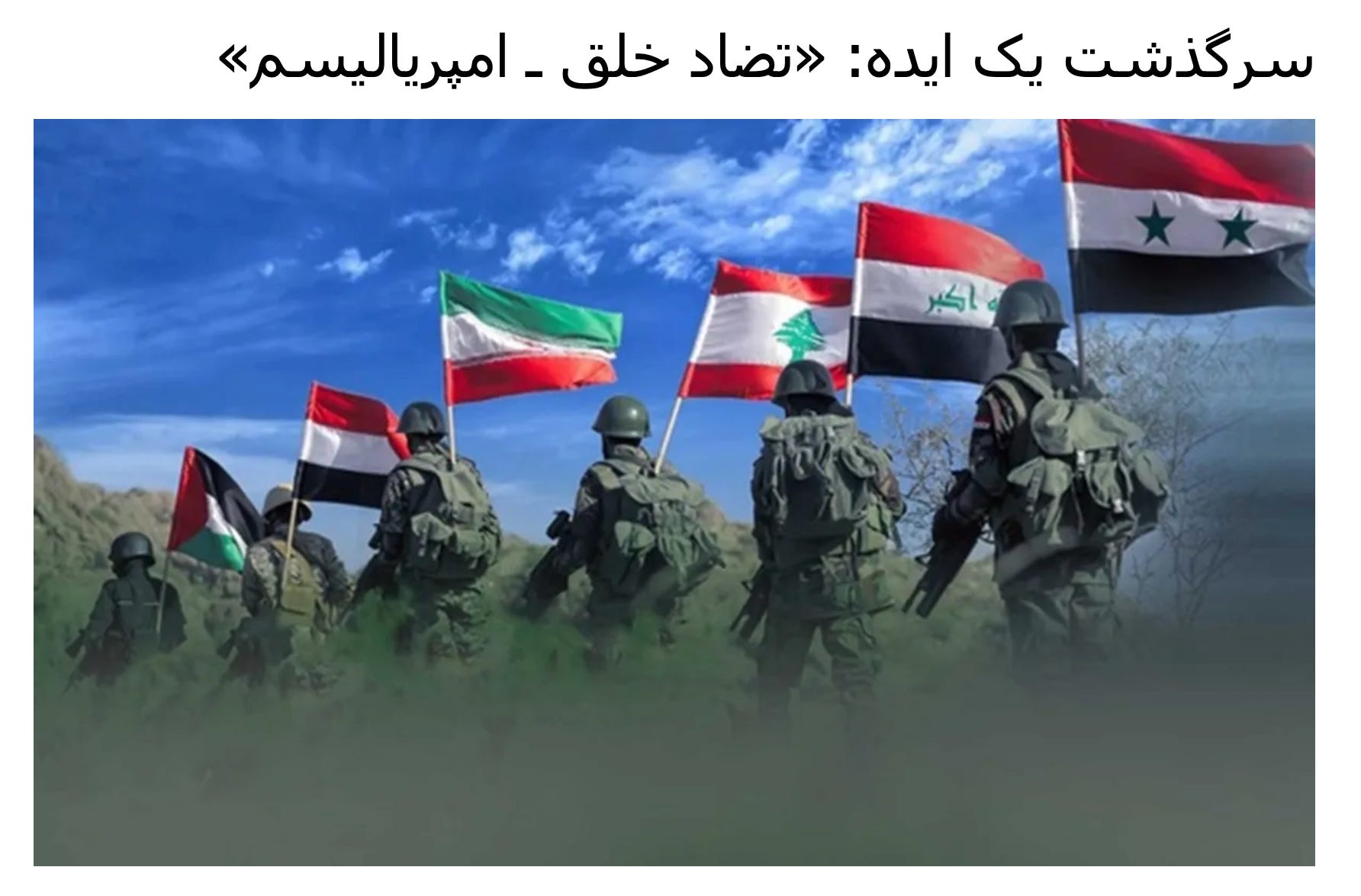
Introduction: A Dispute over a Formulation, or a Dispute over the Meaning of “Left”?
In recent years, one of the strangest theoretical displacements in the space of the Iranian left has been the revival of the “people–imperialism contradiction” formulation to justify a kind of politics that not only bears no relation to the revolutionary left tradition of the 1970s, but in some cases stands as its exact polar opposite. This revival is less a rereading of a legacy than a kind of appropriation and transformation of it: a concept that took shape within the context of a revolutionary strategy is turned into a tool for justifying an established order.
Meanwhile, the critique leveled at this formulation by certain tendencies — particularly within the current known as “Workers’ Communism” [کمونیسم کارگری] — while playing an important role in exposing the populist and nationalist functions of its later forms, has in some instances fallen into a problematic overgeneralization: generalizing the critique of “populist socialism,” directed at later and deviant formulations, back onto the founders of that formulation themselves.
This essay takes shape precisely within these two intertwined errors: on one hand, the exploitation of the concept of the “people–imperialism contradiction” by the current of thought known as the “axis of resistance left” to whitewash an entrenched power bloc; and on the other, the hasty generalization of the critique of “populist socialism” onto the very formulation of the founders of the People’s Fedai Guerrillas.
The concern of the present piece is neither a nostalgic defense of the past nor its blanket rejection, but rather the reclaiming of a historical formulation through a careful rereading of it in its own context and demonstrating how a concept can pass from within a revolutionary strategy into a tool for legitimizing power.
[For brevity’s sake I have focused on the article’s first concern, namely the people-imperialism contradiction. For those interested in his detailed reading of Jazani and populist socialism, I recommend reading Darolshafa’s entire article.]
1. The “People–Imperialism Contradiction” Formulation in Its Historical Context
If we want to understand exactly what “the people” [khalq] means in the formulation of the “people–imperialism contradiction,” we must first distance ourselves from a misunderstanding: “The people” is neither a socio-ontological category, nor a homogeneous social whole, nor another name for “the nation;” rather, it is a historical-strategic formulation that arises from within specific conditions of struggle. For the left situated in the Global South of the twentieth century, the issue was not simply “capitalism” as an abstract totality, but a particular kind of capitalism whose operation was interwoven with imperialist domination, structural dependency, and political obstruction [انسداد].
…
On the one hand, “the people” here does not mean a unified, contradiction-free nation, nor is it simply a pseudonym for the working class. It is a name for formulating a possibility of struggle under conditions in which no single force is capable of carrying the burden of revolution alone. This formulation is not a negation of the internal contradictions of these forces, but their temporary and organized suspension within the horizon of a shared struggle against political obstruction and imperialist domination.
2. From Revolutionary Formulation to State Ideology: The Turn After 1979 (1357)
With the emergence of a paradoxical situation, for the first time, a regime comes to power that cannot simply be formulated as “dependent on imperialism” since its official discourse is “ estekbar-setizi” [استکبارستیزی literally anti-arrogance but used in political discourse to mean anti-hegemon], and at the ideological level it presents itself as the representative of “the oppressed” [mostaz’afin مستضعفین ]. We will not enter into the discussion of what serious conceptual gap exists between “estekbar” [arrogance also hegemony in political discourse] and “imperialism,” and between “the oppressed” and “the proletariat,” nor into what theoretical and political consequences have followed from disregarding this gap and simplifying the matter by saying “these are merely differences in naming.” But let us assume that distinguishing these conceptual differences was genuinely impossible for the left that championed the “people/imperialism contradiction.”4
In the aftermath of Bahman 1357 [February 1979, i.e. the Iranian revolution], it seems that the simple gap that had existed in the earlier formulation (”the people” versus “the dependent regime”) disappears. Now we face a situation in which the established regime can easily define itself with that very same language and within the same conceptual apparatus, and this is precisely the point of crisis.
At this point, what happens for the inheritors of that tradition is a subtle but decisive displacement: instead of analyzing the regime’s material and class position, they are satisfied with analyzing it on a discursive level. “Anti-arrogance” [estekbar setizi] is understood not as a claim but as an objective position; “supporter-of-the-oppressed” is read not as an ideology of mass mobilization but as the actual expression of a class front.
As a result, an equivalence is established: if the regime takes a stance against America and imperialism, then it stands at the “the people’s” front. It is here that the formulation turns from an instrument of analysis into an ideological shortcut.
3. Comprador Bourgeoisie: Analytical Error, or “the Fantasy of Preserving the Father”?
Here we are dealing with a psychological-ideological mechanism that is not merely a matter of analytical error; a displacement of desire and denial is also at work. The axis-of-resistance subject, at the level of discourse, constantly speaks of “oligarchy,” “comprador bourgeoisie,” “the Chamber of Commerce,” “neoliberals,” and “domestic pro-NATO elements” — but it is precisely through this that it can conceal its own relation to the totality of the ruling capitalist order. By continually attacking part of capital, it exempts itself from the responsibility of defending capital as a whole…From this viewpoint, “comprador bourgeoisie” is less an analytical category than a mental object of projection; a vessel into which all the filth of capitalism is poured, so that the rest of the order, i.e. that same state, security, military, and monopoly capitalism it favors, can still appear with a “populist,” “pro-oppressed,” and “anti-imperialist” face.
The axis-of-resistance subject sees itself not as a cog in the justification of rapacious capitalism, but as a compassionate reformer who wants to save capitalism from the hands of bad, infiltrated, Westernized elements. This is its central fantasy: the system [i.e. the Islamic Republic], at its foundation, is anti-imperialist, of the people, and potentially emancipatory; it merely needs to be cleansed of undesirable, contaminating elements. Thus, every time the material reality of repression, exploitation, executions, imprisonment, privatization, wage suppression, and the elimination of leftists appears before its eyes, a defense mechanism immediately activates: these are either the work of infiltrators, or an isolated error, or the result of imperialist pressure, or “we mustn’t play into the enemy’s hands.”
From this crowd’s point of view, the gallows and bullets that the regime aims at protesters are all legible within the horizon of anti-imperialism, and if anyone laments them, they must be either pro-NATO or deceived by enemy propaganda. In this intellectual apparatus, the anti-imperialist Islamic Republic fundamentally has no quarrel with workers, women, feminists, real leftists, and well-intentioned critics; if there has been some clash, it must be the work of Zionist and imperialist infiltrators who wanted to tarnish the system’s reputation. If it later becomes clear that there was no infiltrator involved after all, the ready answer is: yes, it was a mistake; even the most anti-imperialist regimes are not free of error.
This is precisely the point where political critique must be joined to psychoanalytic critique. The axis-of-resistance subject cannot face the truth that its beloved object—the imagined anti-imperialist state—is, in fact, that very same repressive capitalist state. Therefore it splits “the system” from “the system’s errors.” This splitting has a clear psychic function: preserving love for the object. It must be able to go on loving the system as the historical subject of anti-imperialism without being forced to see the blood of the worker, the woman, the protester, and the repressed leftist on the hands of that very object. So it attributes the blood to the infiltrator, the liberal, the pro-NATO figure, an administrative mistake, or wartime conditions.
For this reason, too, its position is never merely “geopolitical analysis”; it is a kind of emotional loyalty to a powerful father who, no matter how much he strikes, must still be presumed well-meaning: if the father struck, it must have been expedient; if he struck too much, bad advisors are to blame; if he killed, conditions were harsh; if he killed again, we must be careful the enemy doesn’t exploit it.
It is here that anti-imperialism turns from an emancipatory politics into a patriarchal theology of the state: the state can err, but its essence is pure; it can repress, but its direction is correct; it can crush the worker, but in its historical totality it is a friend of the oppressed. A complementary mechanism is also present here: any critique that wants to criticize the existing state not as a “material vessel of survival” but as a specific capitalist, security, and repressive state, is immediately accused (with a postcolonial gesture) of being captive to a Eurocentric, anti-state, colonized outlook as if separating “the regime” from “the people” were itself complicity in imperialist de-statification.
But here a decisive slippage occurs: from the correct proposition that “a Global South society without state capacity [دولتمندی] and defensive infrastructure against imperialism becomes defenseless,” they suddenly conclude that one must therefore defend this real, existing state, with its exact class, security, and anti-worker composition. They deliberately ignore the fact that the issue is not the abstract negation of statehood but distinguishing between the necessity of statehood and the whitewashing of the existing state.
This is the same fantasy that allows the axis-of-resistance subject to simultaneously stand alongside rapacious capitalism and see itself as a defender of the downtrodden.
So the issue is not simply that this current makes an error in analyzing Iranian capitalism; it is that, through a political fantasy, it has deprived itself of the ability to see reality. Every piece of evidence against the system becomes evidence against infiltrators; every act of repression, a tactical error; every workers protest, an enemy project; every woman’s cry, liberal-imperialist sedition; every leftist critique, pro-NATO pseudo-leftism. Such a subject continually rewrites reality so that its beloved object is not harmed. This is precisely why it is dangerous.
Last Word: Reclaiming Concepts, Not Returning to the Past
The fate of the “people–imperialism contradiction” shows that no concept, not even if born in a revolutionary moment, has meaning outside its usage history, force field, and political praxis. A concept that once tried, under conditions of dependent capitalism, political repression, and imperialist domination, to open a way for linking different levels of struggle, can today fall into the hands of those who use precisely that same concept to purify a capitalist, security-oriented, and anti-worker state. This metamorphosis is not merely the result of later interpreters’ bad intentions; it is a sign that concepts, if separated from their historical context, their class relation, and their horizon of praxis, easily turn from instruments of critique into instruments of legitimation.
For this reason, reclaiming this formulation from the axis-of-resistance types does not mean a return to it, nor does it mean the revival of such divisions as “national bourgeoisie/comprador bourgeoisie” in a world where the circuits of capital, state, finance, trade, industry, and militarism are intertwined. What remains of this tradition, if anything, is its method: taking concrete conditions seriously; translating abstract concepts into the language of organization and real struggle; and, most importantly, understanding praxis as the place where theory is not only implemented but also corrected…
In confronting the axis-of-resistance, the issue is not only that they present a wrong analysis of Iranian capitalism or global imperialism; the issue is that this error is tied to a political and psychological function. They, by invoking “comprador,” “oligarch,” “pro-NATO,” and “infiltrator,” remove the burden of capitalism’s evil from the whole of the existing order and place it on part of it, so that they can still preserve their beloved state in the position of anti-imperialist father. In this way, every repression is translated into error, every execution into necessity, every workers’ protest into the project of the enemy, and every leftist critique into Eurocentrism or unintended complicity with colonialism. Here, we are no longer dealing with analysis, but with a device for rewriting reality; a device whose task is to preserve love for the state, even when the state speaks with the most naked forms of class violence.
But the critique of this misuse, if it leads to the complete erasure of the history of this formulation, itself turns into another form of elimination. Reducing the entire tradition of “people/imperialism” to an inevitable deviation is just as unhistorical as its revival to justify the existing order…
The dispute over the “people–imperialism contradiction” is ultimately not a dispute over vocabulary; it is a dispute over the left’s struggle with its own concepts. Does it use concepts as living tools for knowing, organizing, and changing the world, or does it reduce them to labels for choosing camps, exonerating power, and suspending class struggle? If there is a lesson to be taken from this history, it is neither a return to past formulas nor a refuge in abstract certainties of today; rather, it is that no concept remains liberatory without liberatory praxis. Concepts must be returned again to their historical field: not in order to repeat the past, but in order to prevent the language of revolution from becoming the language of the state, the language of anti-imperialism from becoming the language of capital, and the language of the people from becoming the language of the repression of the people.
“Where Is Yashar Darolshafa? A Researcher Disappeared Into Detention” https://en.radiozamaneh.com/38206/ [in English.]
Behrooz Ghamari Tabrizi: https://atopiaschool.com/articles/a3106003-8d22-4c05-8a2a-a63209e54f03 [in Persian.]
Mohammad Maljoo: https://truethings.naghmehs.com/p/anti-imperialist-left-or-the-axis. I have quoted from my translation of Dr. Maljoo’s writing on this issue in the aftermath of the most recent war. While Dr. Ghamari-Tabrizi’s text quotes him in places, he provides no citations but I believe he is engaging with this piece published in October 2025 (after the 12 day war but before the latest one): https://akhbar-rooz.com/2025/10/14/30833/
In November 2025, Ali Khamenei, Iran’s late Supreme Leader, gave a speak to students laying out his understanding of estekbar. You can read that speech here.
Liberatory praxis. This is a beautiful phrase. It is one which anyone truly interested in equality and freedom should have written on their heart.
Well presented, well argued, well crafted intellectual gobbledegook to conveniently avoid the far harder job of actual opposition to the Islamic Republic.
Once again in order to avoid the Stark Truth of the kind and amount of personal sacrifice is required to unclench the claws of the still illegitimate Islamic Republic from the throats of the Iranian people.
Which is that probably 100,000 people need to die in the streets in order to permanently weaken the Islamic Republic so it can finally be "erased from the pages of History".