

“The people of Iran will determine the kind of government they want.” Ruhollah Khomeini
“Whether Iran’s structure will be a republic or a constitutional monarchy will be the decision of the people.” Reza Pahlavi
“We will abide by the vote of the people. However the people vote, we will abide by it.” Ruhollah Khomeini
Since at least 2001, the son of Iran’s deposed Shah, Reza Pahlavi, has been consistent about one thing: once the Islamic Republic is gone, a referendum will determine the shape of Iran’s next government. He said that on Jan 24, 2001 and said that on February 13, 2026 at the Munich Security Conference. The “Emergency Phase Booklet” put out by the NUFDI fund, lays out the details of the first “100-180 days” after the fall of the Islamic Republic and details how this transitional government, led by “Crown Prince Reza Pahlavi, in his role as the leader of the national uprising (hereinafter “Leader of the National Uprising”)” would work. At its center is a referendum (point 12.6) that “within a period of four months…[the transitional government shall hold] a referendum for the nation to choose the system of government, namely a democratic monarchy or a democratic republic.”
The consistency of this vision bears thinking about, particularly since there’s not been much consistency in terms of the role he, and/or his supporters, envision him playing. (His half hour interview on the PBD podcast run by the Iranian-American businessman Patrick Bet-David[1] perfectly captures Pahlavi’s refusal to commit to a role despite Bet-David’s best efforts to get him to say whether he wants to be king or not. But we digress.)[2]
The importance of this consistent message lies in the uneasy way in which it mirrors the birth of the Islamic Republic of Iran, both because plebiscites and referendums can act as a “repressive strategy with the objective of hindering internal regime rivals and discouraging the coordination of the external opposition,”[3] and in the ways in which the terms of this “quarter of a century and counting” proposed referendum gets more muddied as time goes on.
On March 30 and 31, 1979, less than 2 months after a seismic revolution ended the Pahlavi monarchy, a referendum was held to determine the nature of Iran’s post-revolutionary system. In the lead up to the referendum, the transitional government made the minimum voting age 16.
In my Iranian revolution class, I often just show the students the two ballots people were given and ask them: which do you think is Yes to Islamic Republic and which is No?
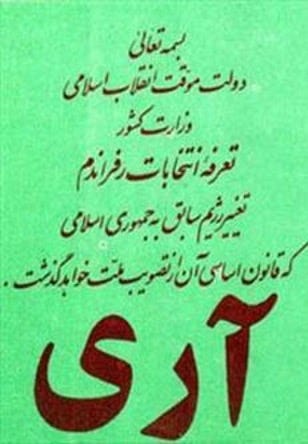
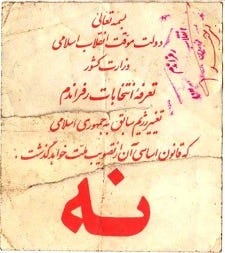
In the end, the voter turnout was 98% and of these 98%, only one percent picked the flaming red ballot.
Two things were happening here. Both a reflected in the Pahlavi proposed referendum.
First, in such a short time after the end of a politically repressive system, no to the Islamic Republic was understood by many as a yes to the monarchy. And people knew one thing over everything else: They did not want the monarchy.
As a friend of mine in Iran told me recently (during our animated, never toxic, and always thoughtful arguments over why she now supports Reza Pahlavi and even an attack by foreign governments), if someone is starving, they just want food. What that food is doesn’t matter. The (evil) genius of referendums held shortly after prolonged repression and mass mobilization is that it turns the given binary choice—Islamic Republic yes or no? democratic monarchy or democratic republic—into food dangling in front of a starved population. One option becomes satiation. The other continued starvation.
In other words, referendums are not necessarily vehicles for direct democracy, as they are being touted by Pahlavi and his supporters here, but rather “they often function as a substitute for a comprehensive discussion on the merits of vital policy issues” and in doing so they work to shut down debate instead of nurturing them.[4] In fact, their power as a political promise comes from how they masquerade as a democratic tool even as they foreclose debate—a fundamental democratic tool.
Second, the current proposal for the terms of a post-Islamic Republic referendum seems to be changing and shifting towards opacity. What does it actually mean to propose a “democratic monarchy” as one of the two options on a post-Islamic Republic referendum? Is that the same as a constitutional monarchy, a form of government in which a hereditary monarch’s powers are bounded by a constitution and most real decision-making rests with an elected parliament and government?
If yes, then how to understand Pahlavi’s own declaration that: “If people want me to be in that institutional role, you’re technically muzzled, you can’t have opinions, and boy do I have opinions. But can the Queen of England or the King of England today have an actual opinion on the government & its policies? They can’t. And that’s a ceremonial role I don’t see for myself either.”[5] And if no, then what is it?
The shift in language from “constitutional monarchy” to “democratic monarchy” in the Iranian opposition lexicon is not innocuous. It invites future voters to imagine a novel hybrid whose terms are undefined, while leaving unclear how fundamental questions, including how would a monarchy that is apparently not ceremonial but is apparently also democratic function?
In 1979, the option to end starvation was “Islamic Republic,” a concept that in that snapshot moment was unclear. What was it? An 8-minute news report interviewing people on the street on those days brings home the confusion that the term evoked in the population even as they were heading towards the polls.[6] People from all walks of life, with a wide variety of accents (locating different geographies and socio-economic status) predominantly say they are voting for Islamic Republic. A few people, mostly women, say they won’t vote because they don’t know what an Islamic Republic is. Some say they don’t know what it is but will vote for it anyway. In one scene, a man attacks the reporter for trying to find “the one person” against the Islamic Republic. Most people when asked emphasized the Islamic part of Islamic Republic. They liked Islamic. They liked Republic. Could Islamic Republic be less than the two desirable parts?
At that moment in time, people’s understandings of what an Islamic Republic was had almost no relation to what came after for a simple reason: The concept was not born out of the revolution itself, but out of the elite political will that went into the constitutional debates in the summer of 1979. When that constitution was put to a vote again in December 1979, turnout dropped from 98% to 76%. But by then, game over.
That’s the other thing about referendums:They don’t give you a do-over. Just ask the British about Brexit. Or Iranians in 1979.
[1] https://www.technologyreview.com/2020/05/07/1001252/youtube-covid-conspiracy-theories/
[3] https://www.cambridge.org/core/journals/european-political-science-review/article/abs/plebiscites-a-tool-for-dictatorship/90DB6CDACAF06866E6A0FE35958D7EB3
[4] https://www.proquest.com/docview/1993432144?pq-origsite=primo&accountid=9703&RAO=true&_oafollow=false&sourcetype=Scholarly%20Journals
[6] https://www.aparat.com/v/n25ugk1
Thank you Naghmeh for this wonderfully illuminating piece! The primary sources are so vivid, hadn’t seem them before. I want to echo your point about the irreducible ambiguity of referenda in the immediate wake of regime change. Most voters see it as a stamp of approval for the change, not a considered choice among real options. That acclamatory function is very useful for the new or would-be rulers. They use it to claim popular backing for their right to rule, and to tout the illegitimacy of their opponents. See Egypt 2011.
Excellent analysis. I wish mainstream media would engage with you to share this perspective with the world; the masses don’t understand this about Shah Koochoolou