
Between Bombs and Labels
A cri de coeur from the editor-in-chief of Shargh Newspaper Shahrzad Hemati

The text below was posted by Shahrzad Hemati on her Instagram account on Feb 20, 2026. Hemati is a long time journalist and currently the editor-in-chief of Shargh newspaper, which, in the current atmosphere of uncertainty and tragedy in Iran, has been publishing some of the most important reporting on the social and political situation inside the country. Topics include how communal mourning in the aftermath of the mass killings of January 2026 has affected children; the fate of the injured in the violence of January who either didn’t go to hospitals for their wounds or went too late; and how the heavy bail set for protestors who were arrested in January is shaping the fate of the prisoners and their families, who are unable to pay it. As politicians and social media personalities outside Iran turn the thousands of dead into weapons for political gain, war, or to silence those they disagree with, journalists inside Iran such as Hemati have kept the focus on the aftereffects of this tragedy on the living.
Why is this an important essay? I have posted my reasons after the translation to make sure that if you read only 2 minutes of this post, you read her words, not mine. If you want my framing first, scroll down to the break, but make sure you come back and read her essay.
What follows is my translation of Shahrzad Hemati’s essay (with her permission), produced as part of a collaborative effort to engage with a wide spectrum of perspectives and analyses published inside Iran. I invite you to read them, incorporate them into your understanding of Iranian politics, and help distribute them widely.
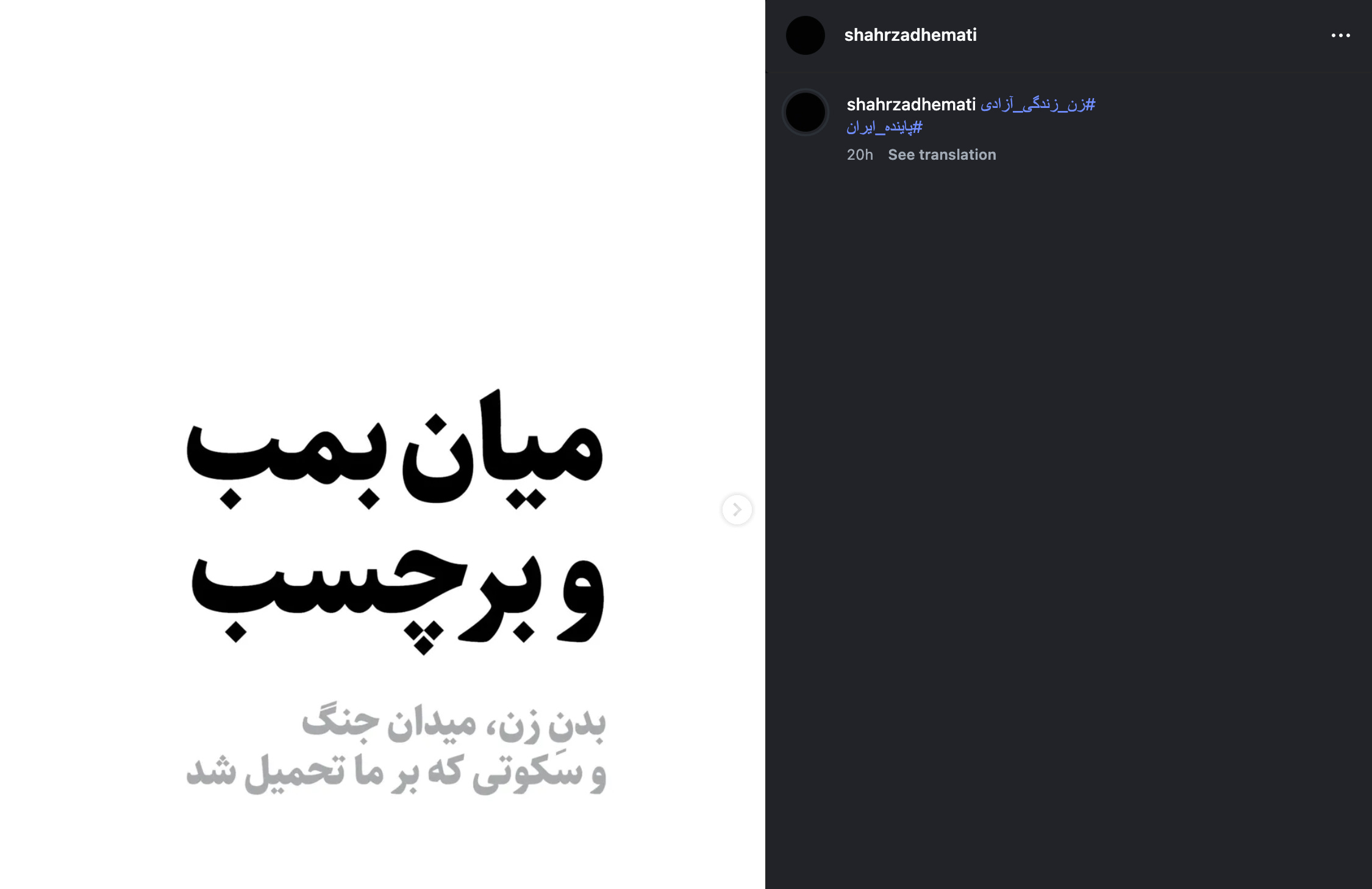
Between Bombs and Labels
Women’s Bodies, the Battlefield, and the Silence That Has Been Imposed on Us
Once a week, we arrange it so that all three of us sleep next to each other. Me, Nader, and Afra. Tonight, we put our bedding down in the same place as we did during the war. In the living room. Afra sleeps between me and Nader and listens to a story, then falls asleep. She’s a heavy sleeper. That’s why she didn’t realize there was a war. When the house was shaking like a cradle, Afra was asleep in my arms. The doors were slamming hard, and I was covering her ears.
Tonight, we slept there again. Just as tightly together. The child has a cold and is uncomfortable but falls asleep quickly. What do we do? We open our Instagram pages. I send news of the war to Sahar. The photos of the killed to Nader, and then suddenly we burst into tears.
In war studies they say bombs don’t take a side, but their effect does. Someone who has money can leave. Buy a safer house. Get a visa. Store medicine. Have a choice. But someone who has to make ends meet when a dollar is the equivalent of 165,000 tomans has already broken their back under the pressure of inflation and the collapse of livelihood long before a single bomb drops. The poor, even before a bomb explodes, are wounded. And poor women, even more wounded because she must also manage the anxiety of others in addition to her own. This is exactly unseen labor that is multiplied during war, and no one includes it in their strategic calculations.
I see something that makes me angry and someone says:
“Shahrzad, be quiet! Now is not the time to speak.”
We’ve heard this sentence for many years. In feminist theory they call this the politics of silencing; suspending a woman’s voice in the name of a bigger project. There is always a “now is not the time.” We always have to wait until the war ends, the revolution is victorious, until security has been established. In this permanent suspension, our bodies and voices are pushed to the margins.
I have gone to the forensic medicine office. I have been present at most funeral processions, and this makes me remain silent in the face of every remark. I leave the final remarks to the mourning families and do my work. The same work we’ve been doing despite all the pressures. We told stories of hospitals full of the sick, full of the families of the killed. We wrote as much as we could. We published photos of people’s loved ones. This was all we could do. Shame on us.
One of the tactics of the security forces when you post something they don’t like is to force you to remove it. They make their threat in the name of security, and what do I do? Naturally, like a citizen who knows I perform my main duties in my media [presumably Shargh newspaper], with teeth tightly clenched, I remove the post.
But this removing of posts, this fear of writing, now has another dimension. A dimension that may hurt civil society activists, writers, and journalists more than security threats: social pressure, online threats, bullying, accusations of treason. Violence is not just bullets; symbolic violence sometimes wounds deeper than physical violence.
We’ve been censored for years. They said there has to be a war because you who are here don’t totally understand, and are sellouts, and war will bring democracy. We stayed silent. They said a red carpet from the blood of our loved ones had been laid out for those emigrated abroad and their chosen leader. We looked with wide eyes, tears flowing, and stayed silent. In protests they shouted “Woman–Whoredom–Freedom.” We stayed silent. About the only movement that has to some degree been able to break the dictatorship at its edges, they said: its time has passed. Again we stayed silent.
Women’s bodies in war are always a symbolic battlefield. On one side, formal power manages it; on the other side, sometimes opposition forces also reproduce the same masculine logic of power: You’re either with us or against us. The insults hurled at women activists are usually more sexual and more violent. The stigma sticks to the body more directly. War, even before it reaches the houses, falls upon the bodies.
On the other side, the story was different. They said terrorists killed [people in Jan]. We watched the videos and stayed silent. They said terrorists struck and held memorials for them. We went to Behesht-e Zahra cemetery and beat our chests and struck our heads and faces but said nothing. Someone constantly came behind us saying: “Hush! Do not speak. Now is not the time.”
Let me make a bitter confession. The way you treat us is even scarier than what the Islamic Republic does. Many civil society activists are willing to endure the Islamic Republic’s prison but not become targets of abusive cyber attackers who have forgotten the days when those who sought democracy were tortured. When security forces censor, it’s predictable; but social censorship, from peers, from those who consider themselves bearers of freedom, is more exhausting. This is just reproducing authoritarianism from within the pretense of freedom.
Now is the time for a war that some dear folks say won’t hurt. It comes quickly with surgical precision, and we should welcome it. Surgery? For whom? For those who can leave or the ones who must remain? Why is it that in all these sensitive moments, we must be here while you’re far from us? Why, with this collapsed economy, should we wait for America to come, strike, leave, kill, and make the carpet of blood even prettier? War, if it comes, is not distributed equally among classes. More worn-out houses, more crowded neighborhoods, more exhausted bodies will get a greater share of destruction.
Why shouldn’t we enjoy these blessed moments of freedom together? Why do you wait on the other side of the borders? Come, let’s experience these sweet and nice moments when our loved ones are in prison together. Let’s go visit Kahrizak together [reference to the forensic medical center where the bodies of the killed protestors were laid out for their families to identify]. Let’s go visit the graves of our loved ones so that Trump comes and strikes, and we can all enjoy this bloodless surgery together.
To be honest, I didn’t write this piece to then publish it. Not because years ago on Twitter you promised that the day after the overthrow of the Islamic Republic, you would hang me from a tree in Haft-e Tir Square. Rather, I’ve taken a vow of silence for the sake of the families of the eternally remembered of our homeland. For all those who have lost a loved one and who are the ones truly mourning. I remain silent so that I can obey their decisions.
But I will not forget that in the days when here [in Iran] you could smell blood in the air, you cheered for the prince and said a red carpet of blood had been laid down [for him]. I will carry this cowardly metaphor with me for as long as I live.
And as for myself: I am a spectator of these cold days. And I hope that if a bomb hits our house, it takes all of us. Me and Afra and Nader when we are in each other’s arms.
Perhaps from the outside, this sentence looks like a death wish. But the truth is that it’s from exhaustion, from an anxiety that has no end. When you are trapped between two violent discourses—one with bombs, one with labels—the tight embrace of three people is the safest place on earth.
And we still sleep there. Tightly together. Against the politics of death, with the politics of life.
***
As I mentioned above, this is a rich text and worthy of widespread attention for numerous reasons. Below I will lay out just a few of them.
First, Hemati is a prominent journalist working inside Iran. As the editor of one of Iran’s most important newspapers, her voice deserves a place alongside the multitude of others who keep getting quoted or published in mainstream Western media.
Second, in the past several weeks, there have been important discussions inside Iran about its future. Most prominently is the close to 5-hour discussion posted on the independent Azad media channel titled “Bloody January and Iran’s Future.” This discussion, which took place inside Iran, featured Hesam Salamat representing a secular republican viewpoint, Sajjad Fattahi, a secular monarchist viewpoint, and Milad Dokhanchi representing a reformist viewpoint. What was remarkable about it was not that this conversation was happening within Iran as much as the fact that these three men often vehemently disagreed with each other, but the conversation never devolved into name-calling or character assassination, a feat that in today’s political climate, whether in the US or Iran, is altogether admirable and uncommon.1
But as singular as this conversation was, it was critiqued, quite rightly, for not just the absence of women’s voices (as people have pointed out, Azad has rarely featured women in its panels) but also the absence of women in “the political imagination” of these three men. As the writer Mahzad Elyassi noted in her Instagram post: “In the past 3 years, women, by refusing mandatory veiling in Iran, have created a different type of politics. A politics based not on taking over the pillars of power but on the everyday erosion of it…yet this political agency is either marginalized or remains invisible in the analyses of many men.”2 Hemati’s piece reminds us of both the singular place that the Women, Life, Freedom occupies in Iran’s modern history and the fact that the effects of war, much like so many other things, are determined by both class and gender. She also, sadly, points out that the opposition led by Pahlavi outside of Iran has not only rejected the Women, Life, Freedom movement, in the name of a secular Iran it is actively disparaging it.
Third, the essay clearly, effectively, and perhaps at cost to herself, calls out the reactionary and anti-democratic forces in the Iranian diaspora, many of whom support the son of the deposed Shah, Reza Pahlavi. This branch of the opposition to the Islamic Republic, in the name of a secular Iran, has leaned hard into deeply authoritarian practices. In the name of Iran, they unleash expletives (almost always a variation on raping you, your mother, or your sister), try to silence any voice they deem not 100% supportive of their king (you can watch them unleash their venom on Christiane Amanpour here for daring to ask Reza Pahlavi about confronting his supporters’ attempts at silencing voices they don’t agree with)3 even as Pahlavi and his advisors keep up the charade that his ambition is merely to get Iranians to a free referendum,4 call Lindsey Graham uncle for pushing through what he has dubbed the Make Iran Great Again agenda5, and along with their dear leader, have not just supported a US attack on Iran but have begged and pleaded for it.
Since January 2026, they have grown louder and more emboldened in their violence, as Hemati calls it. When someone like Hemati, who has been targeted by the Islamic Republic and yet who so courageously works as a journalist inside Iran under impossible circumstances, writes, “Let me make a bitter confession. The way you treat us is even scarier than what the Islamic Republic does,” a chill should run down your spine.
Lastly, it’s hard to convey the amount of anxiety-laden suspense that permeates the lives of people inside Iran today as they wait for a US attack, whether they are for or against it. It bears remembering that the 8-year war with Iraq from 1980–88 was the defining event for multiple generations of Iranians. While the wounds from that war were closed, they never fully healed. The 12-day war with Israel—the chaos of its beginning, the intensity of its entire run, and the eventual participation by the US—for many merely reopened that decades-old wound. For others, too young to have experienced the war with Iraq, it became its own source of trauma. One of my favorite jokes about how on edge everyone is shows two men sleeping in a living room. One of them farts under the covers. The other screams, jumps up, and says, “They attacked, they attacked! They fired missiles!” as he trips over his friend, who gets up, hand to heart, and in an absurdist tone says, “Me! It was me! I farted! I farted!”6
Having grown up in Iran in the 1980s, when I first read the opening lines of Hemati’s piece about sleeping in the living room with her child and husband, I thought she was talking about the 8-year war with Iraq. Back then, we didn’t sleep in the living room since there were too many windows, but in the narrow hallway connecting the three bedrooms to each other. Or sometimes in the kitchen, with its small window that opened to an enclosed space. Even though I quickly realized she meant the June war of 2025, the experience she so effectively conveys felt eerily familiar. (You can read about my war memories here.)

I wrote about the problems of his call for a referendum here:
All This Has Happened Before. But Will It Happen Again?

“The people of Iran will determine the kind of government they want.” Ruhollah Khomeini
❤️🩹
Thanks you for sharing and your bravery - stay strong and stay the world are watching 🙏🙏🙏