
Beyond the Binary
Anthropologist Ali Abdi on listening, memory, and the lives that unsettle our certainties

It should be easy, but somehow it eludes many people, to condemn two things at once: The brutality of the Islamic Republic of Iran and the senseless violence of the current US/Israeli war. In the following text, posted on his telegram channel, Ali Abdi does exactly that through a careful and unflinching description of Iran’s “complex social reality.” The text moves through the streets of Tehran, pulls on memories of conversations in Isfahan, and lays side by side the killing of 9 year old Kian Pirfalak during the Women, Life, Freedom movement in 2022 and the school children of Minab in 2026. In doing so, he charts a way out of the common yet constructed binary of repression vs. war by focusing on “the lived experiences of others.”
Ali Abdi is an Iranian anthropologist and political activist known for his involvement in student movements and his writings on social and political issues, including gender and minority rights. He gained prominence as a student activist during the 2009 Green Movement.
After leaving Iran, Abdi pursued doctoral studies in anthropology at Yale University in the United States, where his academic work focused on gender dynamics and marginalized communities. He returned to Iran in 2023, where he was later arrested and sentenced to a total of 12 years in prison “for articles he wrote a decade ago about gender and sexual minorities, 5 years for protesting the announced results of the 2009 election and 1 year for ‘propaganda against the regime’ during those years.”
The text is translated by Alireza Doostdar, Associate Professor of Islamic Studies and the Anthropology of Religion at University of Chicago. It is produced as part of a collaborative effort to engage with perspectives and analyses published inside Iran. I invite you to read them, incorporate them into your understanding of Iranian politics, and help distribute them widely.
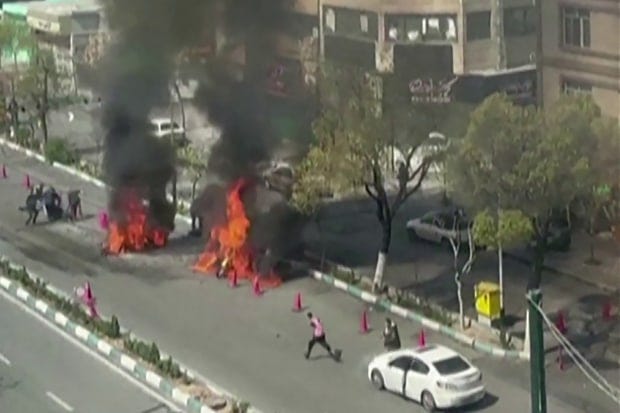
Beyond the Binary
by Ali Abdi, March 26, 2026
(1)
We are in the first days of Farvardin [third week of March and the start of the Iranian new year.] I have come to Tehran to buy a book. It feels apocalyptic: the streets are dark and lifeless; the sky is cloudy and smoke-filled; the pedestrians are in sorrow and disarray.
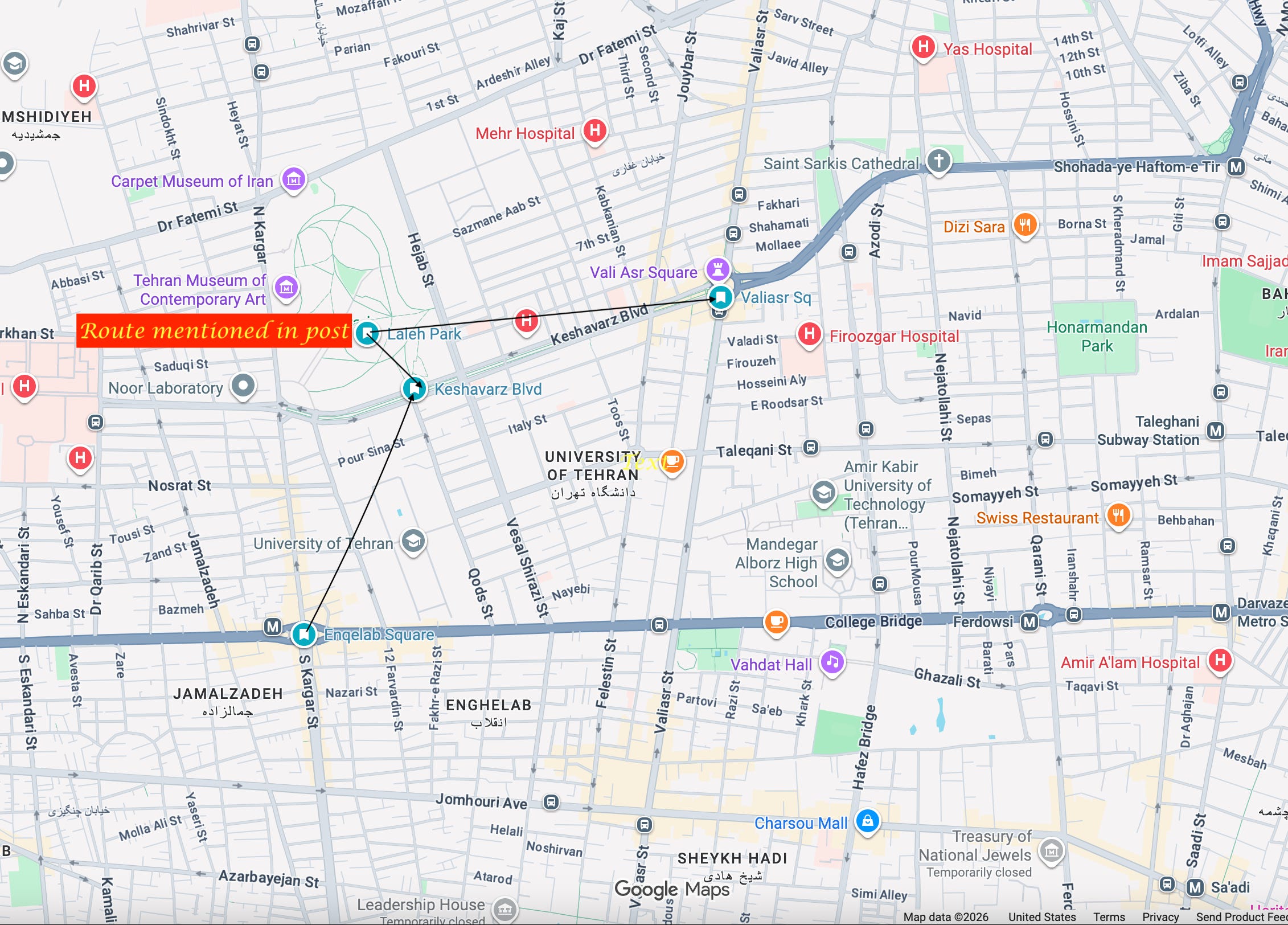
A few bookstores are open around Meydan-e Enqelab [in English commonly known as Enqelab Square though it’s a roundabout.] But even here, there is a sharp smell of sulfur. Someone gestures with his hand, pointing at a location he says they have bombarded in the south. A black plume of smoke rises to the sky seemingly from Shahr-e Rey.
On Keshavarz Boulevard, I see several men dressed in black and armed with Kalashnikovs. They have handcuffed a few people to the railings in front of a building. They shine flashlights into the detainees’ eyes and interrogate them.
The atmosphere is heavy and fearful. One of the men in black comes up behind me and tells me that I will be detained if I don’t walk faster.1
There is no sign of the usual bustle in Laleh Park. The food vendors along the boulevard are gone; the park market and kiosks are closed; and there are no signs of Tehran’s famous cats in the darkness.
In Meydan-e Vali Asr [in English commonly known as Vali Asr Square], about a thousand people have gathered with Iranian flags. A large television screen stands on one side of the roundabout, playing Mohsen Chavoshi’s “Hasbi Allah.”2 A eulogist chants praise for the courage of the first and third Imams of Shia Muslims and the resistance of Iranian fighters. The people chant along with him.
A man steps onto the platform and speaks of one of his friends who had been behind a missile launcher and lost both hands in the hospital. He speaks of another friend: “He was martyred last night. The martyr’s son was born just a few hours ago.”
Most of those present in Vali Asr are women. I see at least two women who are not wearing hijab.
For twenty-seven days now, Iran has been under bombardment by the wicked forces of the world. For more than forty years, Netanyahu had wanted to bomb Iran. The director of the U.S. National Counterterrorism Center [Joe Kent] wrote in his resignation letter last week that the Israeli lobby dragged Trump into this war.3
One hundred thousand residential and commercial units across Iran have been damaged to this day. Three hundred medical and emergency units have been destroyed or rendered inoperative. Five thousand compatriots have lost their lives. Millions in Iran (and Gaza and Lebanon) have been displaced from their homes. And the environmental, psychological, and economic damages of the war will only emerge later.
Netanyahu and Trump are embodiments of human wickedness in the contemporary world: racist, deceitful, greedy, child-killing, child-abusing. Their ultimate goal is to weaken Iran under the banner of “fighting the Islamic Republic.”
Israel opposed a strong Iran even before the 1979 Revolution. America’s inhuman sanctions have been imposed on the Iranian people for fifty years, regardless of which government has been in power. It was the U.S. government, not Iran, that tore up the nuclear deal in front of the cameras.
(2)
We are in the days before the war. In Isfahan, I speak with a friend I met through cycling in the city. He had been arrested on the 18th of Dey [January 8, 2026 referencing the bloody Iranian crackdown on protestors] and spent a month in Dastgerd Prison [i.e the Isfahan Central Prison].
He says two of his cellmates were brothers in their twenties. The younger brother had asthma. Their mother went to the judge several times, saying her son needed medication. The judge did not agree to the mother’s request for the medicine to be delivered. The younger brother grew weaker each day in prison, but the authorities paid no attention. Eventually, in the final week of his detention, he lost consciousness in the crowded and stressful environment of the prison. The authorities took him to the hospital. The next night, news came that he had died in the hospital. My friend spoke of the dust of mourning scattered through Dastgerd Prison after the news.
I go to a hospital in Isfahan for my father’s surgery. There, I meet another acquaintance who has come for his wife’s treatment. He tells me about his sister and brother-in-law who were crossing the street on the 19th of Dey [January 9, 2026] when the brother-in-law was shot and killed in front of his wife’s eyes.
The acquaintance says that for nine days, the authorities did not release the body to the family. They gave the family two options: either pay a significant sum to retrieve the body or sign a document stating that the deceased had been a supporter of the government and a martyr. In the end, the boy’s mother agreed to sign the document under psychological pressure. The acquaintance says that his sister still has difficulty speaking.
(3)
The media — from Iran International to state broadcasting — generally construct binary narratives; that is, they portray two groups of Iranians in opposition to one another so that a story of truth versus falsity takes shape and each side comes to see the other as an enemy: pro-/anti-government, pro-/anti-war, religious/non-religious, and so on.
These binaries, however, are simplifications of a complex social reality. Most of Iran’s population probably does not belong to either end of the spectrum.
A free-minded Iranian opposes oppression. It makes no difference whether the oppressor is foreign or domestic, whether oppression is carried out in the name of religion or in the name of human rights. A free-minded Iranian opposes discrimination. It makes no difference whether that discrimination comes from a racist European or from a prison guard, whether it is the result of colonialism or authoritarianism.
A mother whose son, a soldier, was killed behind a missile launcher and a mother whose son was killed on the 19th of Dey both experience similar suffering as human beings. A soldier who lost both hands behind an air defense system and a protesting farmer from Isfahan who lost his eyes to pellet shots are both deserving of empathy and care.
The families who spent [the Iranian] New Year’s [day] at martyrs’ cemeteries share common experiences with the families of those killed in the Ukrainian airplane tragedy.4 Kian Pirfalak5 and the girls of Minab6 are equally deserving of attention and mourning.
Our collective well-being depends on bringing these ordinary people closer together. The Iranian phoenix takes flight through their coming together.
This closeness is only possible if we become familiar with the lived experiences of others. Familiarity requires listening to the other. Listening is an act of selflessness. Selflessness does not arise from anger and resentment.
For Iranian society to pass through this crisis without falling victim to the violence of people against people, there is no path except connecting with those ordinary others—stepping out of our epistemic caves, leaving behind our self-made tribes, and walking toward those who possess a different worldview but share in our humanity, Iranianness (and Muslimness).
The truth is that the beginning of this path lies within us before it connects to anything outside of us.
(4)
These days, when Red Crescent rescue workers pull someone from beneath the rubble, they do not ask about their political or religious beliefs. Their service is inclusive, selfless, without discrimination, effective, directed toward preserving the lives of all Iranians.
These are some of the best practical examples we have for breaking down conventional binaries.
Reference to checkpoints set up across Tehran by Iranian security forces. You can read another Tehran resident’s account of these checkpoints here.
Mohsen Chavoshi is a prolific singer and music producer based in Tehran. He released Hasbi Allah during the current war in March 2026. You can hear it here:
See: https://www.bbc.com/news/articles/cg4g66r3z40o
On January 8, 2020, a passenger plane flying from Tehran to Kyiv was shot down by IRGC, killing all 176 people on board. See https://www.theguardian.com/world/2022/sep/14/our-lives-are-destroyed-families-take-fight-for-truth-of-flight-752-to-icc
Kian Pirfalak was a 9 year old boy from Izeh who was shot by Iranian security forces during the Women, Life, Freedom protests in November 2022: https://en.wikipedia.org/wiki/Killing_of_Kian_Pirfalak
On February 28, 2026, a US missile struck a primary school in the town of Minab while it was in session, killing at least 160 children and teachers. To read testimonies by some of the families, see https://www.theguardian.com/global-development/2026/mar/28/parents-victims-iran-minab-shajareh-tayyebeh-school-bombing-describe-day
Question, maybe a dumb question: if Abdi was sentenced to so many years in prison in 2023, how is he free and able to write this now? Am I missing something?