
Delam Barat Par Par Mizaneh
On the one month anniversary of the US/Israeli war on Iran

Four weeks ago to a day, I woke up to a million messages on my phone. “I’m sorry this is happening” was the gist of it. The long threatened US/Israeli war on Iran has begun as I, uncharacteristically, had been in a deep sleep.
Something in me broke and for the last 4 weeks, I’ve been trying to both understand it and put it back together. Here are some of its pieces.
I’ve been thinking a lot about how years ago, at an informal meeting of some students and scholars of the Middle East, a woman turned to me with real fear in her eyes and said: What do you have to say about the culture of death in Iran? I was taken aback: No one had asked me that question before and so I didn’t think I had much to say. “Which culture of death exactly do you mean?” I asked trying not to sound flippant. “You know,” she retorted, “the one they teach Iranian children in schools.”
That scene from long ago keeps turning in my head. For us to get here, to get to a war with no objectives, no purpose, no reason, and seemingly no end, a lot of things in both short and long term needed to happen. For years in meetings, briefings, in classrooms and conversations with various policy people and journalists, I thought I had done everything right: I had listened to them present a distorted view of Iran, I met them where they were, and I had engaged with their certitudes, as ridiculous as they were, all in an attempt to be heard, to get them to at least acknowledge that perhaps reality was a bit different than what they thought, and in doing so create a tiny tear in their own desire to rain death on Iran in the name of…whatever was de jour that day.
I had failed, now I see, so abjectly.
I had done this “engagement” with people who could barely acknowledge the humanity of so many Iranians at a cost to myself. The cost I now realize was to my own feelings, my own sense of belonging. I had macheted my own self in two: the clear-headed analyst and the person who yearned, yearned and desired to go back to…what? Home? Maybe not back but go to a place where belonging felt organic, felt rooted in the soil.
When you miss someone or something in Persian you say دلم برات پر پر می زنه, my heart flutters for you. I wish my heart would just beat. This fluttering is killing me.
In these past 4 weeks, journalists call and want you to provide local flavor: Tell me about how it felt to walk in Isfahan. Tell me about the last time you walked along the joobs of Tehran. I haven’t been back in 20 years, I tell them, trying hard not to roll my eyes. I’m not the right address for this.
The last time I walked in the city I was born in was 2006. The next year, I went to India for the summer. The year after Egypt. The year after Syria. I was a citizen of the world and Iran…well it was going to be there as it had been all my life. Then 2009 happened and as I followed it by going to internet cafes all over Damascus, glued to Twitter, I never once thought that this was it. That the door was forever shut in my face.
Why I never went back to Iran after that is a story for another time. But as the years rolled by, the realization set in that slowly but surely, I had slipped from being an immigrant to being in exile and I hated that. Growing up in Los Angeles where those who had fled the revolution in 1979 and after beat their chests for their “vatan” and froze emotionally and mentally in the moment that they had left Iran made me hypersensitive to that. After we immigrated to the US in late 1988, I kept going back to Iran. Every time I arrived, conversations and relationships would pick up seamlessly from where we had left them off 9 months ago. Immigration didn’t feel like a rupture. It felt like just an addition to who I was. Friendships kept going, even flirtations and love and lust would play themselves out while I was there, and then pick up where they had been left off the next time I went back.
I was living inside a changing country and I was changing with it. The Iranians in LA and elsewhere in the US whose image of Iran had frozen with their departure felt strange and wrong to me. I would never want to be that.
To not be that, to not let unrequited desire for return turn me into a caricature, I took a machete and cut myself in half. I could not, I would not feel. I would only think. I would only analyze. I would try to understand Iran as an object of my expertise as an historian. I would not feel.
To do that, I stopped looking at images of Tehran. I did not want to see the snow-capped mountain in the background of buildings and highways and overpasses. I did not want to see the sycamores of Vali Asr, the water running in the joobs, or young and old sitting in cafes. I read the newspapers, the magazines, the books, and I tried to understand the country’s political, social, economic, and cultural evolution as it was, not as I wanted it to be, and through it all, I tried not to see it. I didn’t want my heart to flutter.
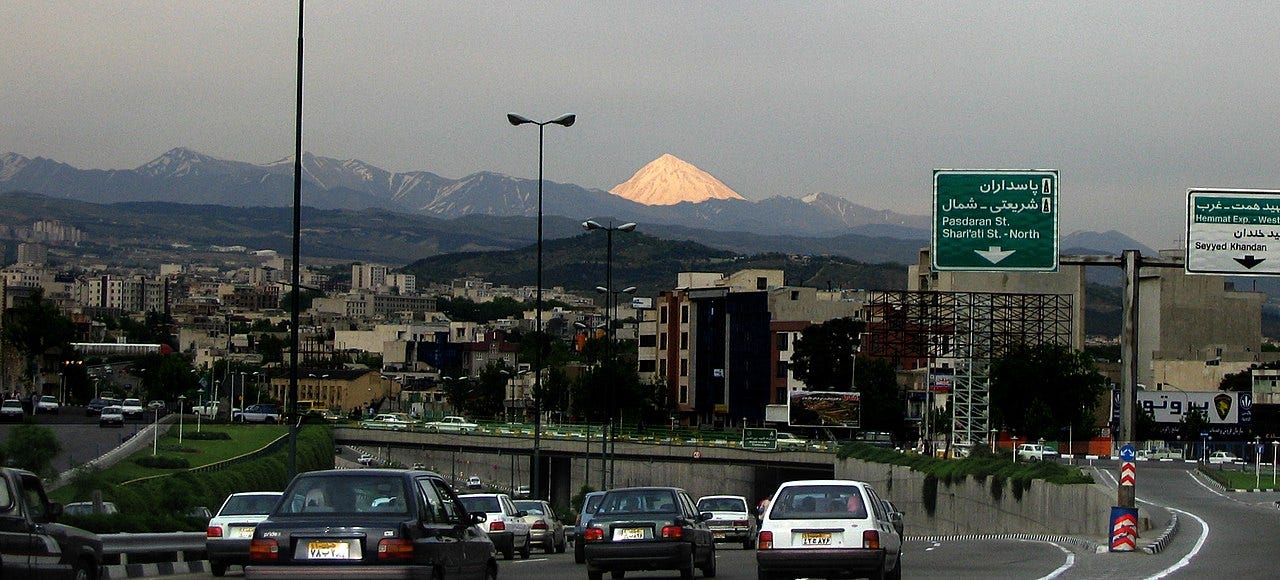
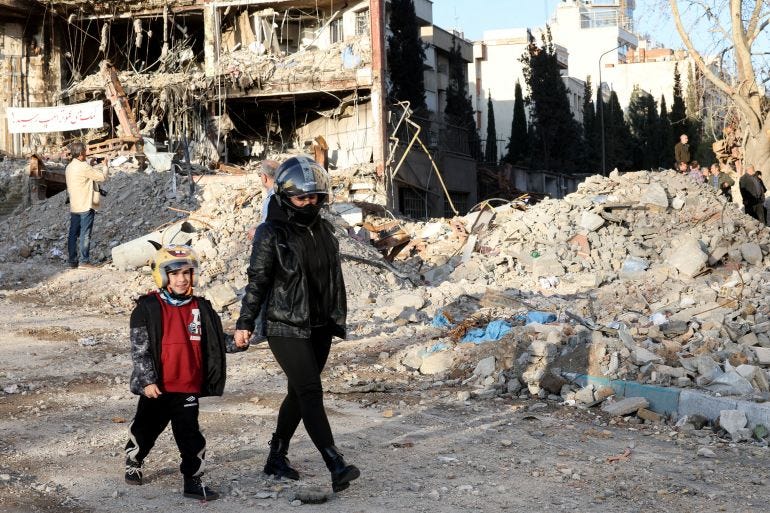
Then on February 28, the bombs started falling and haven’t stopped since. And I just realize now that the thing that broke in me was, to mix all of my metaphors cause honestly, I’m too tired to not mix them, the slowly constructed wall between who I am and who I want to be. That wall came tumbling down.
I’m very surprised by all of this. I know, without a single doubt in my heart, that I’m not an Iranian nationalist. I do not believe in Iranian exceptionalism. When at times a sense of pride or just amazement creeps into me about the fact that so many Iranians over the past decades have kept coming into the streets demanding political, social, and economic freedom, I brush it off. I remind myself that so have others and I just might not know about it. When I feel crushed by the sight of bombs falling on city after city after city after city, when I am overwhelmed by anxiety when I hear the sound of explosions and then, as a child of war in the 1980s, feel the tremors of concrete falling in my body, I remind myself that even at that moment, people in other parts of the region are experiencing something akin to that. I’m not special. Nor are Iranians.
Yet. Yet why does this hurt so intimately? And why can’t I bottle up my heartbreak and throw it in the sea?
In the past 4 weeks strange things have happened. I find that all I want to do is speak Persian. Because of the fact that my family went back and forth between the US and Iran in the 70s, I have been bilingual since I was 4. I dream in fact only in English. But these days, I find myself searching for normal everyday words in English. My brain is flooded with the only language I knew for the first 4 years of my life. Sometimes when I’m sitting in class or at a dinner party, I become conscious of the strange music of English coming out of my mouth and into my ears. It’s not that it feels alien. It’s that it makes me miss Iran; it makes me want to cry. I have no other way of explaining it.
In finding and translating writers, thinkers, and journalists inside Iran, I have entered into strangely intimate relationships with people I have never met, and quite possibly never will meet. I contact them, formally introducing myself in Persian. They inevitably write back with “Naghmeh joon,” dear Naghmeh, as if we’ve been friends for decades, as if we have shared memories. They use their expensive and rare moments of connection to the internet to send short messages that end with “تصدقت” or “قربانت” or “دمت گرم” untranslatable expressions that literally mean “may I sacrifice myself to you” or “may your breath continue to be warm.” These translations feel so wrong. They’re feelings and emotions of sincerity, gratitude, and an intimacy born of intense crises. They’re commonly used public expressions that feel so private to me.
These past 4 weeks have been strange. They feel futile. They feel incomprehensible. They feel like they shouldn’t be. They feel endless. Every day, I tell myself, today no more tears. But every day I also tell myself you cannot let this feel normal. You cannot let it be ordinary. I’m so worried I will forget as the war drags on. I’m so worried I’ll go back to being two halves instead of this one heartbroken self.
***
p.s. Some days ago Junot Díaz posted this poem. If you ever wondered what the point of poetry is, here you are: It says in few words fully what took me 1500 words to say incompletely.
Meditations in an Emergency
by Cameron Awkward-Rich
I wake up & it breaks my heart. I draw the blinds & the thrill of rain breaks my heart. I go outside. I ride the train, walk among the buildings, men in Monday suits. The flight of doves, the city of tents beneath the underpass, the huddled mass, old women hawking roses, & children all of them, break my heart. There’s a dream I have in which I love the world. I run from end to end like fingers through her hair. There are no borders, only wind. Like you, I was born. Like you, I was raised in the institution of dreaming. Hand on my heart. Hand on my stupid heart.
Sending you a big hug Naghmeh joon. Thank you for your beautiful post.
It reminds me of when your friend, the art museum director in Tehran, wrote "my heart broke with sorrow" after that encounter with the young Basij security guy.
I'm afraid the "cult of death" exists outside Iran, one fears to look at statements by the secretaries of war and defence in U.S. and Israel.
As Arundhati Roy said not long ago, "I stand with Iran," meaning the people, the land, the trees, the culture, the entirety of the place. War is just devastation.
Keep your heart alive no matter what.
Thank you for sharing.