
Homes without Windows; Windows without Glass
A newspaper report and a war diary from Iran that take stock of ruin and destruction

For today, Sunday, I have translated two posts connected through one of the most ubiquitous things in Iran today: shattered glass. Shards of glass as reality and metaphor are everywhere in people’s narratives of the war, in people’s fears for their lives, in photographs capturing the utter ruin of life after numerous bombing campaigns.
I’ve been thinking about it not just because if you pay attention, you realize it’s everywhere but because I’ve been trying to think and feel my way through what those who are alive will be confronted with during and after this war ends.
The post for today is long enough and impactful enough that it doesn’t need much framing from me. The first piece, “Homes without Windows,” was published in Shargh newspaper and is a field report from a neighborhood in Tehran in the aftermath of bombings last Monday.
The second piece, “I Want a Life as Vast as Iran,” is a translation of one of Nazanin Matinnia’s war time diary entries that she writes for Etemad newspaper (with her permission.) In my communications with her, Ms. Matinnia who is the editor of Etemad’s back page, explained that for now, the newspaper has been reduced from 8 pages to 4, and these notes find their place somewhere in the abbreviated newspaper. When she can connect, she posts them on her instagram and telegram channels.
These translations are produced as part of a collaborative effort to engage with a wide spectrum of perspectives and analyses published inside Iran. I invite you to read them, incorporate them into your understanding of Iranian politics, and help distribute them widely.
“Homes without Windows” by Nastaran Farokhe published in Shargh Newspaper on March 14, 2026
The blast wave has destroyed the walls of homes, scattering people’s belongings across the ground: from the red carpet of one house, whose burnt fragments now hang from a tree, to the green kitchen curtain lying abandoned in the middle of the alley. This is the scene after the Monday evening bombing in the Majidiyeh neighborhood. Signs of war can be seen throughout the capital’s neighborhood; ruins whose fate, how long they will remain this way, is unknown. Houses that were once people’s refuge have been destroyed by explosions, like the blast on Monday evening in Akbari Alley in Majidiyeh [neighborhood.]
An elderly Armenian man walks from one end of the alley to the other. His hands are tucked into the wide pockets of a wool coat, and he murmurs something to himself. Pointing to the balcony of one house whose wall has collapsed, he says:
“My longtime friend and his wife lived in that house. They were sitting at the table eating when they heard a terrible sound, and then pieces of the wall were thrown into the house. It was a difficult night. They had to leave their home. Just look at what has happened to their only possession.”
Each Window, a Story
The attack struck four floors of a seven-story building, which caused damage to houses in this alley and even those in the back alleys. Most houses no longer have windows. In the middle of the alley, several men can be seen gathering debris from the destroyed wall of a room. From another shattered window, a young woman hurriedly stuffs clothes into a large bag. Curtains from several windows hang outside in disarray, showing that the residents left their homes after the explosion. Other windows have been covered with blankets or thick cloth.
The walls of homes behind the attacked building have also been completely destroyed. A dining table, pink kitchen tiles, and an apron hanging on the wall are now covered in ash. The blast wave hurled belongings from several homes into the street: a set of blinds, kitchen dishes, and a deep red carpet whose burnt fragments can be seen hanging from a tall tree on the sidewalk.
The iron doors of most houses stand half open, revealing some of the damage inside. One building—of which little remains except a few columns and a concrete wall—was the Armenian Scientific-Cultural Institute. What remains is a dusty lot with a small room whose side walls have collapsed. Only a blue wall remains, with a painting still visible on it. Elderly Armenian men stand at the entrance, looking sadly at the ruined walls. One of them, with whiter hair, says:
“We had a place of our own here, and now this too has been destroyed. What is left of this institute for our community? The roof has completely collapsed, and no walls remain. They say the items inside are gone too. It was a valuable place that has been lost.”
Among the crowd gathered outside the houses, a woman enters the alley. Her home, like the others, has been damaged. Laughing, she says:
“My right ear still can’t hear.”
The blast wave took her hearing. Holding a worn out bag, she walks quickly:
“I came to grab some essential things and leave. I just entered the alley with fear. I’m afraid it might be attacked again. I was alone at home when the explosion happened. I don’t remember what happened afterward. The neighbors say I was screaming so much that they gave me a handful of sedatives. I probably had a nervous breakdown.”
Several Armenian men who live in the same alley explain:
“Most people close to the blast suffered panic attacks. Everyone was in bad shape. At first, we didn’t know how much damage had been done. After a while, we saw that the courtyards of all the homes facing south had been destroyed.”
They open the doors of several houses. Inside, the yards are filled with stones, dirt, broken stairs, and shattered walls. A middle-aged woman and a teenage girl passing through the alley stop for a few seconds:
“Our house is two alleys up. Thank God I had just stepped inside from the balcony. The blast wave shattered the stone façade and threw pieces both inside and outside the house.”
Most residents of this alley have been forced to abandon their homes; dust-covered houses with broken doors and windows where no sign of life remains. People return to the alley to see the destruction: the black and gray skeletons of buildings and residents in dusty clothes gathering what remains of their homes.
This story mirrors what has happened in other neighborhoods of Tehran where a single explosion has destroyed people’s entire lives. Because this is the story of war: destruction after destruction.
I Want a Life as Vast as Iran by Nazanin Matinnia
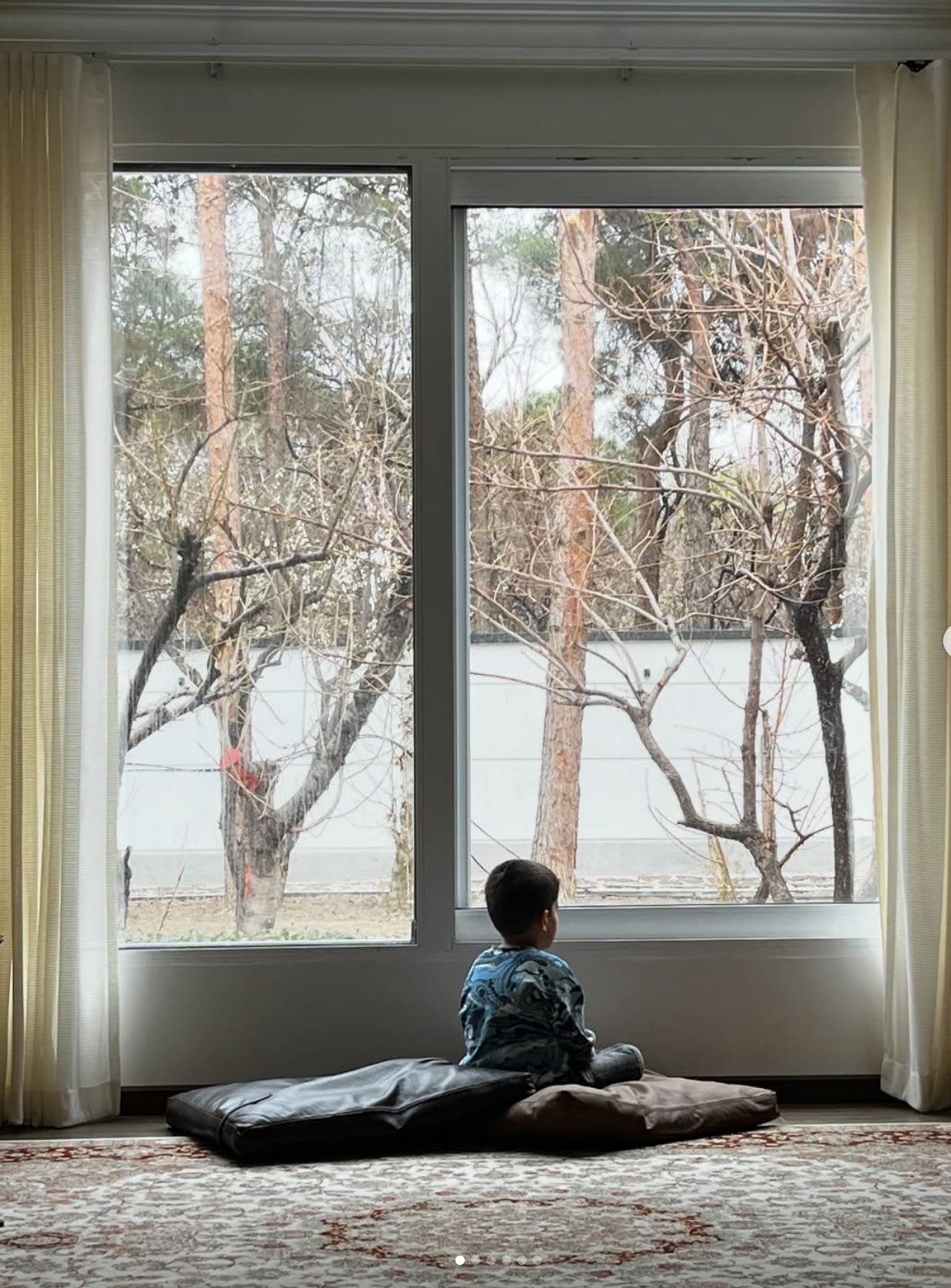
I was saying, “I wish I were in a swimming pool right now,” when the child suddenly said, “I wish I lived in the past.” Surprised, I asked, “Which past?” He said, “A very long time ago when we didn’t exist.” Then he started talking about distant times he had seen in photos, and because he doesn’t like the “now,” he wishes for that instead.
I’ll be honest: things aren’t good. The pressure of anxiety and stress these days has torn apart the psychological resilience of adults, and what reaches children after the frightening sounds and the shaking of the walls is the sight of fear, anxiety, and insecurity in people’s words and eyes. No one can really do anything. In this “now,” the best and most logical decision is simply to stay alive and pass the time. Beyond that, we have control over nothing. No one hears the voice of us scared people, and it’s not even clear what exactly is happening.
On state television and domestic news agencies, everything is safe and secure. On Iran International, the war is called “Operation Liberation.” It’s not clear who is paying the price for all of this. The voice of ordinary people is cut off.
The governor of Tehran says everything is available and there’s no need to have irregular transactions. But he doesn’t say what the sections of society who were already crushed by inflation before the war should do when bread exists but they cannot afford to buy it. Businesses are closed or suspended. Nothing is coming in for it to go out.
Unlike the 12-day war when Tehran was almost emptied out, today the cost of leaving is so high that many people have chosen to stay and continue living under the sound of explosions in the hopes that perhaps some opening will appear, a small window toward life.
I miss those windows toward life.
I miss the peace of mind of drinking a cup of coffee in the cafés of this city, sleeping without the stress of the news, even taking a simple shower without fearing that an explosion might happen and I wouldn’t hear it or know what has happened because of the sound of running water.
The struggle for survival is killing people. Even when the sounds stop, the invasion of thoughts and worries begins. There’s no peace, not even in sleep. Even embraces feel anxious, and conversations are full of things you would never imagine. For example, did you know glass is impossible to find? A friend whose windows were shattered in one of the strikes has been living for three days in a house without windows. But they have to stay there because the house is now exposed and must be guarded.
Or take those with serious illnesses who need specialized medicines. They fearfully move through the city in search of them because most specialized pharmacies are located in neighborhoods that were the hardest hit by attacks. And even if they are lucky enough to find a chemotherapy drug, they don’t know what fate awaits them before the day of injection.
I’m not making this up. I know someone who is sick, the sister of my friend is undergoing chemotherapy. Just yesterday they couldn’t find her medicine, and by the time they did, a blast wave had already destroyed one wall of their house and shattered the windows.
That’s just how it is.
When you talk to people, you can’t understand what it is that war gives to those that beat its drum. What we are experiencing shouldn’t be even a curse on an enemy, let alone a wish for fellow citizens with whom you share a sorrow. Yet it seems that except for us frightened people inside the country, i.e. those of us who hear these stories and are living in this exact “now,” there’s not much understanding or empathy. Even talking about freedom and peace now sounds sentimental and unrealistic. If you do, people from one side or another attack you, calling you an agent of this enemy or that enemy. The middle ground has disappeared. Life under a calm sky and on solid ground has become a distant dream. Silence and withdrawing into oneself require immense patience and endurance, yet they seem to be the only option.
Days keep passing like this. Everyday life has become long anxious hours with no ability to predict the next moment. No one knows where they’ll be tomorrow or what will happen. Spring, the dream that used to connect winter to the future, has become the most distant season of life. When you reach out to grasp it, you get nothing except smoke, ashes, and the ruins of war.
The thread of our hope is worn thin. All that remains is staying alive in the present moment. But if even that is cut, even if after the hard days of this difficult year, that mysterious desire to live disappears, what then? If we reach a point where we no longer even want to stay alive, will anyone see us, take our hands, wipe our tears, and gently push this heart, torn as it is by grief and fear, back toward life, toward the desire to survive, to remain, to be?
Thank you Naghmeh for doing this extraordinary work of curation and translation. Those of us who don’t read Farsi are in your debt. As US media once again covers war as war gaming, oil prices, and the toll on US consumers, it’s necessary to be reminded that war means elderly people sitting down to eat having their walls collapse on them, adults scared to take a shower lest they miss an incoming strike, and children wishing they live in the past. 💔