
How the War Amplifies the Stress and Anxiety of Oil Workers
A translation of the article "Mission on the Narrow Line of Life" in Payame Ma newspaper in Iran

Yesterday, the news was dominated by Israel’s attack on Iran’s gas and petrochemical facilities in Assaluyeh, in Iran’s South Pars gas field. Iran retaliated by attacking several energy sites, most importantly Qatar’s Ras Laffan Industrial City, which produces 1/5 of the world’s liquefied natural gas supply, causing immense damage and spiking gas prices. Globally, it’s seen as an escalation in the 3-week-long war.
For today, I’ve translated an article published in Payam-e Ma newspaper about a week ago that focuses on the emotional toll of working in Iran’s oil fields, particularly during wars. Payam-e Ma describes itself as a national newspaper that focuses on environmental issues, cultural heritage, urban issues, and “subjects ignored by mainstream media.”
The article is part of a broader journalistic development in Iran, where politically sensitive issues are approached from a societal perspective. The focus here, and in many other such pieces, is the emotional toll of both oil work and war on the people engaged in it. The descriptive tone of the piece leaves it open for the reader to draw their own conclusions. But the journalistic choices here stand out, particularly the ways in which the article layers the three major wars Iran has fought in the past 47 years: the Iran-Iraq War, the June 12 war, and the current one.
I highly recommend reading this article in conjunction with Peyman Jafaari’s article, “Iran’s Petrochemical Industry: A Disaster Zone of Precarity and Pollution” (2019)1, which not only gives a historical sense of the development of this industry—particularly Assaluyeh—but also delves into the conditions in which many of the workers in Iran’s oil and gas industry live, including substandard pay and poor housing conditions. Reading his piece alongside the article below fills in many of the things left unsaid but hinted at in the Payam-e Ma article.
This translation is produced as part of a collaborative effort to engage with a wide spectrum of perspectives and analyses published inside Iran. I invite you to read them, incorporate them into your understanding of Iranian politics, and help distribute them widely.
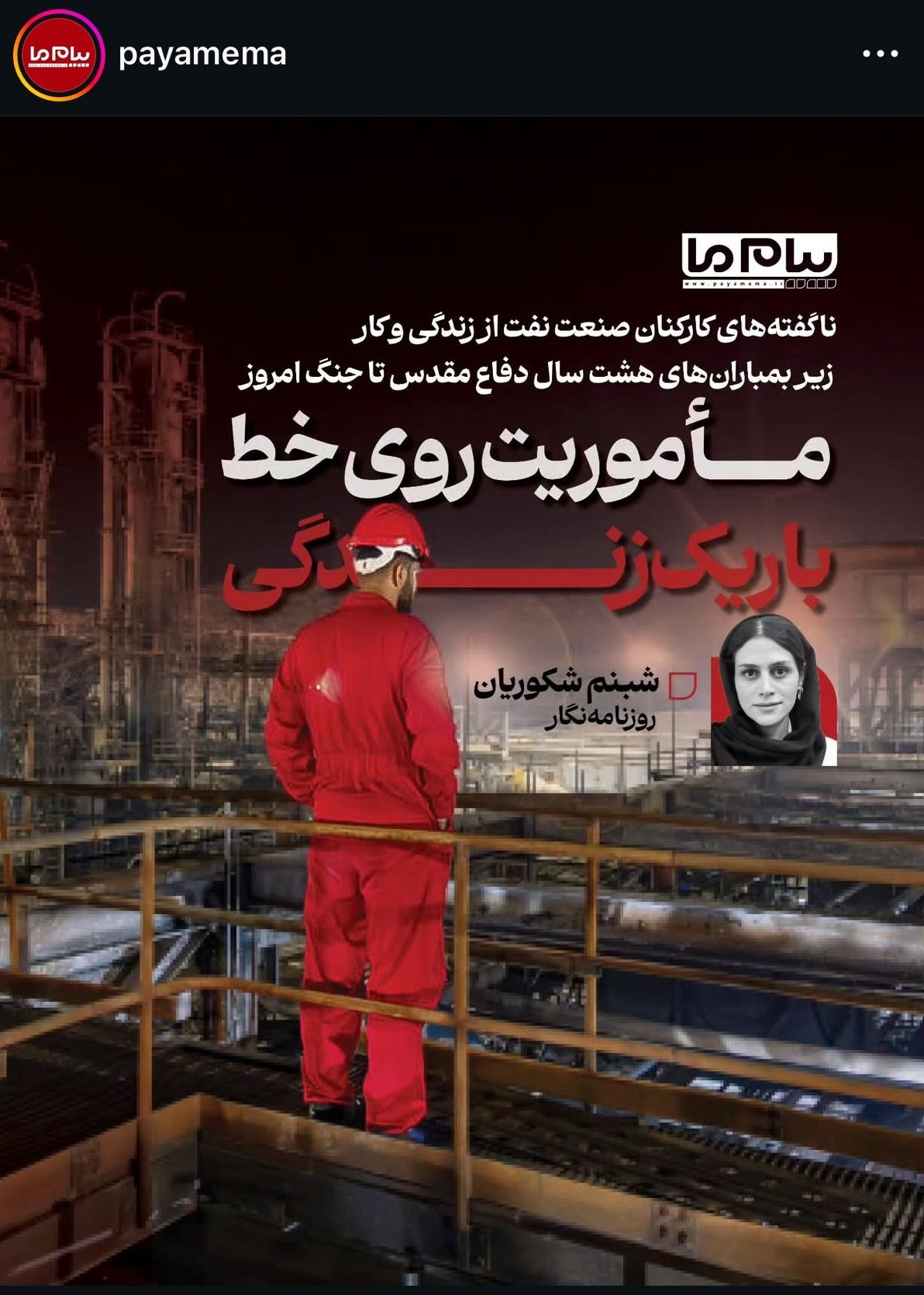
Mission on the Narrow Line of Life by Shabnam Shakourian
March 13, 2026
In southern Iran, war is always accompanied by greater stress; here, attacks reach cities and facilities in which the heart of the country’s oil industry beats. A place where rigs, pipelines, and oil tanks are part of the everyday landscape of people’s lives, and this proximity makes the danger more tangible. Employees of the oil industry have for years experienced this narrow line between work and danger; from the days when bombs in the eight-year war shook heaven and earth, to today when with rising tensions, energy infrastructure is once again among the possible targets of war. In the meantime, the attack on Tehran’s oil depots has sounded the alarm once again. Nevertheless, there are those who, in these same conditions, work far from their families and in the heart of oil fields; with the awareness that one mistake, one moment of negligence, or one attack can be the last day of their lives.
Esfand 1404 [February/March 2026]; Kupal oil field
If you go 60 kilometers from [the city of] Ahvaz toward the northeast, the plains of Khuzestan gradually change color. The desert horizon gives way to an industrial landscape; rigs rising from the ground, pipelines stretching into the distance, and the constant sound of pumps and compressors breaking the silence of the plain. The Kupal oil field stands in the midst of this, spread like an industrial city in the heart of the plain; a city that knows no night or day and whose lights are never turned off. On days when once again the issue of attacks on energy infrastructure is raised in war analyses, the importance of such fields is more obvious than ever. Stopping production here is not only an industrial phenomenon; it is an event that can affect the energy market, the country’s economy, and the lives of millions of people. But within this complex network of equipment and machinery, another life also flows; the life of employees who remain far from their families for months and work in danger daily.
“Pouria Babadi,” a manager of one of the projects in the Kupal oil field, who works for a private company, says about the reality of work in the oil and gas industry: “Anyone who enters the oil industry very quickly understands what kind of world they are facing. Many of those who enter this industry after graduating from university do not get an accurate picture of the real dangers of this work during their studies. When new personnel come to the field, they realize that the environment in which they work is accompanied by danger every day. In the oil and gas industry, one mistake can be the last mistake; a mistake that may both destroy equipment and endanger human lives.”
This reality has made saying goodbye to one’s family take on a different meaning for many oil workers. Babadi says: “Almost all of us, when we leave home, have this feeling that it might be the last time we see our family.”
This feeling is, of course, not limited to industrial hazards. When war and crisis are also involved, the anxiety multiplies. According to Babadi, employees of oil projects usually live far from cities and their families, and gradually experience a kind of isolation. Their daily connection is more with their coworkers than with their family. In such conditions, people usually show two kinds of reactions; some become indifferent to the news and try not to follow it at all, but others constantly follow the news and share their stress with others. But even when the work shift ends and employees return to their abode, their minds do not separate from the field.
He says: “At night our minds are also occupied. When we sleep, we sleep with wondering what will happen tomorrow; whether we will be here or not. Then we think about our families who are kilometers away from us.”
In Babadi’s view, the hardest part of this life is not the danger of the work, but the distance from family. He recalls a memory: “In 2010 I was in Jask when they informed me that my father had died. It had been nearly two months since I had seen my father and the rest of my family. I felt horrible. For a long time, I blamed myself for not seeing my family. This was not just my experience; this has happened many times for my friends and colleagues as well.”2
Naturally, when news of war or attacks on cities arrives and employees are kilometers away from their families, this psychological pressure multiplies. He has a strange account of the beginning of the twelve-day war [the Israeli/US war with Iran in June 2025]: “At the time of the twelve-day war I was in the Cheshmeh Khosh oil field. At first I spoke with my wife and son and everything was fine, but three days later when the war intensified, the stress became much greater. Even though both my wife and I are from the south and have only vague memories of the eight-year war [with Iraq from 1980-1988] when even some of our relatives were killed or injured, we still were very worried. I told my wife to come with my son from Tehran toward the south. At that time, I was living in a camp and my idea was that if we were together, it would be better. I [met my family] at one in the morning in Arak. They had arrived earlier and were standing next to a shop. When I arrived and got out of the car and hugged my wife and son, I could not stop my tears from flowing. It was as if God had given my family back to me once again. It was a strange scene that will never be erased from my mind.”
Babadi says that these days, with the beginning of tensions again, his stress has increased: “This time too I had spoken with my wife that if war happened and conditions were difficult, she should come toward the south. For now they are in Tehran. The internet has been cut and conditions are very difficult; we cannot even see each other from afar. We only speak on the phone a few times a day. I miss them very much and I have severe stress. At night I look at their pictures, hoping for the day when we will see each other again. This is the nature of our work. My wife is from the south and many members of her family worked in the oil company, so she understands the conditions and knows what to do in such situations. So my mind is somewhat more at ease.”
However, when he speaks about his family, there is sadness in his voice. He says that a few days ago his son said a sentence in a phone call that is etched in his mind: “He said it has been 22 days since I have seen you. For me, hearing this sentence was very hard; I felt my son is counting the days. When I got married and had a child, many times I thought of leaving the job and returning to my family. But to tell the truth, the fact is that we have grown up in these oil fields and we do not know any other work.”
According to Babadi, many operational employees, after years of working in the field, can no longer tolerate desk life. The sound of compressors, the smell of gas, the movement of machinery, and the constant excitement of operations have become part of their lives; a life that flows far from cities, but in which the pulse of the country’s energy beats.
Despite this, in moments of crisis, it is these same employees who, alongside firefighters, maintenance crews, and operations teams, try to ensure that the work does not stop. Babadi says that throughout his years of work he has seen many friends who have died in various incidents or suffered serious injury; nevertheless many oil industry employees still believe that the work must continue.
According to him, in times of crisis, the work structure also changes. In such conditions, administrative staff are evacuated or work remotely, but operational employees must remain on site. Sometimes even those who are on leave are called back to join operational teams. He explains that even reducing production in an oil field is a complex process. For example, if it is decided that a field’s production much decrease from 100,000 barrels to half, a series of precise operations must be carried out at a specific time: “Sometimes it is necessary for a valve to be closed exactly at a specific hour. If it is done a few minutes late, the entire operation may face problems. Despite all these difficulties, oil industry employees have a kind of unwritten commitment to their work. There is a particular sense of pride among oil industry workers that when an incident occurs, everyone only thinks that the work must continue.”
Summer 1985; Izeh [a town in southern Iran between Ahvaz and Isfahan]3
Summers in Izeh are hot and heavy. A city located in the Zagros mountains and known by many for its ancient reliefs and old history. But for oil industry employees, Izeh recalls other days; days when the sound of bombs and mortars echoed in the south of the country and oil projects continued in the heart of the mountains.
“Majid Shakourian,” who during the war worked for a private company and was among the managers of oil projects in this region, recalls those days this way: “Recalling these memories is bittersweet. Bitter because during the war, and especially during the missile attacks on Tehran, I was not with my family to protect them. But on the other hand, it is sweet, because like the soldiers of the homeland who were fighting the enemy in that period, I and people like me were also striving on another front to preserve the interests of our dear country Iran.”
He says many projects at that time were carried out in mountainous and remote areas; places that did not even have access to roads: “We worked in areas in the southern mountains of the country where, due to the lack of proper roads, reaching them was very difficult. I will never forget that period. I still remember the amazement and anxiety in the eyes of children who for the first time were even seeing a car.”
But the bitterest part of those years for him was distance from family: “Something that always troubles me from that period is not being beside my family and not seeing the growth of my eldest daughter. That I deprived myself of that joy. After so many years I still have not been able to forgive myself.”
He recounts a memory of one of his work trips when he could not endure the distance and returned home: “I remember one year after the Nowruz holidays I had set out by car toward my mission location. After two hours of driving, I decided to return to Tehran. I returned just to be with my family for a few more hours. Those few hours were worth the return.”
According to Shakourian, in those years each mission could last three or four months and communication with family was very limited: “The only means of communication was the direct telephone lines of oil facilities to Tehran. With the permission of the unit manager, we could make one call a day. Hearing the voice of family, if they were available, reduced some of the psychological pressure of distance. But due to the continuous bombing of oil facilities, even this possibility did not always exist.”
He says lack of news from family on days when reports of missile attacks on Tehran were received created great psychological pressure: “In conditions where Tehran was under missile attack and we had no news of our families, the pressure and stress had multiplied.”
Nevertheless, he says many oil industry employees in those years, despite all concerns, remained at their mission locations: “The important point is that not everyone has the possibility of having a job where they can join their family at the end of the day. Of course, in times when the country’s conditions are not normal, distance from family becomes much more difficult. But what, in that period and even now, makes the pain of distance somewhat easier for those who by choice or necessity accept such working conditions is the feeling of creating better living conditions for their family and for all the people of the country, which can be a consolation for being away from family.”
Shakourian believes this situation still continues for many oil industry employees: “Even now, despite the sensitive conditions, many of our colleagues and fellow countrymen are still present at their mission locations far from their families, and with concern about the country’s conditions and the situation of their families, they are engaged in performing their duties. We must accept that the course of life does not always proceed according to our wishes.”
https://toxicnews.org/2019/11/18/irans-petrochemical-industry-a-disaster-zone-of-precarity-and-pollution/
Peyman Jafaari notes: “Although most workers are recruited from areas far from Asaluyeh, the majority of them have short breaks of only one week after working three weeks. The working hours are long as well, between 12 and 16 hours. As one contract worker in Asaluyeh explained: “Every morning, we punch our cards at 6.45 am for breakfast and start at 7.45 in the petrochemical plant. We finish at 7.30 pm and are picked up by the transport service that takes us to our dorms. We work 14 (sic) hours but are only paid for 8.”
The town of Izeh has been the site of unrest and repression in various recent protests including during Women, Life, Freedom protests and the December/January protests. It also has a fascinating distinction of being one of tens of Iranian cities designated as “exile cities” whereby criminals convicted of certain crimes get exiled to as their punishment. It is also a tribal town.