
Humanity is Losing Part of its Historical Record.
An open letter from Dr. Eskandar Mokhtari from Tehran on the ongoing destruction of Iran's cultural heritage sites

The Iran news in the Western press is currently focused on the Strait of Hormuz, and Pakistan’s shuttle diplomacy and the future of US-Iran negotiations. The current ceasefire remains unstable and uncertain. As such, this is the perfect time to take account of the reverberations of the US/Israeli war on Iran in a number of areas. For today, I want to return to the destruction wrought on Iran’s cultural heritage sites.
According to Reza Salehi Amiri, Iran’s minister of Cultural Heritage, Tourism and Handicrafts, overall 140 cultural heritage sites were struck during the war across 20 provinces. 63 of them were in Tehran, 23 in Isfahan, and 12 in Kurdistan. Of the best known sites that received news coverage during the war, the damage to the 17th century Chehel Sotoon palace in Isfahan is ongoing in that the decorative features of the palace such as such as the “mirrorwork, wooden elements, and ornamental surfaces” continue to fall at a faster pace than before. This is the case for other sites as well.
The war damage to Iran’s economy and the cost of reconstruction is vast, complex, and a topic for another time. Just in terms of the heritage sites, the cost includes not just reconstruction but also the loss in tourism, an industry that employs around 1.6 million people in Iran.1
A recent statement signed by over 200 scholars, faculty, researchers, and practitioners in the fields of archaeology, history, art history, cultural heritage, and related social sciences and humanities has been released that calls for both accountability for the destruction of these sites and safeguarding against future wars. (To learn more, you can also click here for an interactive map produced by The Middle East Cultural Heritage at Risk in Armed Conflict project)
One of the signatories of that statement is Dr. Eskandar Mokhtari, an Iranian scholar and conservation expert who has led major heritage restoration efforts, including that of the Golestan Palace and the reconstruction of Arg-e Bam in 2003 after a 6.6 earthquake on the Richter scale completely demolished this ancient world heritage site. Dr. Mokhtari is also a former deputy of Tehran’s Cultural Heritage Organization and a founding member of the nongovernmental institute, Tehran Watch [دیده بان تهران] that focuses on conservation and documentation of Tehran’s cultural heritage sites.
The letter by Dr. Mokhtari translated and printed below was sent to my colleague, Azam Khatam on March 18, 2026 at the height of war and Iran’s ongoing internet and communications blackout. A colleague in Iran was able to call Dr. Khatam and read it to her on the phone as she typed it on her computer. After that with great difficulty, Dr. Khatam sent the text back to ensure she had taken down the information accurately. We then translated it and tried to get it published in major newspapers but were told the topic had already been covered.
We don’t believe it has. As Dr. Mokhtari warns at the end of his letter without proper attention and action “the damage unfolding in Iran will not be an exception. It will be a precedent.”
This post is part of a collaborative effort to engage with a wide spectrum of perspectives and analyses from inside Iran. I invite you to read them, incorporate them into your understanding of Iranian politics, and help distribute them widely.
The Destruction of Tehran’s Cultural Heritage By Dr. Eskandar Mokhtari
Since February 28, when coordinated air and missile strikes by the United States and Israel against Iran began, a significant number of the country’s historic buildings have been destroyed or damaged. Alongside the mounting human toll, more than 110 historic sites across the country and roughly 60 in Tehran alone have been damaged, according to preliminary reports.2 These are not incidental losses. They point to a pattern that raises urgent questions about the protection of cultural heritage in modern warfare.
For those who have studied and worked to Iran’s heritage sites, the damage is not abstract. Consider the fate of Golestan Palace in central Tehran, widely reported in the Western press. For centuries, it has stood as a layered record of Iranian history, with roots in the Safavid era and its defining form shaped under the Qajar dynasty. I have known the Golestan Palace complex in detail for three decades. In 1995, when the Ministry of Justice proposed construction within the surrounding grounds of the palace, the Cultural Heritage Organization commissioned a [site] evaluation. I led that effort with colleagues. We believed that even a careful clearing of the site would reveal the remains of Tekyeh Dowlat, Iran’s first purpose-built performance space. Though demolished during the Pahlavi period, its remains persisted underground. In less than two weeks, we uncovered part of its plan and the construction proposal was halted.
At the time, it seemed that the site had been secured for the future. In later years, as I began teaching at the university, I continued research on the Golestan Palace and worked toward its inscription on the UNESCO World Heritage list. That designation, achieved in 2013 through the efforts of many colleagues across academic, governmental, and civic institutions, was widely understood to strengthen protections for the site. It did not anticipate the kind of risk now facing it.
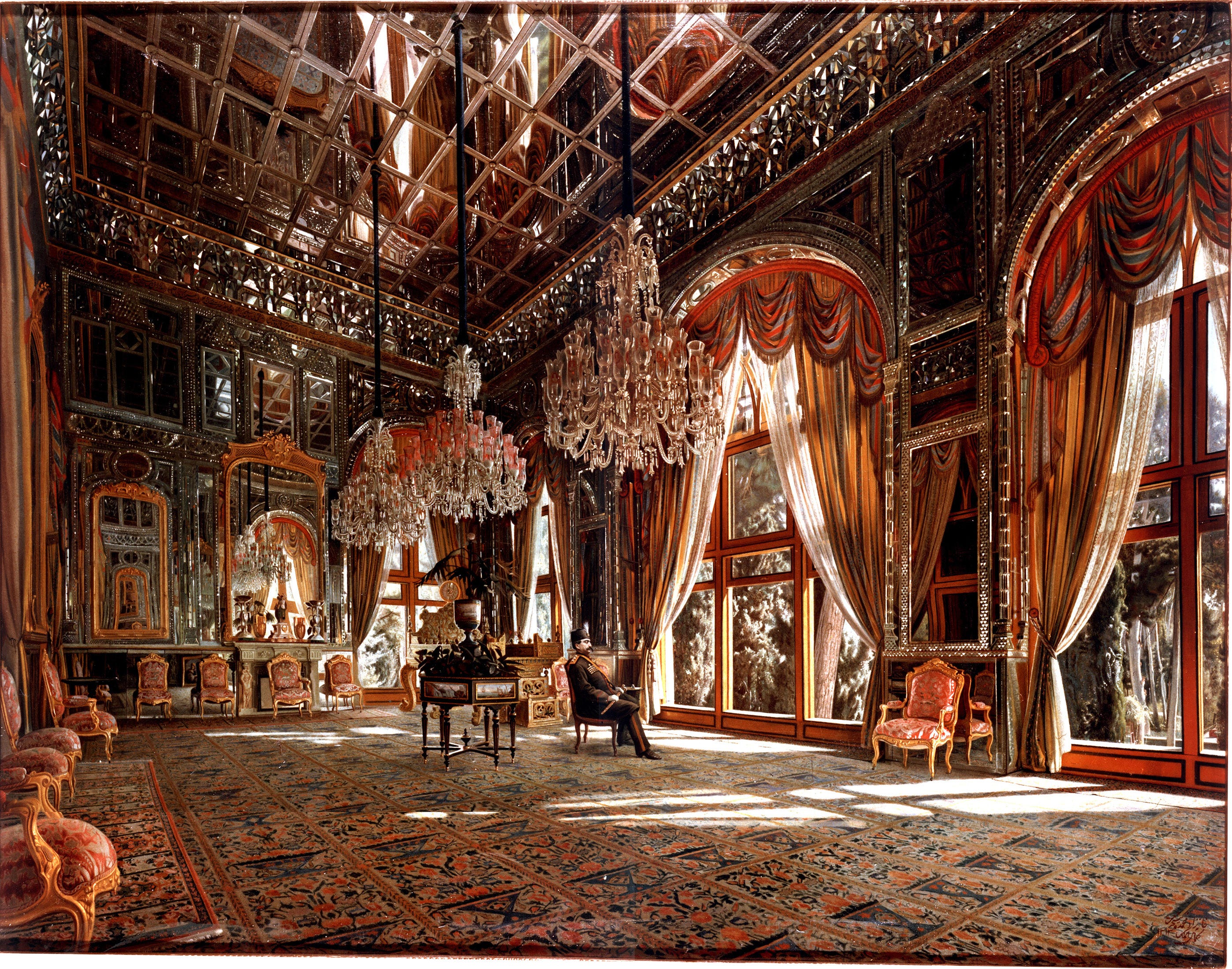
In the first wave of attacks [in the 2026 US/Israeli war], the palace complex was severely damaged. Doors and windows shattered. Delicate wooden structures collapsed. The mirrored ceilings of its famed Hall of Mirrors, immortalized in a celebrated painting by Kamal-ol-Molk, were broken apart.
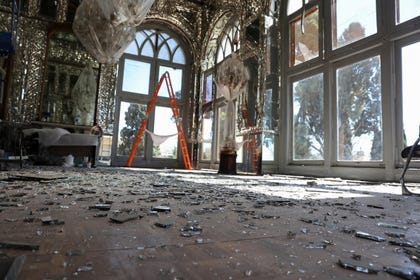
The destruction has not been confined to a single site. The Sa’dabad complex in northern Tehran, once home to Qajar and Pahlavi rulers and now the country’s largest museum campus, has also suffered extensive damage. In the city center, historic buildings in Baharestan Square have been struck, along with key political landmarks including the former parliament and senate buildings. In one case, a missile brought down the roof of the Senate’s main hall, an architectural feature inspired by the dome of the Sheikh Lotfollah Mosque in Isfahan. Even public squares, the shared civic spaces where history is lived rather than displayed, have not been spared. Baharestan Square and Arg Square, both tied to Iran’s Constitutional Revolution and Iran’s struggle for freedom, have sustained damage. So too have the storied Ferdowsi Square and other urban landmarks that form part of Tehran’s collective identity.
Beyond the capital, the scale of destruction is equally alarming. In Isfahan, Chehel Sotoun Palace and the Naqsh-e Jahan Square complex, both UNESCO-listed sites, have been seriously damaged. These are places that have endured for centuries, surviving political upheaval and regional conflict. Their vulnerability today underscores a troubling reality: the norms meant to protect cultural heritage in times of war are increasingly fragile.
International law is not silent on this matter. The 1954 Hague Convention the Protection of Cultural Property, to which US, Israel, and Iran are all signatories, and related agreements explicitly require the safeguarding of cultural property during armed conflict. These rules exist because the destruction of heritage is not only a local loss. It is a global one. When such sites are damaged, humanity loses part of its historical record.
The stated aim of precision targeting in modern warfare is to limit harm to civilians and nonmilitary structures. Yet the evidence emerging from these attacks suggests a different outcome. Historic city centers, dense with cultural landmarks, have been struck repeatedly. Whether through intent, indifference, or failure, the result is the same.
What is at stake is more than architecture. Cultural heritage anchors identity. It tells societies who they have been and, by extension, who they are. Its destruction severs that continuity. It leaves behind not only physical ruins but a deeper rupture in the narrative of a nation.
There is still time to act. International organizations, cultural institutions, and civil society must press for adherence to the legal frameworks already in place. These are not symbolic gestures. They are necessary steps to ensure that the protections promised on paper are honored in practice. If they are not, the damage unfolding in Iran will not be an exception. It will be a precedent. And the next time war comes, as it inevitably will, the world may find that it has grown more willing to accept the loss of its shared past.
The information here has been taken from https://www.radiofarda.com/a/experts-warn-about-the-damage-of-war-to-iran-s-cultural-heritage/33733019.html [in Persian] and https://www.tehrantimes.com/news/525484/Damage-to-Chehel-Sotoun-Palace-worsens-as-shockwave-impact-persists [in English.]
The numbers provided by Dr. Mokhtari are from March 18. The unrelenting bombing of Tehran and other cities in Iran continued until the current ceasefire went into effect on April 8, 2026. As such the numbers are higher and as discussed in the introduction, the shockwaves of the bombings in Tehran and Isfahan, for example, mean that even if the sites are/were not hit again, the damage to them continues.