
It doesn’t always have to be an “either–or” situation.
Roya Khoshnevis' message as Tehran burns

Last night, I woke up at 3:00 am and saw that my friend and colleague in Iran, Roya Khoshnevis had sent me a message on Whats App. Roya is a Tehran-based cultural analyst specializing in Petroculture Studies, with a focus on Tehran, as an “Invisible Oil City.”
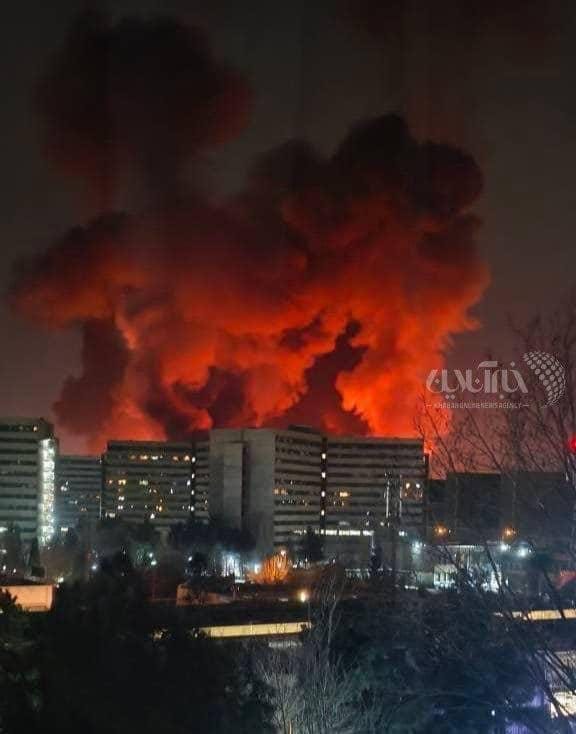
Perhaps it was coincidence, perhaps not, that I heard from Roya the day after Israel struck two oil depots in Tehran, leading to literal rivers of fire running through the city.
This morning’s images of the city were of a grey blanket of smoke choking the people trapped under it. Rain began to fall and Iran’s Red Crescent warned the population of a dangerous acid rain about to descend on them.
Meanwhile, the leader of Israel’s opposition, Yair Lapid tweeted that “Israel must destroy all of Iran's oil fields and energy industry on Kharg Island; that is what will cripple Iran's economy and topple the regime. This war must end when the regime in Iran has fallen, the nuclear facilities have been destroyed, all of the ballistic missile industry has been destroyed, and Hezbollah has been destroyed in Lebanon.”
The self-proclaimed leader of Iran’s transition (from whatever to whatever), Reza Pahlavi, remained steadfast in his refusal to show any empathy, any humanity, to the people he claims he is the leader of. If in January he responded to the question of whether he bears any responsibility towards the people who answered his call to come into the streets and were then slaughtered by saying war has casualties, when the war actually started, he remained laser focused on the sovereignty and well being of United Arab Emirates, Bahrain, Qatar, Kuwait, Oman, Jordan, Iraq, and Saudi Arabia. A lofty position if only it included one more country.
Roya sent me the message below to do what I thought best with it. She said just writing it was cathartic to her. I think what’s best is to keep centering voices inside Iran because somehow as the US and Israel and the Islamic Republic do their best to destroy the region, people in it manage to reject bullshit binaries imposed on them.
It doesn’t always have to be an “either–or” situation. While people argue about which side is worse, who was right, and who was wrong, I keep thinking: why can’t both be wrong? Why can’t there simply be two evils?
Vulnrability is the very characteristic of us Iranians. On Sunday morning [March 1, 2026] while I was helping my mom who is suffering from Multiple Sclerosis, to pack and leave Tehran, the first attack on our neighborhood began. My brother and I jumped to her side. We took refuge in the bathroom. Tightly hugging each other so hard like we never did in my 43 years of life. I was screaming: Babam, babam [my dad]. Baba.
Baba was in a safe place.
Around 45 minutes of non-stop attack on our neighborhood. Close to 15 to 20 bombs dropped.
Five days later, I still imagine our bodies trapped under the weight of the entire apartment building.
I think, when evils are merged and linked it gets more difficult to analyze their actions and behaviors. At least for now, my brain is not clear enough to say which side is worse! We are trapped between the two!
On Monday March 9 (tomorrow), join me and my colleague Arang Keshavarzian for an online discussion of the ongoing situation in Iran and the region. You can register for this Equator event by clicking here.
You can also read four short takes on the ongoing war including my piece called “Iran’s Fearless Intellectuals” written for Equator here.
If you haven’t already read them, I highly recommend the following two substacks by my colleagues Ali Kadivar and Reza Akbari:


Thank you for continuing to bring out voices from inside Iran that those outside, especially non-Iranians, don’t otherwise know exist. I too am against bullshit binaries. I too think the battle against internal repression must be waged alongside its external form. I would probably venture farther and say that in less apocalyptic times the battle against the two is in many ways one and the same. I must confess, though, that it’s absolutely insane to me that in the middle of 45-minute bombing intervals there’s a comparison to be made, that under the pounding of our neighborhoods the question of which side is worse is posed, and more astonishingly still the answer we’re offered is a pained “I don’t know.” We should know. The precision bombs are telling us.