
Life in Tehran: Under the Shadow of Repression, Under the Rubble of Bombs

For those of us glued to our phones in the midst of the ongoing war, the silence of our friends and families inside Iran is heartbreaking. But what this silencing also does is take out the voices of analysts and thinkers inside Iran who have been, and undoubtedly continue, working to chart a path out of the internal and external istisal—despair—that Iran is in today.
Last night as I was staring at my telegram app where all of my Iran based channels are quiet, a message popped up from Mohammad Maljoo. Mr. Maljoo is a prominent scholar and economist who in the fall of 2025 was one of several scholars and thinkers in Iran who were either arrested or interrogated for their work. Several weeks ago, I translated and posted an article he had published in the aftermath of the Islamic Republic’s killing of over 7000 protestors in January. That article had focused on the possibility of hope in the midst of violence.1 His post from yesterday while short also feels like a flash of light in, to use an apt cliche, this darkness.2
It was serendipitous that Mr. Maljoo got through yesterday, a day when a video of Reza Pahlavi, the son of Iran’s deposed Shah, had gone viral. The 6 minute or so video “from Russian comedians Vovan and Lexus, who pretended to be German officials - with one identifying himself as "Adolf" and dressed to resemble Adolf Hitler.” In the video, Mr. Pahlavi earnestly engages with Adolf, making small talk about “Adolf’s” grandfather “an agent in Tehran in ‘40s,” the weather in Munich, where Mr. Pahlavi was when this prank took place. As funny as the fact is that Mr. Pahlavi seems to not get the joke, what he says to “Adolf” is chilling. In response to Adolf saying “our intelligence is ready to start bombing Tehran,” Mr. Pahlavi replies:
“The more we have as part of this coalition vis-a-vis the regime, the better. In fact so it doesn’t isolate just the Israelis and the Americans in this that’s certainly a welcome element for us to have more people joining in this crusade.”3
I hold the words of these two people together not because I see an equivalence, moral or otherwise, but because I find it to be revealing of the moment we're in. Both of these, Maljoo's text and Pahlavi's unscripted words to Adolph, form and inform the horrific moment that Iran and the Middle East at large finds itself in today.
Below is the translation of Mohammad Maljoo’s March 4, 2026 telegram post by Leila Faghfouri Azar and posted last night on her Linkedin page. I am republishing it here with permission as part of a collaborative effort to engage with a wide spectrum of perspectives and analyses published inside Iran. I invite you to read them, incorporate them into your understanding of Iran and help distribute them widely.
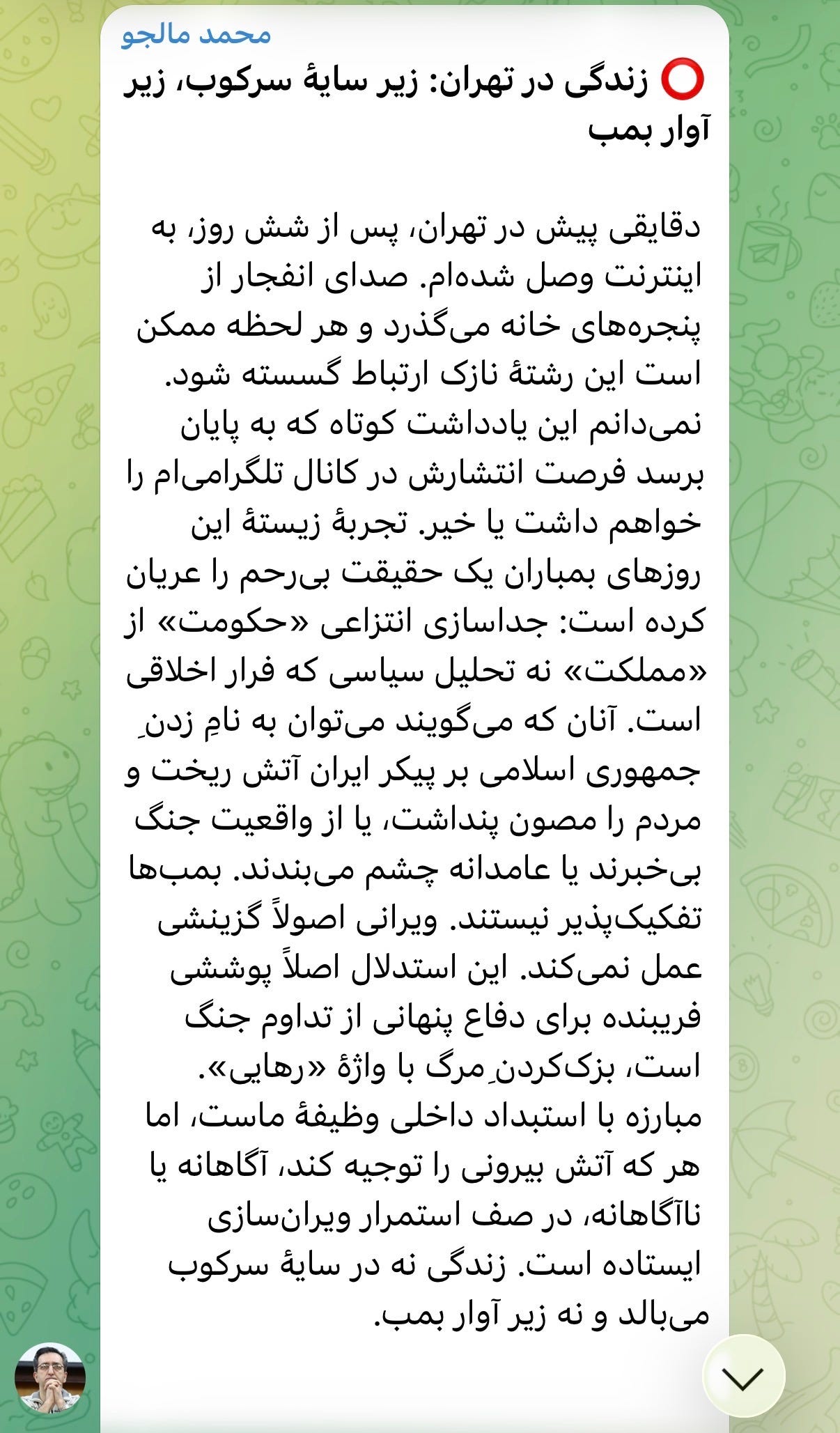
Life in Tehran: Under the Shadow of Repression, Under the Rubble of Bombs
A few minutes ago in Tehran, after six days, I was able to connect to the internet. The sound of explosions passes through the windows of my home, and at any moment this fragile thread of connection may be severed. I do not know whether, once I finish this short note, I will even have the chance to publish it on my Telegram channel. The lived experience of these days of bombardment has laid bare a ruthless truth: to make an abstract distinction between “the government” and “the homeland” is not political analysis but moral evasion. Those who claim that in the name of striking the Islamic Republic one can set Iran ablaze while imagining the people will remain unharmed are either ignorant of the reality of war or are deliberately closing their eyes to it. Bombs do not discriminate. Destruction is, by nature, not selective. This line of reasoning is nothing but a deceptive cover in defence of continuing war; dressing up death with the word “liberation.” No doubt, fighting against the domestic tyranny is our duty. But anyone who justifies foreign invasion, knowingly or unknowingly, stands in the ranks of those who perpetuate devastation. Life flourishes neither in the shadow of repression nor under the rubble of bombs.
From our Massacre to the Birth of a “We”
Over the past month and particularly in the 2 weeks or so when internet was cut in Iran, many academics, scholars, journalists who have spent a lifetime thinking and working on Iran worked hard to make sense about the events and bring their knowledge to bear on this moment. They presented a spectrum of thought: Some solely held the Islamic Republic resp…
Hi ! Please check out my article about Iranian mothers and daughters https://mahnazhatami.substack.com/p/the-unfinished-business-of-our-mothers?r=6a6pnp&utm_medium=ios