
My recommendation of books for better understanding Iran (or something like that)
Heads up: All of them are by scholars including women writing about things other than women!

Every once in a while, newspapers, think tanks, publishers, etc come out with lists of books to “better understand Iran.”
What stands out in these book recommendations (such as the one above from Council on Foreign Affairs) is how consistently books written by women scholars about Iran are rarely mentioned. When mentioned, they are often books about women or literature or memoirs. (See for example this list.) The Financial Times wins the award for pretty much recommending the same set of books in June 2025 to understand the “Israel-Iran conflict” and January 2026 to “understand the unrest.”
(Out of curiosity, I asked AI to give me 10 books written by women scholars on Iran that are not about women. Here is what it said: “That search went down a male-author dead end. Let me try more targeted searches for specific subfields and known female names in Iranian political studies.” Despite the abundance of available titles, AI still had a hard time and gave me 10 books written by 3 women only one of whom is a scholar.)
To wit, below is my recommendation of books for better understanding Iran or something like that. I purposefully focused on scholarship because you can’t understand Iran without the help of those who know the language, the landscape, the sources, the history and have spent sometimes years puzzling over questions and answers. The list includes books by men and women but I have highlighted books by women writing about topics other than women. (Shockingly we exist!)
I focused on scholarship also because I’m personally tired of the oft-repeated sentiment that scholars write either inaccessible books or irrelevant ones. Yes, some scholarship is inaccessible and some are about topics that do not seem relevant to our in-flames world. Just as some policy writing and journalism are plain wrong but that doesn’t stop their authors from being continuously quoted, going on television, and even informing foreign policy with serious implications.
Is erroneous yet accessible knowledge better or worse than deeply researched inaccessible ones? Who am I to pass judgement on such a conundrum?!
What I will say is that if the ultimate goal is to “better understand Iran” then it behooves us to slow down a little and not be scared of complexity in writing and in thought. It is absolutely ok not to understand everything written on a page and it is absolutely ok to not speed read as social media has accustomed all of us to do, and it is absolutely ok to skip parts of something we don’t understand (or like even) and go to the parts that we do. That’s the beauty of reading.
Of the titles below, some I love, some I like, some I have real problems with but that’s no reason not to seek them out. Will these books help you better understand Iran? I hope so. Let’s read them and find out.
Fariba Adelkhah, Being Modern In Iran (2004)
Fariba’s book is one of the few in-depth studies we have of 1990s Iran, a crucial period for understanding the transformations the country went through in the aftermath of the Iran-Iraq war and how the reform era was born. Since the war, the journalistic and policy consensus is that the current people in power are a “new generation.” I’m skeptical. Perhaps the 2026 war has given birth to a new politics much like the 1980s war did. The book through a wide set of topics, gives us a deep view into how.
Touraj Atabaki, Elisabetta Bini, Kaveh Ehsani eds., Working for Oil: Comparative Social Histories of Labor in the Global Oil Industry (2018)
I’m kind of going to cheat here and kind of not and recommend this edited volume that provides a vast and comparative perspective of oil workers and labor relations in the global oil industries. There are only a few essays on Iran in particular but honestly, how can you understand oil and labor if not in a global perspective?
To focus on Iran, more recent scholarship has turned towards histories of oil as infrastructure. I like how these 2 books below stop at the CIA led coup in 1953 and in doing so provide a much needed historical understanding of how we even got there.
Matin Biglari, Nationalising Oil and Knowledge in Iran: Labour, Decolonisation and Colonial Modernity, 1933-51 (2025) & Katayoun Shafiee, Machineries of Oil: An Infrastructural History of BP in Iran (2018)
Firoozeh Kashani-Sabet, Heroes to Hostages: America and Iran, 1800-1988 (2023)
There is no dearth of books and writings about US-Iranian relationships. Firoozeh’s book is a detailed historical look at the two countries’ encounters beginning in 1830. Good historians know how to de-essentialize our firmly held beliefs that things were always the way we think they are now.
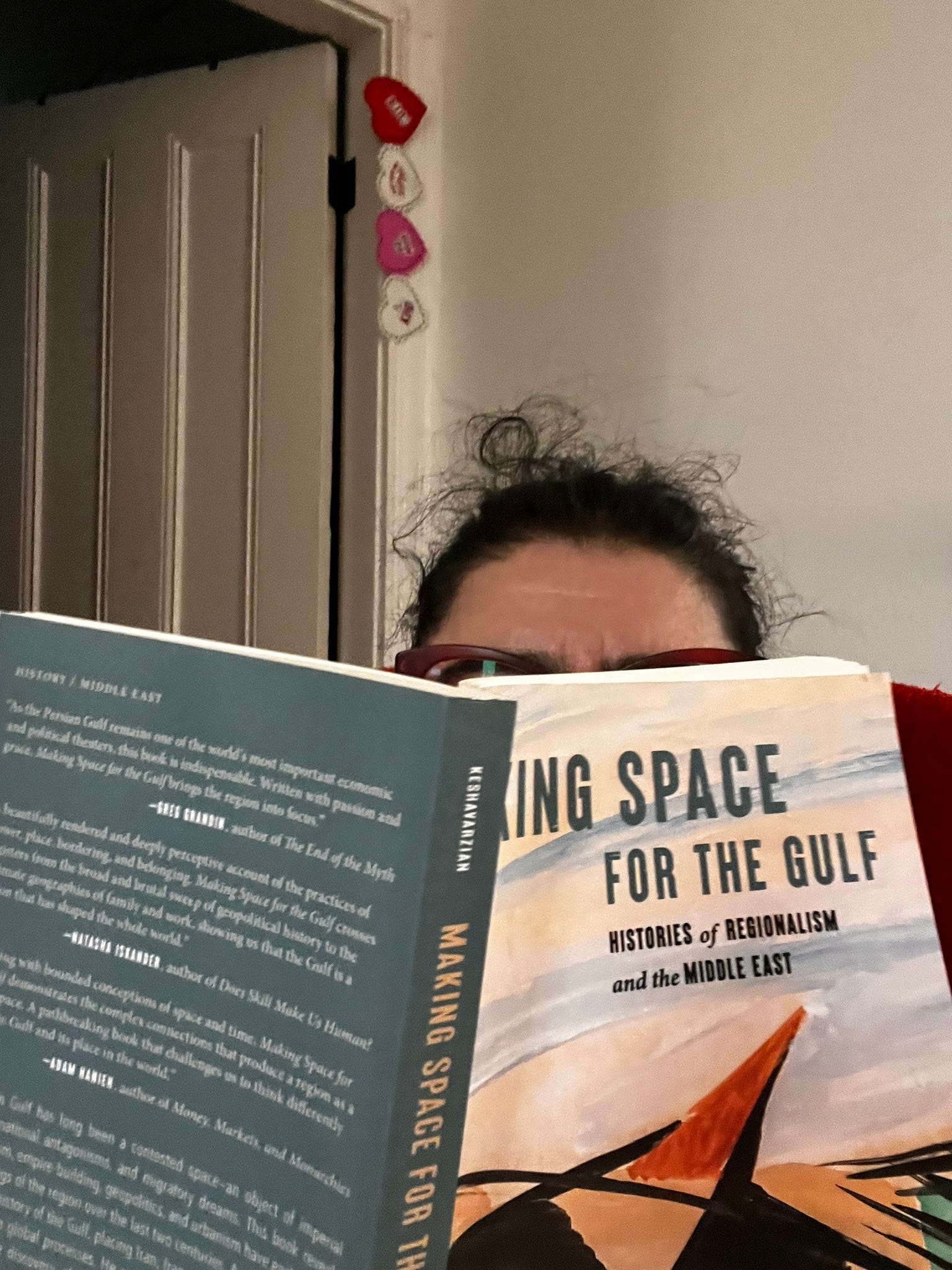
Arang Keshavarzian, Making Space For the Gulf: Histories of Regionalism and the Middle East (2024)
Arang’s book “reveals how for over a century capitalism, empire-building, geopolitics, and urbanism have conditioned and been shaped by different understandings of the Persian Gulf as a region.” It is a thoughtful and beautifully written book that asks us to think regionally as opposed to the current US/Israel/Iran triad. The peace deal that few have seen but everyone has an opinion on is arguably born from much of the history laid out in this book. This is the perfect time to read it.
Arang Keshavarzian and Ali Mirsepassi eds. Global 1979: Geographies and Histories of the Iranian Revolution (2021)
This edited volume of 12 articles, delves into the 1979 revolution from the local to the transnational and global. There are many topics covered and you can pick and you choose which you want to delve into. But put together, the essays in this volume “conceive of the Iranian Revolution not as exceptional or anachronistic, but as an uprising constituted by multiple, interwoven geographies and histories.”
Norma Claire Moruzzi, Tied Up in Tehran: Women, Social Change, and the Politics of Daily Life in Postrevolutionary Iran (2025)
Yes, a book by a woman on women but also no. Norma’s book is a delightfully observed romp through 1990s and early 2000s Iran that begins with a bizarre story of a home invasion in Tehran. It covers topics like food, shoe shopping, cinema, jokes, and sex to draw a detailed picture of politics rooted in the everyday life.
Golnar Nikpour, The Incarcerated Modern: Prisons and Public Life in Iran (2024)
Golnar’s book covers almost 100 years of Iranian history told through the prism of the development of prisons. She reminds us that while political prisoners take up most of our mental space, Iran’s carceral system—past and present—includes a wider range of crimes and punishments that are crucial to its evolution.
Arzoo Osanloo, Forgiveness Work: Mercy, Law, and Victims’ Rights in Iran (2020)
Arzoo’s book focuses on “Iran’s criminal justice system, which affords individuals the right of retribution, but also allows and even encourages them to forgo it.” I have been returning to this book in the past months as Iran has stepped up its execution of protestors to better understand the complex legal system.
Zhand Shakibi, Nostalgia in Late Pahlavi Iran (2025)
Nostalgia is a hot topic in discussions of Iran today. To what degree are Iranians in the grip of nostalgia for the Pahlavi monarchy and does that explain the support for the US/Israel war on Iran by both people inside Iran and the diaspora? This book doesn’t directly address that but it’s the only book I know on Iran that places nostalgia at the heart of its historical analysis of Iran. It focuses on “the forms, expressions, and narratives of nostalgia found in the societal popular and state spheres” and in doing so it shows how the Pahlavi state itself was using nostalgia as an instrument for furthering its broad social and political agenda in 1970s Iran.
Rose Wellman, Feeding Iran: Shi`i Families and the Making of the Islamic Republic (2021)
Rose’s book is an ethnographic study of Basij families. The basiji is one of the most contentious figures in the Iranian political landscape both inside and outside the country. In its focus on the everyday and the home but in basijis families whose “everyday piety are linked to state power,” it is a useful complement to Norma’s Tied Up in Tehran.
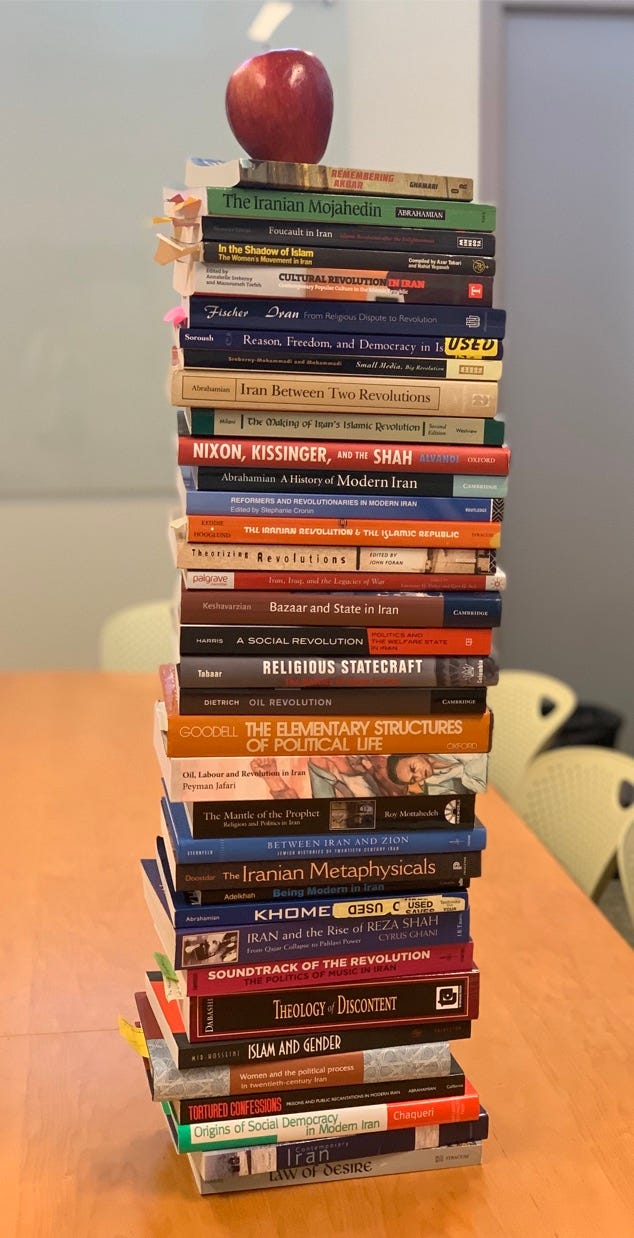
There’s a lot I have left out in terms of topics (environmental studies, ethnic and religious minorities, urbanism, music, etc) and people. My apologies to my wonderful colleagues whose books should have been but are not mentioned. Don’t read into it anything other than the limits of time and space. Feel free to leave other recommendations in the comments or better yet, take over this space and create your own lists that show the diversity of knowledge that can help all of us gain a better understanding of Iran locally, regionally, and globally.
p.s. A very valid critique of scholarship is the price of books. Some of the books mentioned here are prohibitively expensive. The reasons have everything to do with the politics of higher education in North America, which I won’t get into. But don’t let that stop you. You can get a lot of these books through libraries, and some have cheaper (or even free access) electronic versions or are available through used booksellers. Worse case scenario, almost everyone on this list has given book talks that are available on the web if you search for them.
I am a new reader of your blog, very new!
I was motivated to follow you by your article on Maryam Nasr-Esfahani. I read her complete talk at Vazn e Donya which you linked to in your article. Her ideas about horizontal connections and everyday peace fit well with my own thinking about how social change will be ultimately driven.
I lived in Iran from 1972 until the end of 1980 and have followed the country very closely ever since.
I love your reading list and will get into many of the books you recommend.
I would add an excellent book written by a woman, though not an Iranian woman. It is "Children of Paradise: The Struggle for the Soul of Iran" by Laura Secor. It is absolutely one of the best books on the reform movement - with excellent background on how Iran got to the reform period and in-depth stories of some of the lesser known heroes of that movement. Laura made 6-7 trips to Iran about a decade ago and spoke with those profiled in her book.
I look forward to reading more of your posts.
chris fischer
chrisfischer344@gmail.com
Wow! Thank you for this. Very timely and helpful offering and invitation.