
On Anti-Forgiveness
Debates on co-existence in Iran and forgiveness inside my head

I’ve been thinking a lot about forgiveness. Sometimes I wonder if it’s the only thing I think about these days. I do not know whether I can ever forgive, or who, or what it is that I think I need to deal with. The war has left me tilted on an axis of alienation, and I keep thinking if I don’t find a way towards forgiveness, at any moment I might come crashing down.
I have written before about a transformation in my own identity as both Iranian and American. For the longest time, I thought of my immigrant self as two things added up. I wanted to be both, and in being both, I felt empowered in redefining each of these parts of me to be what made me feel the most at home in this country, in my work, in my own skin. This was not about being proud to be this or that. In fact, it was about existing in an identity of my own making that took all types of pride—national and patriotic primarily—out of the equation. It was, to use a yummy metaphor, an existence where comfort food was both tahdig and peanut butter.
The war has changed all of that on such a molecular level. Not just in the obvious ways (though is it obvious?) but in ways that I am truly surprised by. I’ve had so many conversations these past two months with Iranian friends and colleagues in the US about how heartbreaking the absence of an anti-war movement has felt. The sneaking suspicion that, at times, our friends were maybe okay—maybe more than okay—that the war was going on and that the Iranian government was returning the attacks on it. Or conversely, people who were not not unhappy that the Islamic Republic was finally getting what it had coming. Or at the very least, mostly curious to see how it would all work out. If people died, then well, “every war has casualties.” What’s a little loss of someone else’s life for a touch of revenge or a tickle of curiosity?
So many of us have noted, experienced, and even grieved the ways in which colleagues, people we have worked with for years, have not reached out to say “hey, you ok?” either out of discomfort or some other reason I can’t be bothered to fathom. (When a colleague I barely know emailed me because “when Russia attacked Ukraine…I felt alone in my grief,” and then said they were sure many other colleagues had reached out, I cried so hard I couldn’t breathe. I didn’t know if I should tell them, actually, they had not.) At first, I tried to understand. I thought it’s better this way. What am I going to say to their sympathy? What can they say to me? But then I told this to someone whose whole family is in Iran—parents, siblings, aunts, uncles, friends—and they simply said: It’s better to be asked if you’re okay than not, no?
I am genuinely surprised at how so many of my Iranian friends and colleagues in the US have felt alone in their grief. We have theories. We have explanations. We swap horror stories. We wonder how we move forward from here, beyond just forgetting and forgiving.
In Iran the word forgiveness is not used in talking about the segment of the population that in the days before and during the war, cheered, sometimes literally, the bombing of the country. Anything but this was their mantra. The question of how to think about and perhaps heal this immense gash is one of the most sophisticated debates that is currently going on in Iran today.
In the days of the war, people filmed bombs dropping on their city, balls of fire in the sky, plumes of smoke rising up, and you could hear them say “good, good. Hit them”—them being the Islamic Republic, the government that less than two months before the war started had killed an unprecedented number of protesters over two nights. Families tore apart over this. Friend groups broke up. As the war continued, it became clear that the assassination of Khamenei and other political leaders was not going to bring down the system (as anyone with a brain knew it wouldn’t). In fact, the war empowered the Islamic Republic’s most repressive elements, which continued to arrest and execute its citizens as the bombs fell. Simultaneously US/Israeli strikes targeted and destroyed cultural heritage sites, schools, universities, hospitals, clinics, residential buildings, bridges, factories, airports, and industrial sites. Over 1,700 civilian casualties have been confirmed, with 254 of them children.
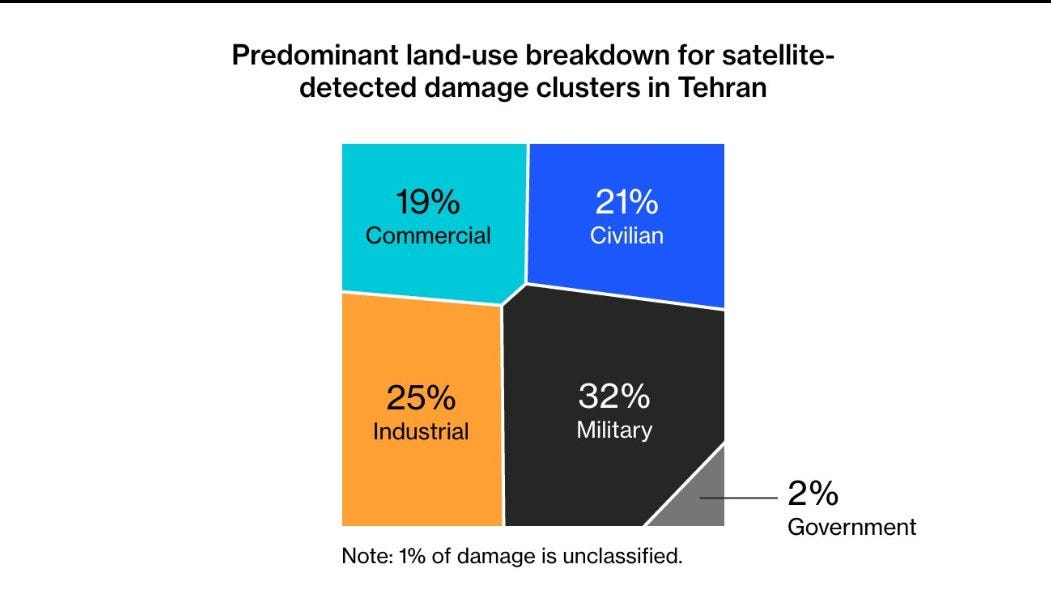
What is left is this: According to Iran’s central bank, roughly 85% of household incomes now go towards the purchasing of essential food items; according to official numbers, roughly 4 million people lost their jobs directly from the war (which happens when you target factories in which people work), though the number is by multiples higher as the government maintains its internet shutdown and introduces stratified internet access. Donya-ye Eqtesad on April 17 predicted inflation will be between 47% if there is a deal, 71% if this no war no peace limbo continues, and a whopping 123% if war restarts. By one count, inflation is currently at 69%.
I give these numbers to say that the conversations in Iran about how to address, if not heal, the rift in society—when those you know, you love, you sit at a table with, you break bread with, invited and celebrated foreign powers decimating your city and country in the name of istisal—is as vital as reconstruction itself. There are those who say that there should be moral accountability for war’s cheerleaders. Meaning that a moral judgement should be made towards their stance, not, as Mohammad Maljoo argues, to persecute, but to “elevate [our] understanding and strengthen [our] collectivity” by naming “our common pain.”
There are others who advocate “co-existence” instead of “solidarity” as a way out of this great societal schism. The sociologist Mahsa Assadollahnejad, for example, advocates the former for a number of reasons, including the fact that she believes co-existence is post-political. Co-existence, she writes, “gives us three principles: 1) co-dependence 2) shared vulnerability and 3) universal grievability. These principles in turn can decrease socio-political violence and allow for the emergence of an ‘us.’”
There are also those who call for empathy as a political act, because, to simplify a deeply humanistic and complicated position, all the other options are to choose a cycle of never-ending violence. Empathy as understanding and the ability to stand in someone else’s shoes, without the need to agree.
I find that I try, and I fail, to learn from my friends and colleagues in Iran. In their case, this question is fundamental to their projects of charting a path forward from the violence of the past months, if not decades. Some of that violence continues to shape their lives. They cannot and will not give into the despair that anger, fury—violence from outside and inside—wrought upon their lives.
Me? I don’t know. I think I finally found my path forward: I can’t forgive but I can engage in anti-forgiveness and I think for now, that will do.
In Violence and Civility, Étienne Balibar proposes civility (or antiviolence) as a political practice that resists “extreme violence” (or cruelty) as a path towards emancipation and transformation.1 Balibar counterposes antiviolence to nonviolence (turning away from violence) and counterviolence (a second act of violence in reaction to the first) because “the prefix ‘anti-’, as in antithesis, antipathy, or antinomy, designates the most general modality of the fact of ‘facing up to’—from within the polity or community as well—or of measuring oneself against that which is, doubtless, enormous or incommensurable.”
As I said, I don’t even know what it is that I think I need to forgive, or who. The whole question feels so presumptuous to me. Who am I to even pose it? Maybe I think about it so much because I am looking for some kind of closure, though honestly that doesn’t quite seem right to me. Maybe I want to go back to a fantasy of a status quo ante. Maybe I keep returning to forgiveness because I don’t know what else to return to.
If forgiveness is a form of release, then anti-forgiveness is something harder to grasp. To be in a state of anti-forgiveness is to face up to forgiveness and to measure oneself against it without turning away from it as a possibility. It is to remain tilted on the axis, without resolution and but also without collapse.
Thank you to Fadi for suggesting this book.
I think sometimes you need time and distance to fully understand an act or omission to reach a point where you can properly choose to forgive or perhaps to simply adjust a relationship so that act/omission does not overly impact your life. It is not always necessary or healthy to forgive. In a sense the act will form part of your new Bayesian prior or knowledge to allow you to make future judgements about people or things.
Thank you for sharing those thoughts Naghmeh, painful and conflicting as they are.
I will share with you the fact that I believe Trump is a sick, evil man who is ruining America and causing all kinds of problems internationally.
And I hope all your friends and family are safe.