
On Ordinary Life
A short essay by feminist philosopher and ethicist, Maryam Nasr Esfahani

Less than a month after the events of bloody January when the Islamic Republic killed, injured, and arrested thousands of protestor, on the Sharif University student channel on telegram, an anonymous poster wrote: “We used to be ordinary people. We would enjoy art, we would enjoy the moon, we used to take pictures of trees in autumn, hands intertwined, and the sky. We used to write. You’re the ones who made us political.”
This demand for ordinary life has become an important part of Iranian discourse, particularly since the Women Life Freedom movement in 2022. The ordinary here means many things and is used in many ways. On the most surface level, it’s been interpreted as a demand for personal freedoms. But beyond the surface, the idea has become almost synonymous with a political demand to not always be political actors. Depending on your perspective, this can be interpreted as either a reactionary/conservative position or a revolutionary/progressive one.
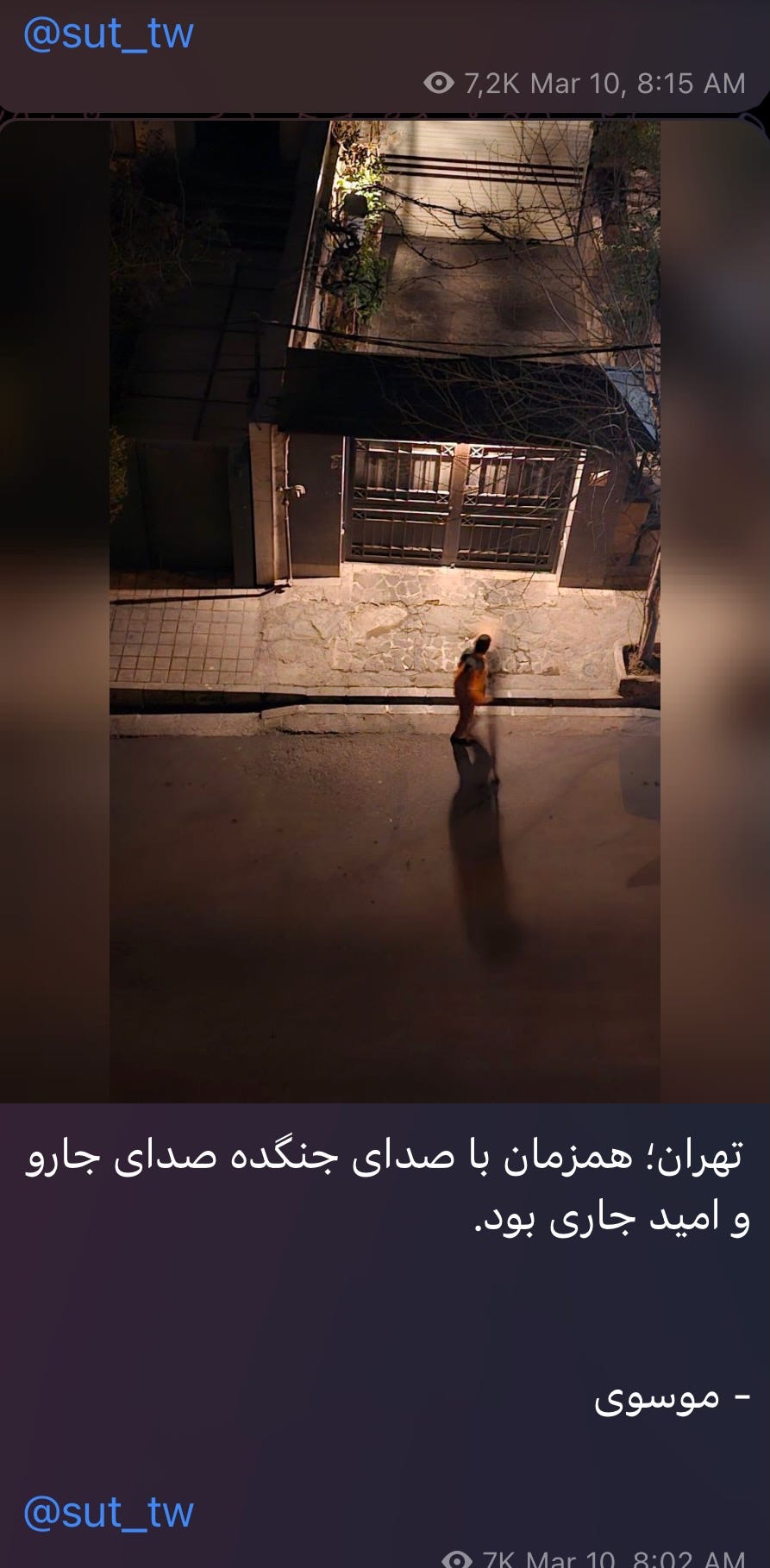
Unsurprisingly, what “ordinary life” means takes on a different urgency in war conditions. Since February 28 when US and Israeli strikes on Iran began, one of the most notable set of images coming out of Tehran has been of people photographing street sweepers who have continued carrying out their job, the sound of their brooms mixing in with that of fighter jets and bombs.
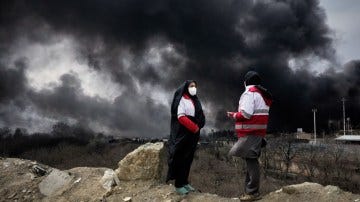
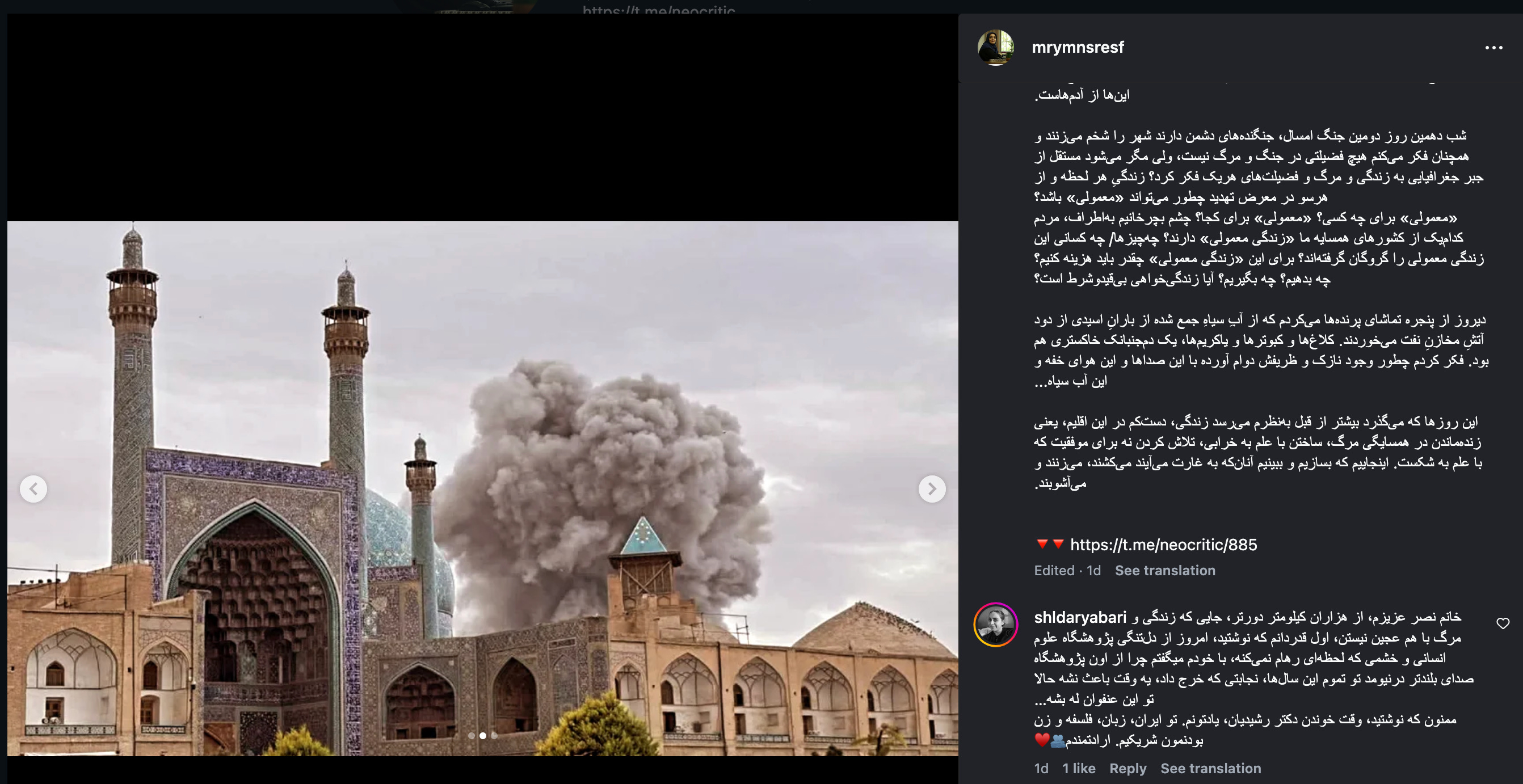
On March 10, 2026, Maryam Nasr Esfahani posted the essay below on her telegram and Instagram pages. She is a feminist philosopher and ethicist and a member of the faculty at the Research Center for Human Sciences and Cultural Studies. She posted this rumination on “ordinary life” a day after Israeli strikes on the city of Esfahan led to extensive damage to several iconic 17th century buildings, causing “the turquoise tiles of the iconic Jameh Mosque” to come crashing to the ground1 and in the aftermath of strikes on oil depositories in Tehran that led to rivers of fire, unbreathable air, and warnings of acid rain over Tehran.
Below is a translation of Maryam Nasr Esfahani’s essay, with her permission, by Alireza Doostdar, Associate Professor of Islamic Studies and the Anthropology of Religion at University of Chicago. It is produced as part of a collaborative effort to engage with a wide spectrum of perspectives and analyses published inside Iran. I invite you to read them, incorporate them into your understanding of Iranian politics, and help distribute them widely.
“The more we care about something, the more conscientious we must be.”
Linda Zagzebski, On Epistemology2
I don’t remember when or where I read this, but someone had written that the expression “ordinary life”—which since 2022 [in the wake of the Woman, Life, Freedom protests] has become common among our young people—is itself one of those “neo-colonial” concepts that the social media of capitalist cyberspace have manufactured to create painful yearning among the nations on the other side of the world and thereby plunder them.
At first glance, to say that “ordinary life” is merely a neo-colonial capitalist media construct seems appealing, because it conveniently reduces yearning to an ideological and economic instrument. But for people like us, who are familiar with the “silencing” function of such labeling, this kind of analysis is in fact a way of denying basic and legitimate human needs.
“Ordinary life” means having security and refuge and shelter; giving and receiving dignity, love, and care; having freedom and the possibility of pursuing one’s dreams; being paid for one’s labor and reaching something after all that running. These are the fundamental elements of human dignity, valid in any geography. They are neither luxuries nor imports. What is truly neo-colonial is withholding these things from people.
Tonight is the tenth night of the second war of this year [according to the Iranian calendar]. Enemy fighter jets are plowing over the city, and I still think there is no virtue in war and death. But is it even possible to think about life and death, and the virtues of each, independently of geographic determinism? How could a life that is threatened at every moment and from every direction be called “ordinary”?
Ordinary for whom? Ordinary where? If we look around us, which people in our neighboring countries actually have an “ordinary life?” What things, which people, have taken this ordinary life hostage? How much must we pay for this “ordinary life”? What must we give? What must we receive? Is the desire for life unconditional?
Yesterday I was watching birds from the window as they drank from the black water that had collected from acidic rain produced by the smoke of burning oil depots. There were crows and pigeons and collared doves, and also a little gray wagtail. I wondered how its delicate, slender body had endured amid these sounds, this suffocating air, that black water.
As these days pass, it seems to me more than ever that life—at least in this geography—means remaining alive in the neighborhood of death, building while knowing that destruction awaits, striving not for success but with the knowledge of defeat. We are here to build and to watch as those who come to plunder us kill, strike, and wreak havoc.
They split open the tiles and designs entrusted to us from our ancestors, and still some people say childishly, “Don’t worry, we’ll build something better.” What do you know of building? How much have you built? Will you build something better than Naqsh-e Jahan? Up to today, how much of what they destroyed have they rebuilt? How many thousands of times have they taken life, and how many “ordinary lives” have they left behind?
Here, ordinary life is a Sisyphean struggle. Ordinary life is not simple; it is complex. It breathes in the air of death. “Ordinary” is a multivariable equation that asks you to remain and go on actively while knowing all of this. Striving for life in the proximity of death is an ethical and epistemic struggle—one that, precisely because it is important, must be thought about conscientiously, and the beliefs around it shaped in such a way that it does not forego the right to a dignified life for the people of this land, nor soothe despair with the balm of “heroic fervor” or “credulity.”
The sounds have subsided… The city’s convulsions have quieted.
https://www.nytimes.com/2026/03/11/world/middleeast/iram-heritage-sites-damaged.html
Linda Zagzebski, On Epistemology, Cengage Learning, 2008.
Thank you for writing this, Naghmeh. In times like this, words feel like my only solace.