
On Thousand Island Dressing and Potato Chips
Happy birthday mom!

Today my mother turns 80. To pay tribute to her in a way that fully captures who she is would require you to sit here and read my words for 80 hours, or 80 days. She is, after all, the progenitor of These True Things.
My mother was 35 years old when she and my dad returned to Iran from America with their two kids—yours truly, age 9, and my brother, age 2. The return would not have been remarkable in any way except for the fact that the year was 1981. The revolution that overthrew the Pahlavi dynasty was two years old, the Islamic Republic had been established, and what eventually turned out to be an eight-year bloody war between Iran and Iraq had already begun.
My parents had moved to the US five years earlier to study. In Iran, they had left behind jobs that presumably would be waiting for them, a down payment on a house in the newly built Ekbatan complex, parents, siblings, nieces and nephews, friends—all the things that make a life, a life.
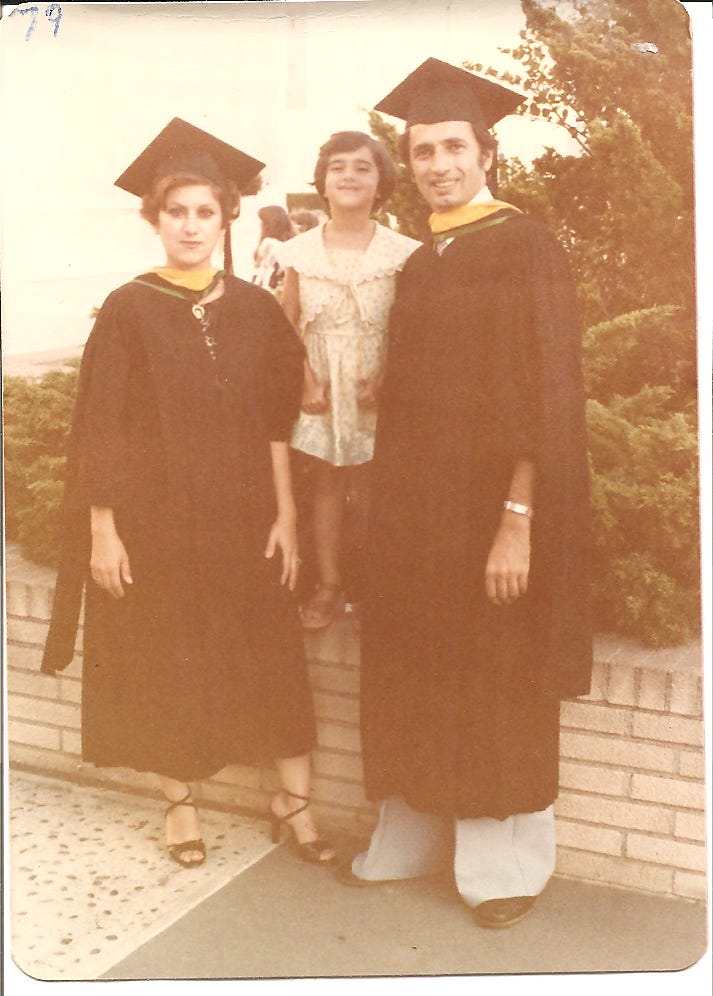
I once asked my parents, “Who leaves America to go back to Iran after a revolution and six months into a war?” My mom shrugged and said, “It was home. We missed home.” I never truly understood what she meant. But I do now. I deeply do.
But I digress. And it’s really hard not to. I want to tell you so much about what it meant to build a life in times like that, to celebrate all that my mother and my father did. As my mom once told me, “We started from below zero when we went back. We would have had a different life if we had never returned.” A true thing if there ever was one.
Almost immediately after the war started, food became rationed in Iran. Food stamps were issued for staple goods: rice, oil, butter, cheese, meat, and other items. Every family was issued stamps giving them a certain amount of these staples based on their size. When state broadcasts announced your grouping, you could go to the store and purchase your ration. Other food items existed in stores, but due to war conditions and a set of reasons beyond this, they were limited or far beyond most family budgets, including ours.
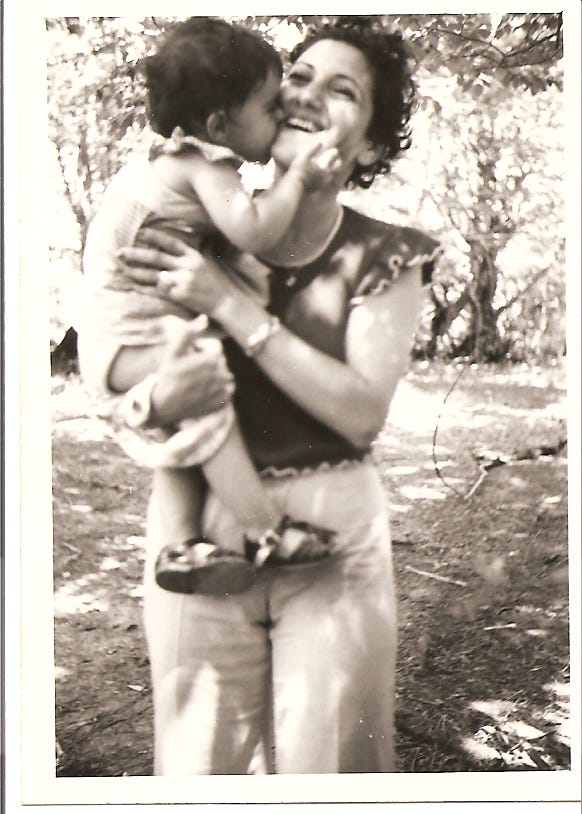
So how do you rebuild a life from below zero when you have two basically American kids you’ve brought back to wartime Iran to live? Sedi, my mother, did so from the most unexpected place. She made, from scratch, the weirdest thing that I personally craved: Thousand Island dressing.
Thousand Island dressing most likely dates back to the late 19th century when, according to my quick Wiki search, it was invented in the upper Saint Lawrence River between New York and Canada. In its basic form, it consists of mayonnaise, ketchup, and chopped pickles—only the last of which was readily available in wartime Iran.
I won’t get into my ode to this weirdly colored, strangely tasting “salad” dressing, other than to say that to this day, if given a choice, I will pick it over all others. I feel as strongly about it now as I did back then, when I was a confused and scared child trying to find my way in a society that was probably as different from San Diego, where I had grown up, as anywhere ever was.
So my mother—never daunted, never afraid, and never one to let something as trivial as wartime food rationing and limited purchasing power stand in her way—set to work. She would make mayo by hand. She would take tomato paste, add sugar and water and whatever else was needed to make something close to ketchup. She would painstakingly chop pickles and make vats of Thousand Island dressing so her firstborn could always have a taste of what felt, at that point, like home.
She would also make vast quantities of potato chips at home, not using a mandoline slicer or any electric or manual device to slice the kilos of potatoes in front of her. No. She would peel the potatoes by hand and then slice them as thinly as she possibly could. Then she spent hours deep-frying them in our kitchen using a pan and immense amounts of precious vegetable oil. To give you a sense of her labor of love, she would make enough to fill a red plastic barrel we had in our pantry that was taller than my little brother. I mention him because nothing delighted him more than getting grounded in the pantry, where his access to these, let’s call them artisanal, potato chips was unfettered.
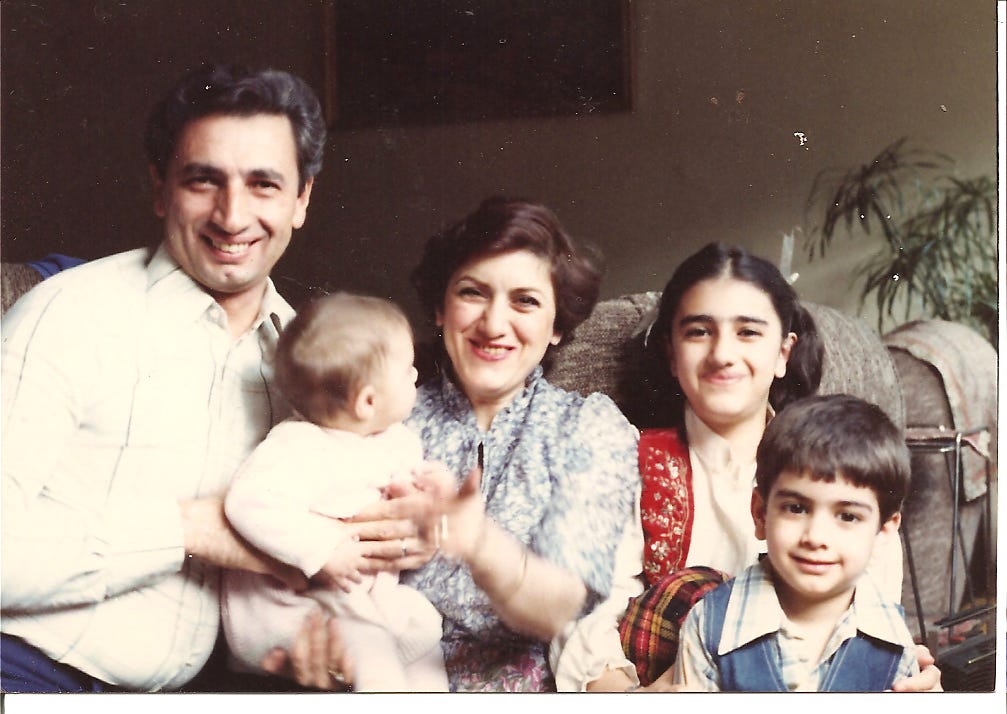
My mother worked full time. At this point, she had three kids, my little sister having joined our family in 1983. She cooked, she cleaned, she worked, and she made Thousand Island dressing and potato chips so home could feel like home.
And let’s just get this out in the open: no, I almost never helped. I was always busy sneaking a novel into my textbook and pretending I was doing homework. There was a brief period when, under the spell of a Japanese movie shown on state television, I decided I wanted to help in the kitchen—with an important caveat: I would only use my feet. The movie was about a girl born in the aftermath of Hiroshima with no arms who eventually was able to live her life doing everything with her feet. She would chop vegetables holding a knife with her toes, cook similarly, and go about her everyday life armless but with incredible toe skills. I was inspired.
When my exhausted mother would ask me to set the table, I would oblige, but since I did not possess superhuman foot skills, the whole thing would literally come crashing down. I eventually gave in to my mother’s pleas to stop using my feet to put plates on the table. So I went back to reading Alexandre Dumas underneath my bed, where I could ignore the knock on the door and the head poking in, calling out my name.
I don’t know why I keep thinking back to these things today. Perhaps I should have told you about who Sedi Sohrabi is as a person and not just as my mother. That would have been the more feminist way of doing it. Maybe I should have given you her biography—where she came from, who she became, who she is today, on the 80th year of her magnificent birth. Perhaps.
But truth be told, it’s these small memories—memories for which there is no photographic footprint, memories that contain the essence of the privilege of having been raised by Sedi Sohrabi—that are the ones that sustain me in moments of crisis and hardship.
I’ve written before about how I lost god when during the Iran-Iraq war I would pray and pray for the war to end and it just would not. What I did not say is that every time I need to pray (a regular thing when I’m on a plane, a regular thing after February 28), I pray to the joy my mother spreads in this world, to the care she brings to all who know her. I pray, in other words, to the life force that gave us Thousand Island dressing and potato chips.
This is such a beautiful, heartfelt story about someone so dear to you. Thank you for sharing — reading it warmed my day. I wish your mom a belated happy birthday.
The most heartwarming thing I’ve read in a while, thank you Naghmeh for sharing this beautiful birthday card! It’s 100% true that it’s these “small” memories that we keep coming back to. I wish your lovely mom a very very happy birthday. ❤️ I bet those “artisanal” potato chips were just scrumptious! 🤗