
There Is More to Iranian Politics Than Geopolitics
A celebrity rape trial in Iran in the aftermath of the Women, Life, Freedom movement

It’s been a mighty week for Roberts commenting on Iran. Robert Pape, Robert Kagan, and Robert Worth have all been dominating commentary on Iranian politics as headlines report that the ceasefire is on shaky grounds. Sorry, I mean Iranian Politics with a capital P.
For those interested in another form of politics, the kind that arises from dynamics within Iranian society and reveals the ongoing push and pull between various segments of society and the Islamic Republic’s power structure, the final hearing in the rape trial of Iranian celebrity Pejman Jamshidi was a news, and thought, worthy moment.
On October 21, 2025, news broke out that a celebrity had been accused of rape and taken to Qizil Hesar prison. The man in question was Pejman Jamshidi, a former soccer player who had become a famous TV and film actor. Four days later, he was set free on bail. Elaheh Mohammadi, best known as the journalist who along with Niloufar Hamedi broke the Mahsa Amini death in police custody in September 2022 (for which they were imprisoned for 17 months), began reporting on the case for Ham-Mihan newspaper. She wrote that 6 months before the case broke out (i.e. during the 12 day war with Israel), this young woman had gone to Jamshidi’s house to sign a contract when he had allegedly raped her. The accuser had then immediately lodged a complaint against him, had gotten a sexual assault forensic examination that had confirmed she had been assaulted. According to Mohammadi’s October 27th report, DNA testing of the kit had matched that of Jamshidi.
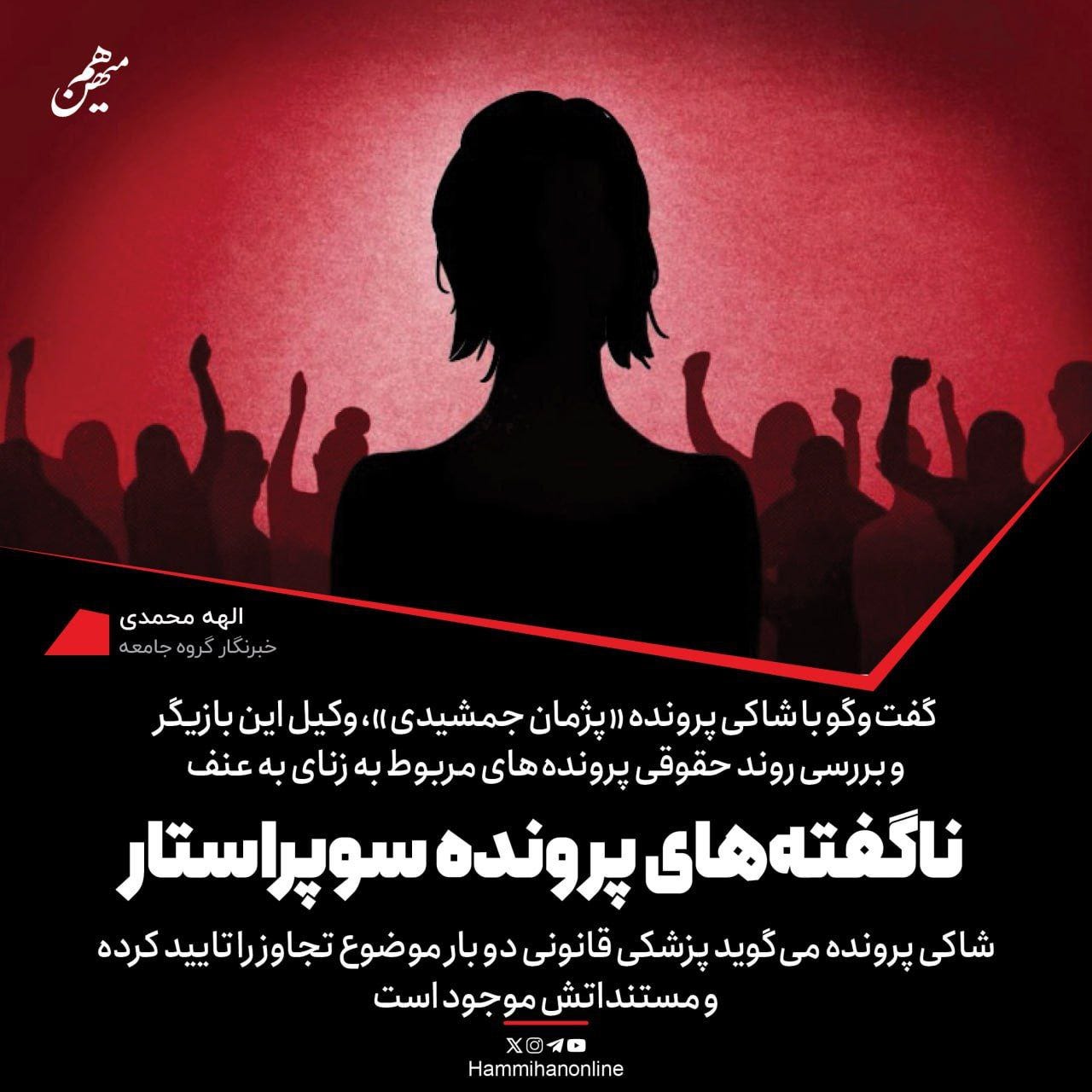
The case caused quite a commotion, with a wide spectrum of commentary. The second and final trial was to have occurred on February 28th but the start of the war delayed it to May 6th.1 A verdict is expected soon. Even if remote, a guilty verdict would be momentous, not only because of who the accused is but because of who the accuser is: a 20 year old woman who seems to not only know her rights but is vocal about them to a broader public.
Today’s translation focuses on two important pieces connected to this trial. The first is Elaheh Mohammadi’s report on the final hearing of the rape case that focuses on the 20 year old accuser’s accounting of the trial. The second is the journalist and anthropologist, Mahzad Elyassi’s piece published in Radio Zamaneh that argues that the case against Jamshidi is not just a legal case but has crucial political and social implications for Iran today.
I have chosen to focus on this today for a number of reasons, many of which are eloquently laid out in Mahzad Elyassi’s piece. Specifically, she points out how the 2022 Women, Life, Freedom movement’s reverberations continue in the courage of this 20 year old woman who despite a legal system stacked against her, harassment by the accuser, and a society enamored of the accused’s celebrity status, has not backed down. Her seemingly simple message relayed in Elaheh Mohammadi’s reporting that “I want to tell these women: do not be afraid at all,” notes Mahzad Elyassi, reflects the ongoing achievements of the Women, Life, Freedom movement to create a new kind of agency among, at least, a younger generation of Iranians, an agency that is constantly ignored or marginalized in talk of Politics both outside and inside Iran. Her critique of Iran’s intellectual class, which continuously imagines politics as male and relegates gender issues to female spaces (and figures), or marginalizes them, or ignores them is particularly poignant and relevant to the crucial ongoing discussions in Iran of finding a way forward after the doubleshocks of the January killings of the protestors by the Islamic Republic, and the US-Israel war on Iran.2
I want to remind readers of this substack of the importance of not only chasing the news—what was the Iranian offer, what was the American response, what happens in the Strait of Hormuz, etc—during times of crisis but also paying attention to ongoing dynamics and debates within Iranian society. As I’ve written before, the dominant framework in which outside analysts and observers understand Iran has often been one of surprise and/or confusion as if everything that happens there is a bolt from the sky. Sometimes it is, if not a bolt then a bomb, but most of the times events that erupt and make it to the pages of Western media, have been evolving and ongoing, both reflecting and shaping state/society relations in Iran. It behooves us to understand them alongside our daily dose of Roberts and their commentary on Iranian Politics.
This post is part of a collaborative effort to engage with perspectives and analyses from inside Iran. Many thanks to Mahzad Elyassi for giving me permission to translate her article. I invite you to read them, incorporate them into your understanding of Iranian politics, and help distribute them widely.
Emtedad [News], Elaheh Mohammadi, May 6, 2026
The final hearing in the case against Pejman Jamshidi was held today. The session had originally been scheduled for February 28, 2026, in Branch 9 of the Criminal Court, but was postponed because of the start of the war between the United States and Israel against Iran.
The case, which began on October 21 of last year with the arrest of Pejman Jamshidi following a complaint by a young woman accusing him of rape, generated major public attention. After the defendant was released on bail, two court sessions were held, with today’s session being the final one.
The complainant, the defendant, his lawyers, and witnesses were present. After hearing testimony from both sides and from witnesses, the previous charges, including forcible rape [تجاوز به عنف], illicit non-consensual intercourse [زنای به عنف با اکراه] and unlawful confinement [حبس], were formally re-read to the defendant, and his final defense statement was taken. According to those present, the case is now close to a verdict, which is expected within approximately 15 days.
Kamiz Borjas, the defendant’s lawyer, told reporters after the hearing that the court had established his client’s innocence and that there was no evidence proving rape occurred. The complainant and her mother rejected those claims in interviews with Emtedad.
The complainant said that during the proceedings the defense lawyers made claims she considered false, including assertions suggesting a relationship akin to marriage, and challenges to forensic medical evidence and DNA testing. She also referred to testimony from a witness who, according to her, saw signs of physical injury on the night of the incident and testified about this in court.
She further said she had recently filed a police report regarding “harassment” by the defendant on Kish Island, where she lives, and that these records had also been submitted to the court. According to her, witnesses attended today’s final hearing and the defendant arrived an hour late:
“Before entering the session, I became very angry and there was a verbal confrontation between us. During the hearing, my statements and those of the witnesses were recorded again, and then the charges of forcible rape, rape under coercion, and unlawful confinement were formally presented to him again, and his final defense was taken.”
The complainant said she reiterated her position at the end of today’s hearing:
“The judge asked whether I consented to reconciliation or settlement, and I answered that under no circumstances would I consent. The judges listened carefully to what I said and reviewed the evidence again. The witnesses’ testimony was also in my favor.”
She also described events from recent days:
“In recent days, Mr. Jamshidi came to Kish Island, where I live, and repeatedly harassed me. I reported this to the police, an official report was filed, and I submitted it to the court. Three days ago, he also offered money to one of my friends, but I still did not agree to settle.”
She said she hopes the court issues a fair ruling:
“I have truly suffered for a year. If I were seeking money or blackmail, as some media outlets and individuals have claimed, I would not have endured all this hardship. I want him and other men like him to no longer be able to do this to any woman.”
She ended by thanking supporters:
“I kiss the hands of everyone who supported me during these months and thank them. We even heard that a barber in Kish refused to cut Mr. Jamshidi’s hair and said, ‘I do not cut the hair of a man accused of rape.’”
She also had a message for other women who might experience similar situations:
“I want to tell these women: do not be afraid at all. I know this is extremely difficult, but no matter how much power, influence, or wealth the other side has, you can still file a complaint and pursue the case. The important thing is not to allow evidence to disappear, to go immediately to forensic medicine, and to know that many people exist who will support you.”
The second court session of Pejman Jamshidi, who is accused of “forcible rape” [تجاوز به عنف] was held on Wednesday, May 6. One domestic news agency reported the possibility of a verdict in favor of the defendant. The importance of this case is not limited merely to the fame of the accused or the nature of the allegation. On a broader level, it carries symbolic political and social significance. The meaningful difference in how the accused and the complainant have been treated in this case reveals the government’s, the judicial system’s, and society’s broader approach toward women. For that reason, it extends beyond being merely an individual or judicial matter. The multiple layers of events that unfolded alongside this controversial case require interpretation and analysis. Even the timing of these developments is notable.
This case became public in the months following the twelve-day war between Iran and Israel, a period during which many analysts argued that a “golden window” had opened for rebuilding the relationship between the government and society. During that time, part of the population, driven by nationalism or fears of insecurity, temporarily aligned itself with the ruling establishment in the face of an external threat. One expected that the Iranian government might use this temporary alignment as an opportunity to repair deep social fractures, reduce domestic tensions, and redefine its relationship with society. Yet this opportunity not only did not lead to any reforms or trust-building policies but was gradually squandered through the continuation of previous behaviors, causing the state-society divide to return to its prewar condition. This divide resurfaced months later in protests and the killings during the January unrest.
The tense relationship between Iran’s political structure and women has remained marked by suspension and profound distrust in the years following the death of Mahsa Amini. This period saw intensified monitoring and control over women’s clothing, implementation of the “Noor Plan” as a continuation of morality-police policies during the presidency of Ebrahim Raisi , and the closure of cafés and restaurants over alleged hijab violations. Nevertheless, the suspension of hijab warning text messages during the twelve-day war was interpreted by some as a possible sign of a policy shift or an attempt to reduce tensions between the state and women; an act that could have been understood as a gesture toward repairing relations between women and the government.
However, in the autumn of 2025, two nearly simultaneous events revived the Iranian government’s hostile approach toward women. First was the parliamentary proposal to reform dowry law and limit prison sentences for unpaid dowries (as a mechanism for enforcement of the law) without comprehensively revising family laws in favor of both genders.
Second was the rape allegation case against Pejman Jamshidi, which received widespread media coverage in October 2025. While any event involving sexual violence or high-profile allegations could serve as a test of the judicial system’s willingness to support women, the developments following the arrest of this celebrity suggested the persistence of unequal power structures and the difficulty women face in pursuing justice. Jamshidi was released shortly after posting bail and, despite having a open case in court, left the country. Public support from many of his colleagues in the film and soccer industries received extensive media attention, whereas the website of the newspaper Ham-Mihan was blocked after publishing the only interview with the complainant. Some members of Jamshidi’s family publicly threatened the complainant without regard for legal consequences, and months later, during the height of the second war on Iran, Jamshidi appeared in state media visiting Red Crescent relief activities, with no mention whatsoever of his open legal case.
On the other end is a twenty-year-old woman who lacks the economic and social backing enjoyed by the accused. Despite facing accusations of lying, fabrication, and character assassination, she has continued to pursue her complaint. Victims of rape and sexual violence are often subjected to familiar patterns of blame: “Why were you there?” “What were you wearing?” “Do you have witnesses?” or “How do we know a rape even occurred?” According to her lawyers, the complainant provided answers and evidence for all of these questions, evidence that was reportedly strong enough--even within the deeply gender-biased judicial structure of the Islamic Republic of Iran--to lead to Jamshidi’s initial arrest.
Women who have had the courage to legally confront their abusers have repeatedly described how the judicial system of the Islamic Republic has refused to even appoint female investigators for such cases, forcing them to repeatedly recount traumatic details of sexual violence before male interrogators who fundamentally approach their claims with suspicion. The reversal of the roles of accused and complainant in sexual assault cases, and the unequal treatment of the complainant and defendant in this case, once again raises the question of whether the formal judicial system of the Islamic Republic, which invokes “women’s dignity” to justify restrictive laws against women and employs the slogan “supporting the oppressed” to theorize war with Israel, is in practice willing to convict powerful and influential men when they are faced with serious documented evidence brought by women who lack power and influence.
Beyond its political and judicial dimensions, this case also carries significant social implications including the way Iranian society responds to such allegations. As soon as news of Jamshidi’s arrest became public, waves of reactions flooded social media and online comment sections. These reactions included both supportive and opposing voices, but much of the opposition followed a similar logic: many users described the case as a setup or conspiracy against Jamshidi, while others framed it as an attempt to distract public attention from economic crises, inflation, and government failures.
One striking aspect was the almost uniform support for Jamshidi among many male users, which one can characterize as a form of “male solidarity,” that ultimately sustains and reproduces patriarchy. The hasty support expressed by [the legendary soccer player] Ali Daei for Jamshidi can also be understood within this framework of male solidarity. Even before a final verdict had been issued, this prominent figure used his symbolic power and social capital to offer unconditional support for his friend and “brother,” without ever facing criticism or even questioning for this abuse of influence and dehumanization of the complainant, a powerless twenty-year-old woman. The outright denial of the possibility of rape, without reflection or any attempt to hear the complainant’s account, came from men who from adolescence onward become familiarized with jokes, threats, and language rooted in rape culture that normalize sexual violence. More than any other group, they know that rape is a very real possibility, yet many reacted by aggressively rejecting even the possibility of sexual violence and questioning the complainant’s motives.
Meanwhile, although many women writers and activists addressed the issue from feminist and women’s-rights perspectives, almost none of the prominent male intellectuals or public figures publicly commented on rape and sexual violence, organized discussions, or analyzed the case in media or YouTube programs. The reaction of many male intellectuals and commentators was complete silence. It was as though the issue was considered purely a “women’s issue” unrelated to them, or perhaps discussing a subject tied to the suffering of many women was seen as beneath the dignity of their intellectual standing, or perhaps another form of male solidarity was operating here as well. This silence itself becomes part of the structure that trivializes women’s suffering, marginalizes violence against women, and excludes it from the sphere of public concern.
Yet this support for the accused, whether through attacks on the complainant, silence, or hidden solidarity, was not limited to men. Surprisingly, many female users also attacked the complainant and addressed her with degrading language. Women are more familiar than anyone else with the male-dominated structure of Iran’s judicial system, the treatment of women who speak publicly about sexual violence, and the stigma and pathological fear of “dishonor” embedded in Iranian culture. Nevertheless, instead of empathizing with the victim, some became part of the process of blaming and destroying her. For some users, merely seeing an actor in films and television series seemed enough to create the feeling that they “knew” him and therefore had to defend him. These reactions reveal how deeply misogyny is rooted within layers of Iranian society, and how women in the position of complainants or victims are frequently met with suspicion, blame, and lack of support even from other women.
Another important layer of this case is the generational divide. While Pejman Jamshidi belongs to the generation born in the late 1970s, the complainant belongs to the generation born in the 2000s. For older generation men, accustomed to authority derived from wealth, fame, and social status, the agency and persistence of a young woman who, according to her own statements, continues pursuing the case despite threats and bribery attempts so that “no other man can behave this way toward other women,” carries significance beyond a personal complaint. More than anything, this persistence highlights the differing worldviews and positions of two generations.
The new generation of women in Iran, especially after the “Woman, Life, Freedom” movement, appears more willing than previous generations to bear the cost of speaking out and confronting power, even when aware that judicial, media, and social structures may not work in their favor. For this reason, the case can be understood not simply as a confrontation between a complainant and a defendant, but as a clash between two worldviews: one that still believes in the immunity of powerful men, and another that is no longer willing to remain silent before it.
For those who read Persian, I highly recommend her article “The Hegemonic Political Thought and Suppression of Women, Life, Freedom Discourse.”
“It’s been a mighty week for Roberts” 😂😂 thank you for still weaving humor into these serious posts