

Everyone I know in Iran has been on pins and needles since Sunday when the US president wrote on his Truth Social account: “Tuesday will be Power Plant Day, and Bridge Day, all wrapped up in one, in Iran. There will be nothing like it!!! Open the Fuckin' Strait, you crazy bastards, or you'll be living in Hell - JUST WATCH! Praise be to Allah.” Those that can get through ask me if this is a real threat to bomb electrical and water supplies and possibly use a nuclear weapon on them. I don’t know what to say. I don’t know how to alleviate their anxiety.
Last night was a really bad night of bombing in Iran. In Tehran, it felt like bombs were falling all over the city. The country’s premiere science and engineering university, Sharif, was bombed. I kept thinking of the time a relative found out I got into MIT and told me: So what? I went to Sharif university.” I don’t remember that as a dig or an insult. I just keep thinking of the pride in his voice.
Today on my telegram account, I received a note from someone in Iran whom I don’t know personally but who had contacted me through mutual friends. He sent me two pieces, one written by himself and one by a friend of his. He told me he had been lucky to be able to connect to just send me these texts if I wanted to translate them and publish them on my substack. “If the texts need editing…I’d be very happy [for you to edit them.] You don’t need to check with me because I really don’t know when I can connect again.”
In reading and re-reading them, in translating their words, I was struck by the unvarnished ways in which they lay bare the fear and the horror of living under both uncertainty and bombs. The ways in which these beautifully expressed experiences reverberate past Iran and exist throughout the region. I have also not been able to stop thinking about my own memories of the Iran-Iraq war, memories that some would say I have repressed but I would say are conveniently tucked away.
For today, I have translated Zahra’s piece as she begins her text with the anxiety of the the US president’s 48 hour threat. It needs no framing and no explanation.1
This post is part of a collaborative effort to engage with perspectives and analyses from inside Iran. I invite you to read them and incorporate them into your understanding of Iranian politics. And as ceasefires are proposed and rejected, and threats to bomb Iran into the stone age hang heavily in the Iran, I hope you distribute Zahra’s words as widely as possible.
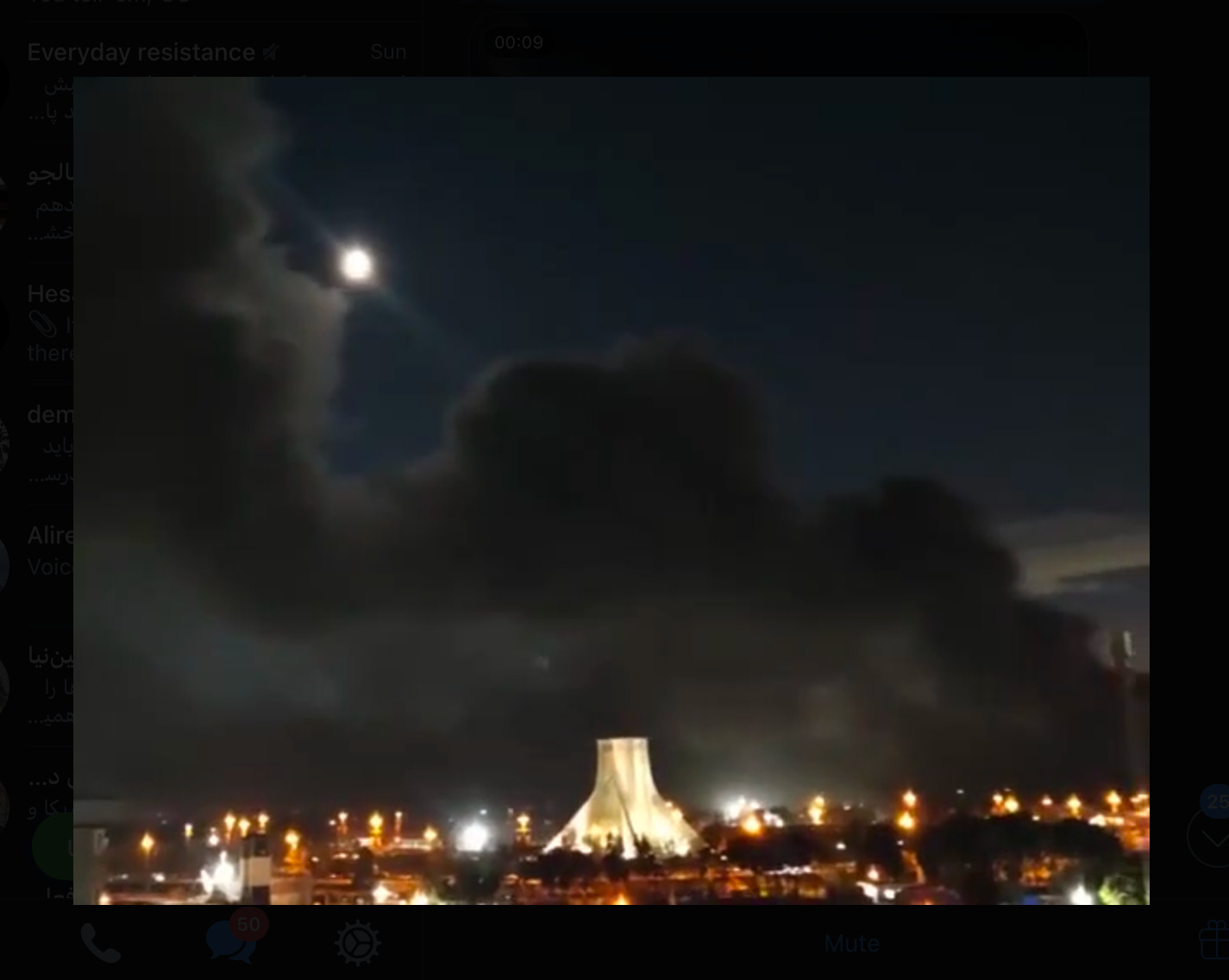
Tehran, Sunday April 4, 2026 by Zahra
I am writing this text while President Trump has said that within the next 48 hours our country will no longer exist, will be destroyed, and I am suspended between this sentence and these 48 hours; neither fully in the present nor in a future that has been threatened. It is as if time has left its linear form and turned into something sticky and stretched that neither moves forward nor stops. To be honest, writing in this situation is impossible; it is as if words have broken down, as if they no longer have the capacity to carry meaning. Words that were always a refuge for me have now themselves become defenceless; they cannot hold anything, cannot frame the world or even make it slightly bearable. When we do not know what will happen to us in the next 48 hours, what exactly are words supposed to describe? What are they supposed to narrate? Where can they begin when every beginning might be an end?
My first encounter with war was long before I understood what war was. I was a four- or five-year-old girl, about 22 years ago, sitting next to my father while the television was showing images of children in Gaza, images that I later realized have never stopped, we just sometimes look away from them so we can live. I asked my dad, “Will they ever attack us?” And he, with a certainty that I now understand was not of certitude but care, said, “No dear, they can’t; Iran is strong.” And with that single sentence I calmed down, so much so that I took a deep breath, put my head next to my dad’s pillow, and fell asleep. That night, security for me was not a defense system or a political equation; it was just one sentence, a short sentence that could keep the world in place and preserve the boundary between sleep and nightmare.
My second encounter with war was at the age of seven, on a trip that was supposed to simply be a trip, not a rehearsal for loss: Damascus, Aleppo, Latakia, the Mediterranean Sea. Syria was beautiful to me, not like a postcard but in the sense of clinging to life so strongly that I did not want to return. After that we were supposed to go to Beirut; everything was ready—the visa, the plan, the excitement—but suddenly news came that Israel had attacked Lebanon, and the trip in a moment shifted from the horizon of possibility to the horizon of danger; the world changed from something to see into something to avoid. I asked my dad the same question again, and he gave the same answer again, and for the second time the world became bearable with a single sentence. Now that I think about it, my childhood was built on an unwritten contract: the world is dangerous, but father says no it’s not.
In this text I am not going to write anything except my own relationship with war. I’m not going to give complex analyses, nor present theoretical positions, just one big “NO:” no to war, no to imperial powers, no to everything that empties life of livability. But this “NO” when it comes out of experience, no longer resembles a sentence; it is more like a tremor, something that passes through language and stays in the body, like a shockwave that, even after the explosion has ended, still continues in the ear.
As I grew older, I understood that we, the inhabitants of West Asia, are not immune from the great evil of the region—the great evil and its allies, or the allies of its allies—a network of power that decides from afar and collapses things up close. But despite this understanding, war had not yet fallen onto my life. Its shadow was there but not itself, and like many of us I had learned to live with this distance, distance that is not so far that you remain unaware, and not so close that it knocks you down. Occasionally, to ease my conscience, I would tweet about the children of Gaza, the people of Syria and Lebanon, the women of Afghanistan, and I thought this level of action was enough. Four ineffective words in a world where a Palestinian child is shot in a food line or an Afghan woman is banned from school. In between strolling among Tehran’s cafes, having my skincare routine, working, and reading intellectual books, I would post a tweet, as if some unwritten balance sheet existed between their suffering and my everyday life. But I now understand that was not balance but suspension, a suspension that collapses with the first strike.
The summer of 1404 (2025) was no longer about the shadow of war; it was war itself: direct, immediate, without any time to prepare, frightening and shocking, like encountering something you always knew existed but never believed would reach you. I had studied sociology and thought I should be able to understand such a situation, but understanding did not help at all; knowledge lay useless beside me, and I could not even move my hands.
It lasted 12 days, and in those 12 days I understood that time in war is no longer calendar time. A day of war is not 24 hours; a day of war can equal a month of ordinary life, perhaps even more, because in war every moment stretches, fills up, becomes heavy, and then settles onto the body. I had always wondered what kind of a war was Lebanon’s 33 day war. Only 33 days? And those 12 days showed me that even one day is too much, far too much, in a way that can permanently change your definition of “a day.”
During that war, when our neighborhood was targeted, I heard a sound that before I only knew of in low-resolution versions in films. But the reality of that sound cannot be seen; it is something that passes through the ear and settles in the body, a sound that is not only heard but felt, like a rupture, like pressure, like a sudden collapse of balance. I developed a stutter for a few hours, as if language too, like the city, stopped functioning under attack. A large piece of shrapnel fell into our yard, where it could have landed on any of us. That war counted as my first war, and it was there that I thought of my mother and father, of the eight-year war with Iraq [from 1980-1988], of how they endured. My mother said at first we thought it would be one week, then it became one month, then one year, and then we saw it had become eight years. This sentence for me was not just a narrative of the past; it was an image of the future, a future where war can stretch itself, make room, remain, and even become normal. And this normalization is perhaps the most frightening part.
After those 12 days, I lived every day with the fear of another war. I clung tightly to life—very tightly—as if it might be lost at any moment and if I loosened my grip it would collapse. I thought I should be grateful for moments when bombs did not fall, a kind of forced gratitude for the absence of catastrophe. Others said I had become more resilient and kinder, and I jokingly said the doctor had increased my medication dosage, and they laughed, thinking this too was part of the post-war package. But those laughs were more like a way of not seeing what they did not want to see: that sometimes, to endure, a person steps back a little from themselves.
On Friday, the day before this war started, I was sitting in a café with my dear companion. He had bought me miniature peach-colored roses. I looked at the flowers and told him I was afraid of war; everyone said there would be war next week. He took my hand, his warm hands taking away some of the cold in my body, and the very next day the war began. It is as if fear sometimes arrives before reality, but this time there was no distance between them; fear and reality overlapped.
I was sitting at my desk at work when I heard the first explosion, and in that moment I understood that “before” and “after” are separated precisely at a single sound. I cried the entire way home. In the metro, people were each in their own world. I argued with a woman who was happy about “Trump’s liberating bombs.” I could not understand how someone could think of something called liberation in the midst of these sounds, in the midst of this fear. Liberation for whom and from what? When I got home, I could not stop crying. The war had truly begun, and nothing was like before anymore, not even me.
My mother said, “During the eight-year war I had to search for my brother’s body. Pull yourself together.” But I couldn’t because what needed to be pulled together no longer had its previous form. They had struck a hospital, a school with 180 students. How can one pull themselves together in such a world? On the seventh day of the war, they struck the same place again, as if war too remembers and returns to wounded places. I woke up screaming, thinking they had hit our house. I did not dare open my door, because opening it could mean seeing something I could not unsee. I just screamed. My father said, “Don’t be afraid, it’s nothing,” my mother brought sugar water [to increase blood pressure and prevent fainting], and at that very moment the second explosion occurred. I saw with my own eyes how the balcony moved back and forth, like it was something alive and reaction to the strike. The blast wave hit my left ear; I could not hear for a few hours, and then the sounds returned, but they were no longer like before, as if something inside them had broken. From that night on, sleep did not come. My ear would not allow it, the same ear that had now learned to distinguish the sounds of drones, missiles, air defense systems, and fighter jets from each other. These are not words that should be part of a person’s everyday vocabulary but have become so. I even searched on Google for the difference between cruise and ballistic missiles, as if knowledge, even if useless, could create an illusion of control when no control exists.
My ear still hurts. The doctor said there is no specific treatment for blast waves. Sometimes it produces the sound of the sea, and, this is the strangest part: that war plants a sound in the body that resembles nature, like the sea, as if the body tries to translate violence into something more bearable. But the most devastating event was none of these. It was the night of Nowruz [March 18]. After three weeks, I had finally managed to pull myself together a little, get out of bed, and not cry for a few days. I set the Haft-Seen table, thinking one must defend life in any way possible, even by arranging a few symbolic signs. But the world had no intention of honoring this. In the middle of the night, I woke up to a sound unlike previous explosions unlike anything familiar, a sound as if it came from within the walls, as if the house itself was collapsing. For a few seconds, I didn’t know where I was. My heart was pounding, and my body froze. Even the clonazepam did nothing; fear knew its own way.
We moved toward the window (or perhaps were pulled toward it) and nothing was like what it had been. The windows had not shattered; they had turned to powder, into dust, like a mist of sharp fragments suspended in the air. The house across from us was no longer a “house”; it was a collapsed mass, a black cavity in the alley, as if a piece of the world had been torn out and taken away. The walls had opened, the rooms had lost their modesty, people’s lives stood exposed like a revealed secret: a bed left half-intact, a curtain still moving, a closet left open, as if someone was still going to return and take their clothes.
The smell of burning and dust had mixed together, a smell that cannot be described and cannot be forgotten, a smell that clings to the throat, the skin, the memory. The sounds were fragmented: screams that did not complete, names called halfway, and silences louder than the sounds themselves. I can only say it was terrifying, but even that word falls short—very short.
Debris, debris, debris. Not as a word, but as reality. Layer upon layer, heavy, merciless. Twelve people were killed, sixteen units completely destroyed, but numbers show nothing. I saw a woman running with a hyacinth flower in her hand [Iranians put hyacinths on their new year spread], holding it tightly, as if were she to let it go, she too would collapse, as if that flower was the last witness of something called life just hours before.
They could not find Radin, a seven-year-old child whose bed had been by the window. The neighbors said he had bought blue sneakers for Nowruz. This sentence is like a nail in my head: “blue sneakers.” They searched for him for nine hours. These nine hours have no relation to ordinary time; nine stretched, exhausting, merciless hours. The rescue dogs were tired, the emergency workers lay down on the asphalt, as if their bodies could no longer continue. And in the end, only part of his body was found. No longer a child, no longer life, just “a part.”
Our alley was no longer an alley. It was a scene of what is left from the end of the world. It was not that its beauty had been destroyed; it was as if it had never existed. The walls were black, the air heavy, and the shattered glass underfoot made a sound like walking on something that should never have been broken.
And from that day, I became another person. This is not an exaggeration; I truly was no longer the one who arranged sabzeh and senjed on the table [two common items for Nowrouz spread]. My tongue would fail, tears would not let me go. I thought of the well-known proverb: “A good year is evident from its spring,” and I changed its continuation: “A good year is not ours, my friend.” It is as if even proverbs must adapt themselves to war. At the same time, involuntarily, I remembered the sentence that a bad life cannot be lived well, and we, the inhabitants of this geography, are caught in the heart of this contradiction: we must live in conditions where living itself has become a problem. And they do not let us live.
The veins under my eyes bulged, my ear throbbed. I thought to myself how did people during the world wars endure without these sedative pills? What does it mean that the doctor says there is no higher dose? Has no special medication been invented for wartime conditions? My body does not understand what war means. The body wants to sleep, to eat, to be calm, but war disrupts this rhythm; it destroys it from within. Thirty-seven days have passed. I have experienced severe bleeding twice. My body is protesting in its own language. My friend said this body is not made for war; it should relax on the beaches of Switzerland. I do not know if Switzerland has beaches or not, but my ear still produces the sound of the sea, as if my body creates another geography for itself, somewhere far from here. One month and one week has passed—37 days—but these 37 days are not just a number; they are an accumulation of something immeasurable, layered on top of each other like debris.
So many people have been killed, so many homes destroyed that I no longer know what to say. Building is so hard. Once I made a clay bowl, and when it broke I was sad for days. Now I think about all these bridges, hospitals, universities, petrochemical plants. Are they going to be rebuilt? And if they are rebuilt, will what has been lost return? Oh my precious homeland.
I want an ordinary life: metro, crowds, complaining about work, seeing my dear companion, evening fatigue, that ordinary fatigue that is a sign of being alive, not of exhaustion. But the city I live in is full of signs of war, like Khuzestan [southern oil-rich province and a major battle site during the Iran-Iraq war] where traces of the eight-year war still remain. When will these traces be erased, or will they ever be erased?
I have been laid off from work. When I started The Thibaults [a multi-volume French novel for which Roger Martin du Gard won a Nobel prize in 1937], I prayed the war would end. Now I am reading its second volume and hope I do not reach the third and fourth ones, because every volume I move on to means the war has also continued. I asked my mother why didn’t we have the sound of wind before? She said there was wind, but there were no fighter jets. And this simple sentence containes the entire difference between two worlds: a world where sounds are natural and a world where sounds are signs of threat. And now, among all these sounds, among all this accumulated experience, in a body that still trembles and a mind that is always anticipating, only one question remains, a question that has no answer and not even a fixed form:
What will the next 48 hours be like?
After I published this post, her essay in Persian was published on the site Harass Watch. The Persian includes a note that says she wrote this a day before 6 members of her family died in US/Israeli bombings of Iran: https://harasswatch.com/news/2568/%D8%AD%D8%AA%DB%8C-%DB%8C%DA%A9-%D8%B1%D9%88%D8%B2-%D9%87%D9%85-%D8%A8%D8%B1%D8%A7%DB%8C-%D8%AC%D9%86%DA%AF-%D8%B2%DB%8C%D8%A7%D8%AF-%D8%A7%D8%B3%D8%AA
What a powerful, moving testimony - and although it may seem wholly strange to use this word, even beautiful.
What Zahra wrote in this childhood memory is so devastatingly true today: "I was a four- or five-year-old girl, about 22 years ago, sitting next to my father while the television was showing images of children in Gaza, images that I later realized have never stopped, we just sometimes look away from them so we can live."
Solidarity is so vital but so complex: seeing but looking away is part of it.
Dear Naghmeh, there are no beaches in Switzerland, (maybe on the lake Leman..) but there are plenty in Italy. A beach is a state of mind, a place where there is no danger, no war, no fear. When all this evil will end, please come to the beach in Italy, I invite you and your friend. I haven't known war in my life, my parents did, I have been lucky. But I could have been in your place, living next door, I wonder how could I have reacted....