
"Roaring Missiles, Wandering Children"
Why according to one Tehran based educator "this summer’s pain sits heavily on our hearts."

For close to a week now, the US has been bombing what CENTCOM called “Iranian military targets” primarily in southern Iran, including Hormozgan, Khuzestan, Bushehr, Ilam, Markazi, and Sistan and Baluchestan provinces. Temperatures in those areas have reached 120 Fahrenheit or close to 50 degrees Celsius with water and electricity at times cut off due to the ongoing war and pre-existing infrastructural problems.
Against this, there is a generation of Iranian students who have now had their schooling interrupted again and again since 2020 — first by COVID, then by the 2025 and 2026 wars — and who are, in these very weeks, sitting final exams and preparing for the Konkur, the dreaded and extremely difficult university entrance exam that in Iran determines who goes to college, where, and in what field. This is what's easy to miss in a war measured mostly in America by gas prices at the pump: the erosion of a generation’s future.
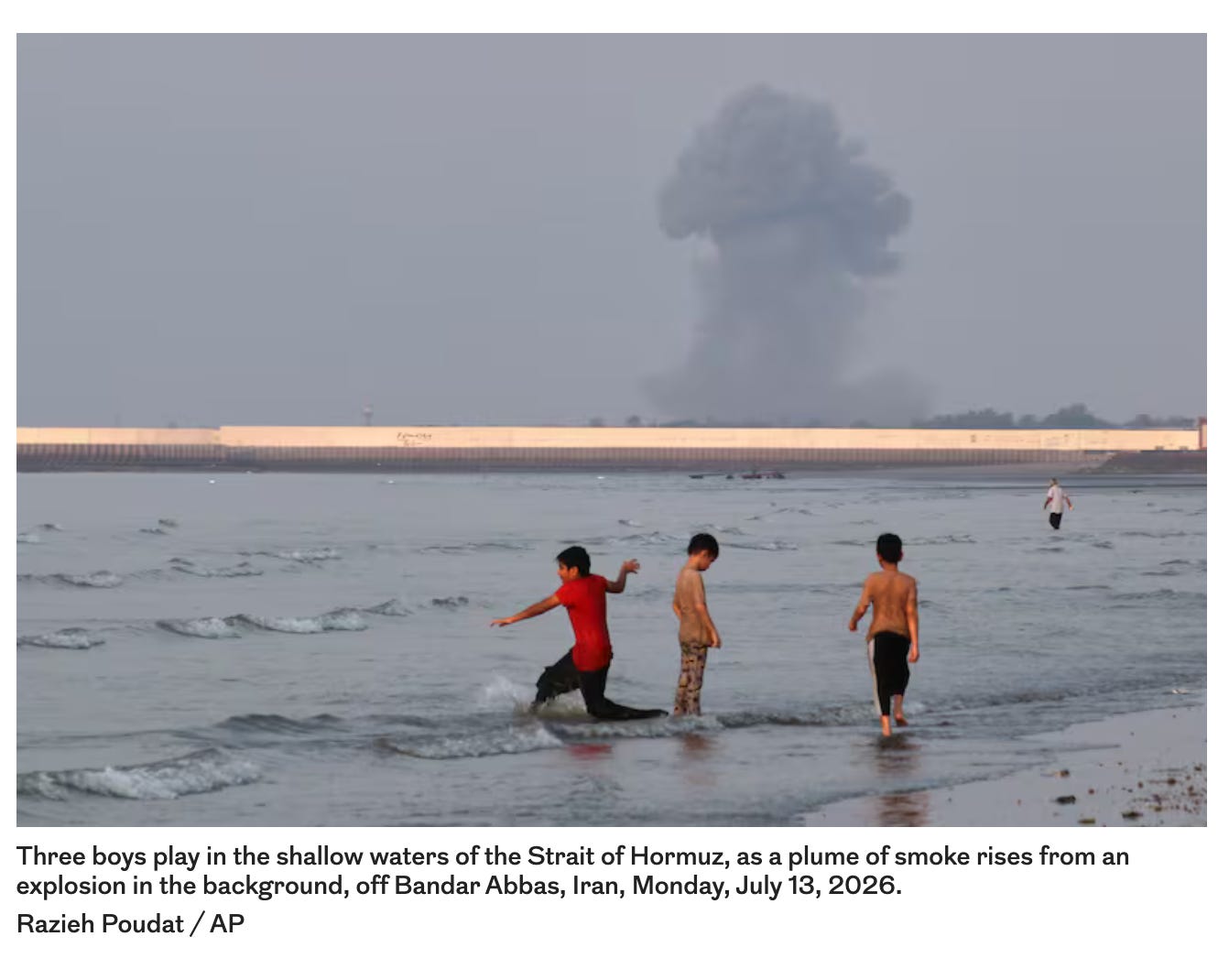
This erosion does not start with the war but war has created insurmountable obstacles to any kind of improvement. According to the research conducted for this post by a colleague who prefers to remain anonymous, Sistan and Baluchestan is southern Iran’s most crisis-ridden province. Only 9 percent of applicants pass the national entrance exam (versus a 13 percent national average) the result of educational exclusion that starts in early schooling. In 2024, educational space per student was 3.87 square meters, well below the 5.4-meter national average. Despite some recent investment, 58.04 percent of the province’s 18-to-24 population lacks a secondary diploma, compared to 27.64 percent nationally, giving the province the country’s highest illiteracy rate.
Khuzestan is a striking contradiction: despite being the hub of Iran’s oil industry, public education investment is low. In late 2024, educational space per student stood at 4.92 square meters against a national average of 5.45. Of 40 educational districts, 18 fell below average, and officials estimate the province needs 500,000 additional square meters of educational space to catch up. In mid-2023, average final exam scores ranged from 8 to 9 out of 20. Along with Sistan and Baluchestan and Hormozgan, Khuzestan had the lowest share of top-3,000 rankings in the 2020 entrance exam and the lowest university admission rate.
Hormozgan had seen modest improvement from before the recent two wars, with educational space per student rising from 4.8 to 5.2 square meters between 2023 and 2024, aided by hundreds of new classrooms built each year. Yet outcomes remain poor: average final exam scores in 2023 also sat at 8 to 9, and the province ranked among the lowest for top entrance-exam rankings. In 2025, 27,000 students were reported as having dropped out or fallen behind, 10,000 of them in the eastern counties of Jask, Bashagard, Sirik, and Minab, exposing sharp divides between the main city of Bandar Abbas and outlying towns.
Bushehr fares comparatively better: educational space per student reached 6.5 square meters in early 2025, above average, with 97.2 percent enrollment coverage and the country’s highest urban household education spending in 2023. Still, average final exam scores that year remained at 9 to 10. But these numbers obscure inequality among working-class, rural, and industrial-zone households, and more than half of school construction funding reportedly comes from charity rather than government investment.1
I asked a friend who is an educator based in Tehran for her reaction to the recent news that the ministry of education has canceled final exams in the 4 provinces of Hormozgan, Khuzestan, Bushehr, and Sistan and Baluchestan currently under daily bombardment by the US. They wrote:
“Adolescence is the time to enter society, to become independent from the family, to find and shape oneself. But war, pollution, street protests, power outages, lack of fuel in winter, all of these, lead to school closures in Iran. Because for no family is a child’s education dearer than their life.
In the more poverty-stricken cities of Iran (“more” because at present this deprivation of basic facilities includes all cities), school is often the only opportunity for scientific and personal growth for children and adolescents. The studious child’s dream is to enter university as the means to escape deprivation and a hard life. These young people succeed in their studies, shine academically, land good jobs, lift their parents out of poverty, create opportunities for their younger siblings to study more easily, and maybe even bring them to the capital, Tehran. Everything else the government hasn’t been able—or hasn’t wanted—to provide through public welfare and education, they provide for themselves through their own hard work. For the children of the more deprived cities, their joy is studying, and even without having a teacher, becoming among the top ranks in the university entrance exam, having their photo published in the newspaper, and so on.
Now school, this one honorable source of happiness for the adolescents of this land, has been withheld from them. Because the war is big, and it cannot tolerate small joys. The entrance exam is near, but the fate of the twelfth-grade exams, which are a condition for entering university, is unclear. This summer’s pain sits heavily on our hearts.”
Below is a translation of a report detailing the effects of this war and bombardment on students in the south by Sogol Danayi and Elnaz Mohammadi. It is part of a collaborative effort to engage with perspectives and analyses from inside Iran. I invite you to read them, incorporate them into your understanding of Iranian politics, and help distribute them widely. My eternal gratitude to my two unnamed friends and colleagues who contributed to the introduction.
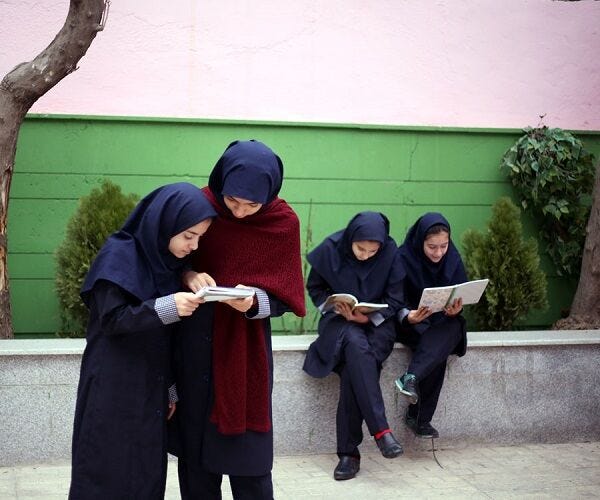
“Roaring Missiles, Wandering Children”
Sogol Danayi (reporter) and Elnaz Mohammadi (society editor) published in Hammihan newspaper, July 16, 2026
With several weeks left until the height of summer and amid the scorching sun, water shortages, and the anxiety of missiles, the children of the South have to concentrate on their end of year exams; it’s no easy task. Even if in the past week missiles and American bombs have not rained down on the provinces and cities of northern and central Iran, and even on the turbulent capital of Tehran, the southern belt of Iran—from Khuzestan to Sistan and Baluchestan—has borne the brunt instead. In the midst of all this, high school students in the South, those who must sit for the anxiety-filled university entrance exam (Konkur) in just one month, are spending these difficult days with troubled minds and exhausted bodies from all this stress.
The arrival of night makes things even more distressing. According to the made-up rules of those who are at war with each other, nighttime is a better time to attack. It was at night that Dezful was struck and the walls of Sepideh’s brother’s house cracked. It was also night when Parastoo and her children awoke in terror, their hearts nearly pounding out of their chests, to the sound of missiles near Jam. And when Mahtab, a twelfth-grade student on Hengam Island, closed her book to set her alarm before going to her final exam the next morning, it was just past midnight.
Khuzestan: War, Once Again
From the ninth of Esfand last year [February 28 and the start of the 40 day US/Israeli war on Iran] until today, children haven’t truly understood what studying and school really look like. Even before that, air pollution and other things had, for various reasons in each province, dragged children from school hallways onto the difficult, arduous path of the barely-functioning domestic “Shad” network on the internet [the domestic software created for online schools during the Covid pandemic], and even after the ceasefire things never returned to normal until this fiery month of Tir [July], when the bombing of the southern provinces began again, leaving children more uncertain and more exhausted than ever. Water and power outages became yet another reason for the tangled suffering of life in the south. And that’s not all: people like Sepideh, who lives in Dezful, and in other cities of Khuzestan, have these days become caught up in a whole array of hardships that, for now, offer no imaginable escape.
Sepideh says the people of Dezful go many hours a day without electricity, their Irancell SIM cards get no signal, and just yesterday she walked across two large sections of Dezful trying to find an ATM to withdraw cash so she could pay for a Snapp ride [Iran’s rideshare app] but even the ATM had no cash. The hardships of life in the south isn’t limited to power outages and lack of internet. Sepideh says that in her city, water was cut off completely for two full days, with only drops coming from the taps. All of this alongside the devastation and horror of the war that has arrived once again: “The night after they attacked, I called my brother and found out the walls of his house had cracked. I feel like death is closer to me than ever.”
Tahoura, a twelfth-grade student in the photography track, is also from Dezful, a city on the banks of the Dez River with a population of over 300,000 known as the capital of Iranian resistance, the city of steadfastness.
From 1980 [the start of the Iran-Iraq war], when it was bombarded more than 160 times by missiles fired from Iraq, up until now, Dezful and its people have had no shortage of hard times, and all of this is preserved in the city’s, and its people’s, historical memory. Tahoura and her classmates, even though they never witnessed the Iran-Iraq war, have with their own eyes, from Khordad 1404 [June 2025, the 12 day war] to Tir 1405 [July 2026], heard so much missile fire and seen so much destruction around their homes that they themselves have now become part of that same historical memory, and part of the endless history of war.
Tahoura is also one of the students who these days feels, above all else, lost and confused. Now that after extensive protests, the Ministry of Education has finally cancelled the final exams for eleventh and twelfth grade in the four provinces of Khuzestan, Hormozgan, Bushehr, and Sistan and Baluchestan, she doesn’t know when this story is finally going to end. The area where Tahoura and her family live is somewhat far from the sites of the explosions, but their loud sounds find their way to their home every night, and sometimes during the day too. Her friend Mohaddeseh’s house, though, is directly behind “the base,” and when it gets hit by a missile, the walls of their house shake violently and their windows shatter. Tahoura and Mohaddeseh also have friends in Bushehr and Hormozgan provinces who call them crying, saying they haven’t been able to sleep for several days. Yet despite all this, they’ve still had to sit their final exams.
Another of Tahoura’s friends in one of the southern provinces says their exam venue was hit by a missile, and now it’s unclear where the students are supposed to take their exams; and even for those who did manage to take their exams, conditions were far from normal. Tahoura says:
“Our conditions for taking the exam were really bad; they kept us in the school courtyard, and we were in the courtyard for close to an hour or more before they took us in to sign in and give our fingerprints to register our attendance. On the first day, which was our religious studies final exam, the weather was extremely hot, and most of the kids were getting heatstroke. There wasn’t even a chair for us to sit on. There were more than a hundred of us, and they kept us in the courtyard in that heat. By the end of the exam, when I came out, I had stomach pain from all the stress. A week before the exams were supposed to start, they kept changing the date, until it finally began on the fifth of Tir [June 25]. Now the [students in the] theoretical academic tracks [Math and Physics] have very little time to study, because, for example, my friends in the math track have four exams in one week, and these aren’t easy subjects either. How are they supposed to prepare themselves? These past few days since the attacks started, my friends keep saying they can’t eat, they can’t sleep from the stress, their stomachs are in knots. Now add to that, for us in our final year, the stress of the university entrance exam on top of it; less than a month after the final exams end, the entrance exam begins, and we don’t know how we’re supposed to prepare ourselves for it. We didn’t go to school for three months of the year. The most critical three months of the school year; after school went virtual, there wasn’t even proper internet for us to get online; Shad kept crashing, classes wouldn’t load. Even in these wartime conditions, the teachers wouldn’t work with the students or help them. Things are still bad. We don’t know what we’re supposed to do under these wartime conditions. How are we supposed to go take an exam in the middle of bombs and missiles? And if the exams are going to be postponed, then until when?”
The situation is similar in most cities of Khuzestan. Zahra is the principal of a school in “Sarbandar,” or Bandar-e Emam Khomeini, a place near Mahshahr. Sarbandar is a small town; people say it’s the size of the palm of your hand. Until just two days before Zahra heard the sound of an explosion, children had been coming to school to take their final exams but since that night, Zahra has wished, for now, not to see the children in school at all:
“We were woken up at 5:30 in the morning, terrified. The sound of the explosion was so loud it was as if someone had struck the door right behind us. Our house is very close to the site so it was as if a bomb had fallen right on our heads. First came the sound of air defenses, then the sound of the explosion.”
Ahvaz, too, is having a rough time these days. Ahvaz has four education districts, and each district selects a set of exam venues for the final exams every year, a venue that has the necessary facilities and equipment and that has served as an exam venue in previous years, and where the administrative staff are experienced. Mahboubeh is a teacher in District One of Ahvaz’s education department. This year, in selecting the locations for exam venues in this district, no attention was paid to whether they were near dangerous sites…Some of the exam venues in District One are in Amaniyeh, Ahvaz, and Amaniyeh is not a location far from danger meaning that even if an explosion doesn’t directly harm students because of its distance, the sound of the explosion alone has a huge impact on the children. Mahboubeh says:
“Although so far no such explosions have happened during the students’ exam times, the parents are extremely worried. A friend of mine is the principal of a school in District 2 of Ahvaz, and her school is a final exam venue. She told me the exams are currently being held, and her school is near the Ahvaz Airport, which has been hit several times. I don’t know why there’s such insistence that these exams absolutely must be held. It’s the same in the other districts too. I’ve worked in various education districts for 20 years, and they’ve never given any real consideration to student safety. The issue of security and the possibility of war doesn’t carry much weight now either. The 22 Bahman secondary school, which is near Chahar Shir, is a clear example of this; a case where student safety wasn’t taken into account at all. Conditions here are simply not good, the sound of explosions is severe, especially in District One and District Four, and the situation is not appropriate at all.”
I gave my son a sleeping pill
On Monday the 22nd of Tir [July 13] an hour before his final exam was set to begin, Ali heard the sound of an explosion. He put down his “History of Literature” textbook and said to his mother: “I can’t study anymore, let’s go to the exam venue.”
At half past six in the morning, his mother had told her sixteen-year-old son that if he heard the sound of a missile during the exam, he shouldn’t panic or rush out of the classroom quickly, because he might get trampled. “I kept telling him to stay calm, I’d point to the school and say, look, it’s still standing, so no missile is going to hit here.” But Ali, her son, couldn’t calm his heart, and told his mother: “You can say that, but I’m the one who has to stay in the school and take the exam.”
Ali and his family live in “Jam.” Jam is one of the counties of Bushehr province in southern Iran. News reports said that the people of Jam county also heard the sound of several explosions at one a.m. on the 23rd of Tir [July 14]. A few hours later, the twelfth-grade students had to take their Persian final exam. Parvaneh, one of the mothers living around Bushehr, also confirms hearing the sound of the explosion, saying her close friend’s child had a final exam that day, but “we heard the sound of four explosions, and some of the kids couldn’t sleep until morning.” So now families living in southern Iran — Chabahar, Bushehr, Asaluyeh, and elsewhere — now find themselves grappling with a new issue alongside the sound of explosions: “in-person final exams.”
Fears among mothers and children in the south echo back to the eight-year war [the Iran-Iraq War]. On the morning of her son’s exam, Ali’s mother had seen distraught and fatigued men going to their jobs at the petrochemical plants, and on the other side, she’d seen children coming to the exam venues with their mothers:
“Some people say to us, what are you afraid of, it’s just a sound. But it’s not just a simple sound because when a missile hits, the whole house shakes, our car alarms go off, we don’t get used to these sounds.”
Ali’s mother is 46 years old; she doesn’t have a clear memory of the eight-year war, but the images of the forty-day war [the 2026 war] haven’t faded from her mind. She says:
“In this recent war, we only went to Shiraz for a few days — there was noise there too, but in the south everything was different, we would see the fighter jets. I kept a hose [شلنگ] in my own car because we were afraid we wouldn’t be able to get gas. The day the rumor spread that they were going to hit the Bushehr nuclear power plant, they said the health center was distributing iodine pills. You don’t know what stress we endured.”
Parvaneh had also gone up north [where there was no bombings] during the recent war, and her reaction was strange to many of those around her too: “I would jump at every sound, everyone was surprised. I’d think, they’ve hit something.”
For over a week now, news has been coming out about renewed missile attacks on southern Iran. The final exams also began on the 21st of Tir [July 12]. Ali’s mother, whose son is in eleventh grade, says he has four final-exam subjects and so far he’s only taken one of them: “Thank God, on the 22nd when he went to the venue, there was no attack during the exam and we got home safely. That same day it was announced that they’d changed the exam venue too since the previous venue was a boarding school that was 500 meters from the site of an explosion; the new venue is about a kilometer away.” She says that even though the venue was changed, the students were still afraid, and some couldn’t study the night before the exam: “The next day the sound came again, so I gave Ali a sleeping pill. I also messaged other mothers telling them to give their kids sleeping pills too, so the kids could at least sleep the night before the exam.” Parvaneh says that on the 23rd, the twelfth-graders had their Persian final exam, and on the 25th [July 16] they have to take their calculus exam; the twelfth-graders still have 13 subjects left to be examined on.
The mothers and fathers of southern students are protesting; they are worried about their children’s lives and mental wellbeing. Some of them have heard from their children that out of fear, they can’t study properly or perform well on their exams.
In response to these protests, the Ministry of Education has only changed the locations of exam venues. Hossein Sadeghi, head of the Ministry of Education’s information and public relations center, told the media: “If there were even the slightest sense of danger to students, the exams would not be held in this manner. That said, all venues located near sensitive or military sites were identified and moved to safer locations, such as Hosseiniehs and public centers, to ensure a completely safe environment.” Two days later, however, he said that final exams had been cancelled for two days in four southern provinces.
Even so, families in the south say this isn’t enough: “My own niece is in Rasht [a city in the north on the Caspian shore], the same age as my son, in eleventh grade, she also has final exams. Well, there’s no war there at all, and no sound, and I hope there never will be. She studies with peace of mind and gets good grades too, but our children in the south face this kind of discrimination.”
Students in non-southern provinces are protesting too, like Taher, a twelfth-grade math student in Kermanshah. He says that from last year’s war until now, his morale has been so poor that he hasn’t been able to prepare himself for the university entrance exam, and now it’s unclear what will happen with the final exams either. “This is literally war. The tenth-graders went virtual and that was that; eleventh and twelfth grade are what’s left. My elementary and middle school siblings went virtual too. We haven’t been able to study since the ninth of Esfand [start of the 40 day war]. Families have no understanding of our situation and just want us to get good grades. Now they’ve only cancelled exams in four provinces; well, hasn’t our province been hit plenty too? What’s the difference between us and them?”
Education is what’s been lost in these days of war. In military attacks, what matters is the lives of students. Schools across the country, in most cities, went remote starting from the end of winter. Ali’s mother also says her son has been attending school “online” since the 15th of Farvardin [April 4]. This isn’t without effect on the quality of education. UNICEF has warned in its reports that war, more than anything else, targets children’s education. According to the organization’s latest estimates, by the end of 2024, around 234 million children in crisis-affected countries needed urgent support to access quality education, a figure that has risen by 35 million in just three years. The organization emphasizes that in times of war, school is not merely a place of learning, but a space for preserving children’s psychological and physical safety. For this reason, international organizations have for years emphasized the concept of “safe schools”; the “Safe Schools Declaration,” endorsed by 123 countries since 2015, is premised on protecting schools, students, and teachers during armed conflict and preventing the military use of educational facilities.
That said, UNICEF does not offer a general recommendation on whether schools should be open or closed during wartime. What the organization emphasizes instead is “the continuation of education under safe conditions.” One of its statements stresses: “A child’s right to education in conflict-affected areas cannot be guaranteed without protecting education itself.”
A Campaign with a Thousand Signatures
Hanieh Hemmati, a candidate for the university entrance exam in the experimental sciences track, lives in Kohgiluyeh and Boyer-Ahmad province. Even though she herself doesn’t live in the south, she has launched a campaign calling on education officials to reconsider how final exams are held for students in the south. Part of the campaign states: “Does educational justice require that a student who, instead of the quiet of a study room, hears the terrifying sound of danger, be examined by the same standard as a student being assessed in a safe, calm environment?” Another part of the campaign calls on officials to: “reconsider the conditions under which final exams are held for students in crisis-affected regions, or, by postponing the exam dates for this group, provide them with a fair opportunity to prepare again.” As of the writing of this report, the campaign has gathered a thousand signatures. Hanieh says of the campaign: “I don’t live in the south, but I read the news a lot, and I didn’t have the means to do much, but I wanted to do something for the people of the south who are under pressure and going through such hard conditions, especially since these exams will determine their future. Many people told me this kind of effort might not have any effect, but I wanted to do something for my fellow human beings.”
Cookie-Cutter Decisions
Mohammad Davari is a teacher and the former spokesperson of the Teachers’ Organization. He says: “Unfortunately, officials’ decision-making hasn’t been backed by sufficient expert input, and it hasn’t adequately addressed students’ concerns.” In his view, adopting a single, uniform decision for all regions of the country, despite the differing conditions, is not the right approach, and officials should act with greater flexibility, adopting different policies and decisions suited to the conditions of each region: “Different regions of the country need different approaches tailored to them.” Regarding the feedback he’s received from students, teachers, and families, Davari says there has consistently been complaint and protest over these decisions. According to him, there have even been protest gatherings at times in response to how these decisions were made, and students and their families are deeply worried: “One of the most important focal points of the protests has been the [government’s] insistence on holding exams and final exams in person, despite classes being held online.”
Just a few weeks before summer, students in several Iranian cities took to the streets in protest. Their protest was against the holding of in-person exams. Although two exams have now been postponed in some southern cities, students and their families say this isn’t enough.
See these three articles for more information in Persian on higher education chances and income inequality:
https://www.pana.ir/%D8%A8%D8%AE%D8%B4-%D8%A7%D8%AC%D8%AA%D9%85%D8%A7%D8%B9%DB%8C-99/1285440-%D8%AF%D8%B1%D8%B5%D8%AF-%D8%B1%D8%AA%D8%A8%D9%87-%D9%87%D8%A7%DB%8C-%D8%A8%D8%B1%D8%AA%D8%B1-%DA%A9%D9%86%DA%A9%D9%88%D8%B1-%D9%85%D8%B1
https://www.khabaronline.ir/news/1787256/%D8%A2%D9%85%D8%A7%D8%B1-%D9%86%DA%AF%D8%B1%D8%A7%D9%86-%DA%A9%D9%86%D9%86%D8%AF%D9%87-%D8%A7%D8%B2-%D9%88%D8%B1%D9%88%D8%AF%DB%8C-%D9%87%D8%A7%DB%8C-%DA%A9%D9%86%DA%A9%D9%88%D8%B1-%D8%AF%D8%A7%D9%86%D8%B4%DA%AF%D8%A7%D9%87-%D8%A8%D9%87-%DA%A9%D8%A7%D9%85-%D9%BE%D9%88%D9%84%D8%AF%D8%A7%D8%B1%D9%87%D8%A7
https://irphe.ac.ir/content/4825/1402071501