
“Sweet Lies and Bitter Truths”
Roya Khoshnevis, a Tehran based cultural analyst, writes about Iran's propaganda war

The text for today was sent to me by Dr. Roya Khoshnevis, a Tehran-based cultural analyst and researcher, specializing in Petroculture Studies with a focus on the Persian Gulf. In it she provides a rarely seen glimpse into the everyday experience of living within the Islamic Republic of Iran’s war propaganda machine.
Over the past decades, Iran has built a sophisticated propaganda system aimed both at its own citizens and the outside world. In the past month, even as people in Iran have struggled to find ways to move past the internet shutdown (mainly through costly and unstable proxy configurations), the Islamic Republic has been steadily putting out videos highlighting its war efforts. Most notably, a number of sleek AI generated videos that cast the US, Israel, and Iran as Lego figures have gone viral (see below for links.)
As Dr. Khoshnevis shows, the propaganda directed at the Iranian public is unfolding across domestic social media platforms (limited to users with an Iranian cell phone number), as well as on streets, billboards, and television screens. All of this is happening in the context of fractured public opinion about the war and deep social divisions. Her piece captures what it feels like to live in the middle of an information war, where truth is uncertain and the consequences are likely to extend far beyond the war itself.
This post is part of a collaborative effort to engage with perspectives and analyses from inside Iran. I invite you to read them, incorporate them into your understanding of Iranian politics, and help distribute them widely. My deepest gratitude to Dr. Khoshnevis for sending me her insightful analysis and agreeing to its publication here.
“Sweet Lies and Bitter Truths”: Iran’s Propaganda War
by Roya Khoshnevis1
My friends and I often joke in our group chat on Iranian social media that some people seem to work for Iran International, others for Islamic Republic of Iran Broadcasting [IRIB]; some for Mossad, and others for Iran’s intelligence agencies. Depending on which outlets people follow and share, they are quickly categorized and divided into opposing camps. Yet this division goes beyond difference of opinion. It has reached a point where people are dying for holding even slightly different views.
One month into the war, both sides present themselves as the victors of this brutal conflict. Each highlights its own offensive attacks, while emphasizing its defensive strength. As a result, we find ourselves trapped between “sweet lies and bitter truths” in an ongoing propaganda war.
The Iranian government calls this war the “Ramadan War.” In doing so, it has rapidly linked the conflict to Shiite belief systems particularly concepts that portray believers as soldiers of the Imamate [leadership of the community of believers after the death of the Prophet Mohammad]. This framing helps explain a notable shift in public presence over just two months: streets that were once filled with broadly pro-war participants are now increasingly occupied by explicitly pro-regime supporters.
The physical absence of Mojtaba [Khamenei], referred to as the third leader of the Islamic Republic, and his reliance on written statements without images or voice recordings,2 echo deeply rooted Shiite beliefs about the “Hidden Imam” [Imam zaman in Persian, the promised Messiah in Shi’a Islam]: an absent figure who will return at the appointed moment. Mojtaba’s anticipated reappearance, zuhur mikonad (“he will appear”), is frequently framed in messianic terms.
This cultivated absence has only deepened public confusion. His image appears across cities on billboards, portraying him as a composed, pious, and restrained leader who will emerge at the “right time.” In religious narratives, this moment coincides with a world overwhelmed by injustice, after which the [hidden] leader returns to restore order. Such a conception of time offers spiritual meaning to those who believe that resisting evil creates the conditions for the manifestation of a just leader and will bring about a form of justice long deferred in Shiism, primarily since the martyrdom of the third imam, Husayn ibn Ali in the battle of Karbala.3
With commercial advertising largely suspended during wartime, and amid attempts to shift symbolic leadership from Reza Pahlavi, who is called the “leader of television” to Mojtaba as the “leader of the people,” cities, roads, and alleyways are now filled with minimalist images of the younger leader. These images are accompanied by a single poetic line:
دست خدا عیان شد / خامنهای جوان شد
The hand of God became visible / Khamenei became young
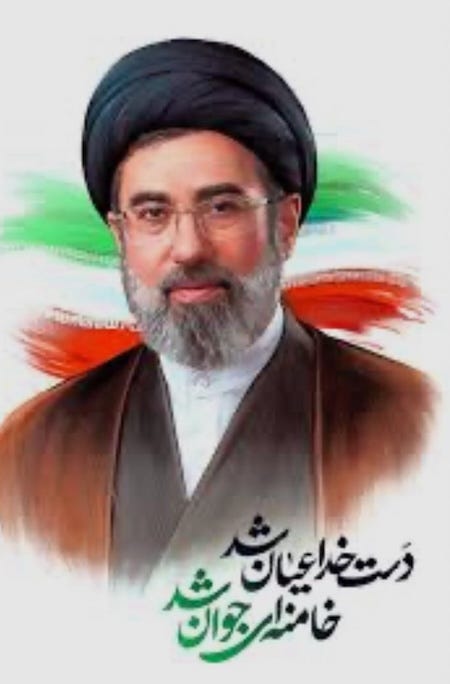
By emphasizing his age, a sense of renewed energy is injected into what we can call the new Iranian mode of resistance. The elimination of senior figures within the Islamic Republic has also coincided with the rise of a younger, more active, and technologically attuned cadre. At the same time, rumors about the death of this “young leader” and members of his family have circulated widely. Whether true or not, such narratives have significantly shaped public perception in recent weeks. As during the Iran–Iraq War, the current conflict is framed symbolically as resistance against illegitimate [literally “false”] global powers.
This propaganda war is also unfolding through new communication platforms. On domestic social media applications such as Bale4, numerous posts depict Iran as the clear victor while portraying the U.S. military as the loser. These platforms function similarly to Instagram, with channels and pages distributing curated narratives. In one such channel, “Akhbar-e Enfejari” (“Explosive News”), I encountered a short animated video titled Come Closer.5
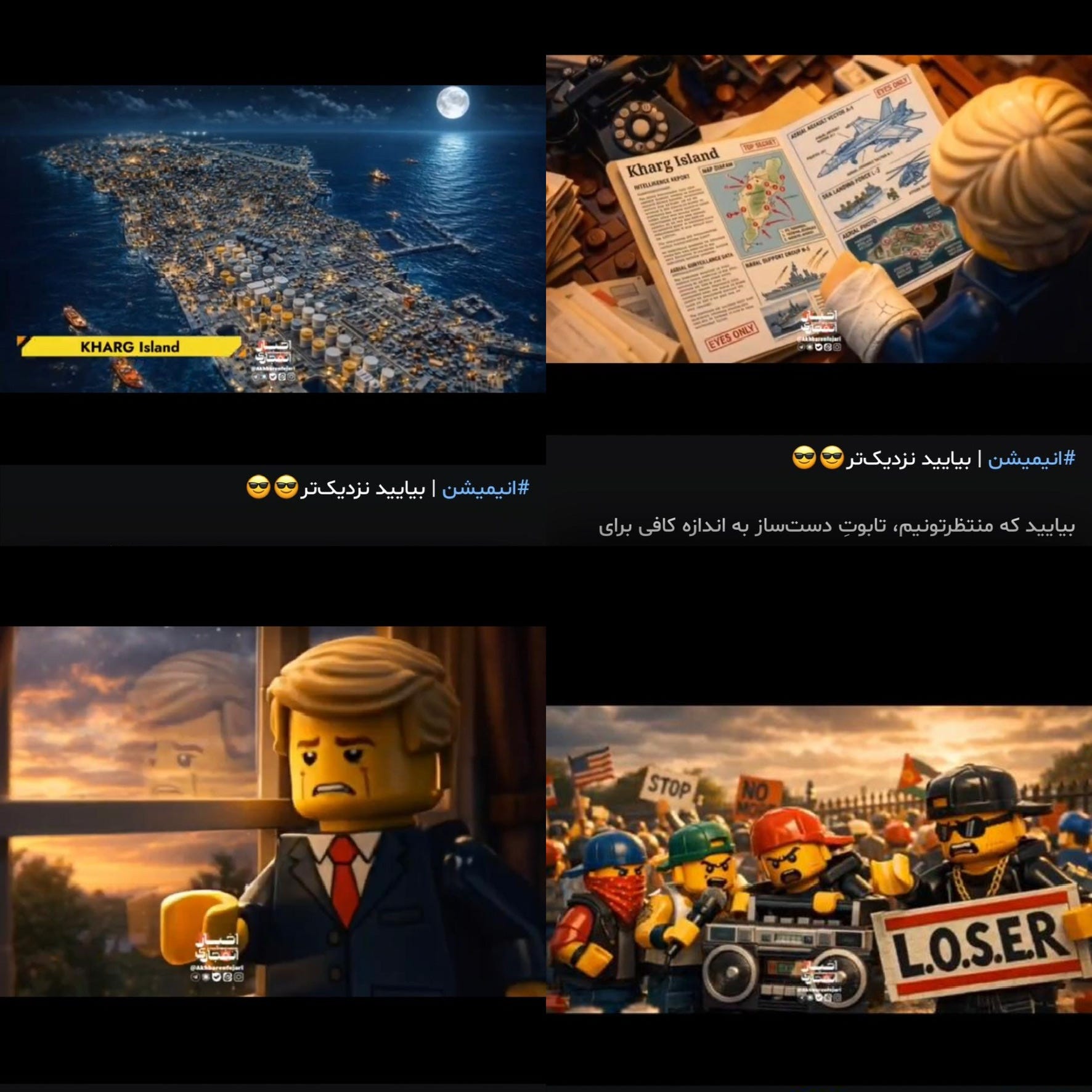
In the animation, characters appear as Lego figures. Donald Trump is depicted as exhausted with a bandaged hand, uncertain of his next move in the Persian Gulf. Kharg Island is reimagined as a futuristic hub resembling a new UAE, complete with advanced infrastructure, modern oil facilities, and urban development. The animation portrays Iranian forces launching attacks from Kharg toward U.S.-aligned positions in Saudi Arabia and Kuwait. Missiles carry symbolic coffins labeled “For Loser.” The video concludes with a distant view of Kharg Island beneath the Iranian flag, accompanied by the phrase: “Come Closer.” [You can watch the video here.]
Beyond Iran’s domestic platforms, alternative media activity is heavily restricted, and its use often deemed illegal.
In recent news, Dr. [Javad] Ramazan-nejad, head of SATRA [Iranian Mass Media Regulatory Authority Organization responsible for issuing permits], addressed controversies surrounding domestic streaming productions, stating: “No consideration outweighs my professional judgment. Under wartime conditions, I will not allow content unrelated to the war to be released in the country under the guise of entertaining people or even in the name of unity or some such things.”6
In line with this emphasis on wartime production, Iran’s state broadcasting has begun developing a scripted television series titled Ahl-e Iran (“The Iranians”), focusing on ordinary citizens who are portrayed as devout Muslims and patriotic figures in the midst of the “Ramadan War.”7 Its symbolism recalls cultural productions of the 1980s, the first decade after the revolution and during the war with Iraq. The series prominently features the Iranian national flag, even suggesting that there’s now a scarcity due to high public demand, particularly for use in state-encouraged evening street gatherings aimed at reinforcing unity among pro-regime supporters.
Although the series has not yet aired, its trailer evokes aspects of post-revolutionary Iranian cinema. As Negar Mottahedeh argues in the book Displaced Allegories, such works exist in a space between reality and fiction. For those living in Iran today—experiencing bombardment while witnessing nightly displays of what might be called “the other side” of Iran’s reality—this blurred boundary cannot be denied.
Long lines of cars move through city streets, many carrying the national flag and expressing support for Iran’s military actions against the United States and Israel. Yet, like many narratives produced both inside and outside the country, these representations often erase other segments of Iranian society. This is why many believe that even if the war comes to an end, the internal divisions among Iranians will persist for years to come.
Mojtaba Khamenei was selected as Iran’s third Supreme Leader on March 8, 2026 after US/Israeli strikes killed his father on the first day of the war. He has not appeared or spoken in public fueling rumors that he is either dead or severely injured.
The Shi‘i third Imam was the grandson of the Prophet Muhammad, revered for his stand against tyranny and his martyrdom at the Battle of Karbala in 680 CE. Karbala holds profound symbolic importance both in Shi‘ism and the Iranian Revolution.
Bale [pronounced ba-leh] is an Iranian messaging and social media platform for domestic use that also offers digital payment and e-commerce services. Since the war started, Iranian government has fully shutdown internet access to the outside world but its domestic platforms such as Bale have been kept functioning. People have increasingly turned to illegal, highly expensive, and inconsistent black market methods for breaking out of the internet shutdown.
The video referred to here is one of several Lego videos posted on “Explosive News” social media, including on X, where the account indicates it was created in March 2026, i.e. after the war started. “Explosive News” describes itself as an “independent Iranian AI production team. The grassroots creators behind the Lego animations breaking the media silence.” These Iranian propaganda videos depict a victorious Iran fighting US and Israel (and recently fifth column forces) entirely as Lego figures. See: https://x.com/ExplosiveMediaa
https://www.asriran.com/fa/amp/news/1152813
The 14 part television series is created by Mohammad Hossein Mahdavian. Mahdavian has directed several films, including the controversial “action film” Midday Incident [ماجرای نیمروز] which focuses the assassinations of Iran’s political leaders in 1981 by the Mojahedin Khalq organization. You can watch the trailer for the upcoming Ahl-e Iran here: