
Tehran: A City of Empty Pockets
and a mea culpa for falling for Chicken Little

Before we get to this important report on the back-breaking economic consequences of the most recent war, a quick mea culpa.
In the past week to 10 days, I wrote and did not publish a number of posts, including one about the ongoing executions in Iran centered on what is known in Persian as “the kids of Ekbatan,” 4 young men accused of killing a seminary student in the fall of 2022 during the Mahsa protests. Nor did I publish about the waves of war narratives (both in writing and in visual art form) coming out of Iran once the 88 day internet blackout ended several days ago. Not even about the simple jubilation of a whole country being able to once again communicate with the outside world, including parents with their children, siblings scattered around the world, aunts, uncles, niblings, and friends once again reunited by voice and image.
I wrote and did not publish because I too fell for something I shouldn’t have fallen for: The constant Chicken Little “the sky is fallling” call of the Iran analysis chattering classes. Every time I was about to publish something about longer term processes and forces underlying Iranian society and political system, a headline on the variation of: Iran deal near! MOU will come tomorrow! Iran and the US on the verge of war again! The Strait is doubled closed! The Strait is almost open! etc. popped on my screen and I thought to myself wait. That is more important than this.
I don’t mean to be disrespectful to many of these analysts who worryingly seem to not get any rest: Everywhere you turn, they are on the radio, television, substack, youtube, newspaper, social media. Often the same handful of people who day in and day out go on camera or behind a mic or type onto screens their reading of tea leaves (mainly the US president’s posts on social media) as if it's some kind of gospel or window into the future. I do not put the blame on them. They’re just doing a job, a calling, perhaps even a necessary service. But it’s my responsibility, as I hope you see it as yours, to drown out the noise.
What is gospel for me is the need to break the cycle of short term analysis and understanding of Iran in “the public.” We need to stop forgoing deeper understandings of Iran in order to chase the news. And we need to continuously build a longer term view of Iranian society and politics that emanates from socio-cultural-political-economic dynamics from within the country even when the media’s attention is focused elsewhere, and even when everywhere around us someone is saying “Hey! Look at me! I can tell you the sky is falling” today and the opposite tomorrow, and feed whatever momentary anxiety or relief we want to feel.
Onwards!
Only days after the ceasefire on April 8, 2026, my colleague Hadi Kahalzadeh wrote:
“War has damaged more than 125,000 residential and civil buildings, including 339 health facilities, 32 universities, and 857 schools, and has directly destroyed over 20,000 industrial units, forcing many related businesses to shut down. In other words, around 20 percent of the country’s production units have been directly damaged.” In the same piece he estimated that “about 10 to 12 million jobs, roughly 50 percent of Iran’s workforce, are now at risk.”1
Today’s translation is a “field report” published in Shargh newspaper detailing the crushing effect of post-war inflation, the rise of the cost of basic food items, and widespread unemployment in all sectors of society. This report is one of many published in various newspapers on the ongoing post-war hardships in Iranian society, which also includes people delaying life-saving health visits or the purchasing of medications for lack of money.2
This translation is produced as part of an effort to engage with a wide spectrum of perspectives and analyses published inside Iran. I invite you to read them, incorporate them into your understanding of Iranian politics, and help distribute them widely.
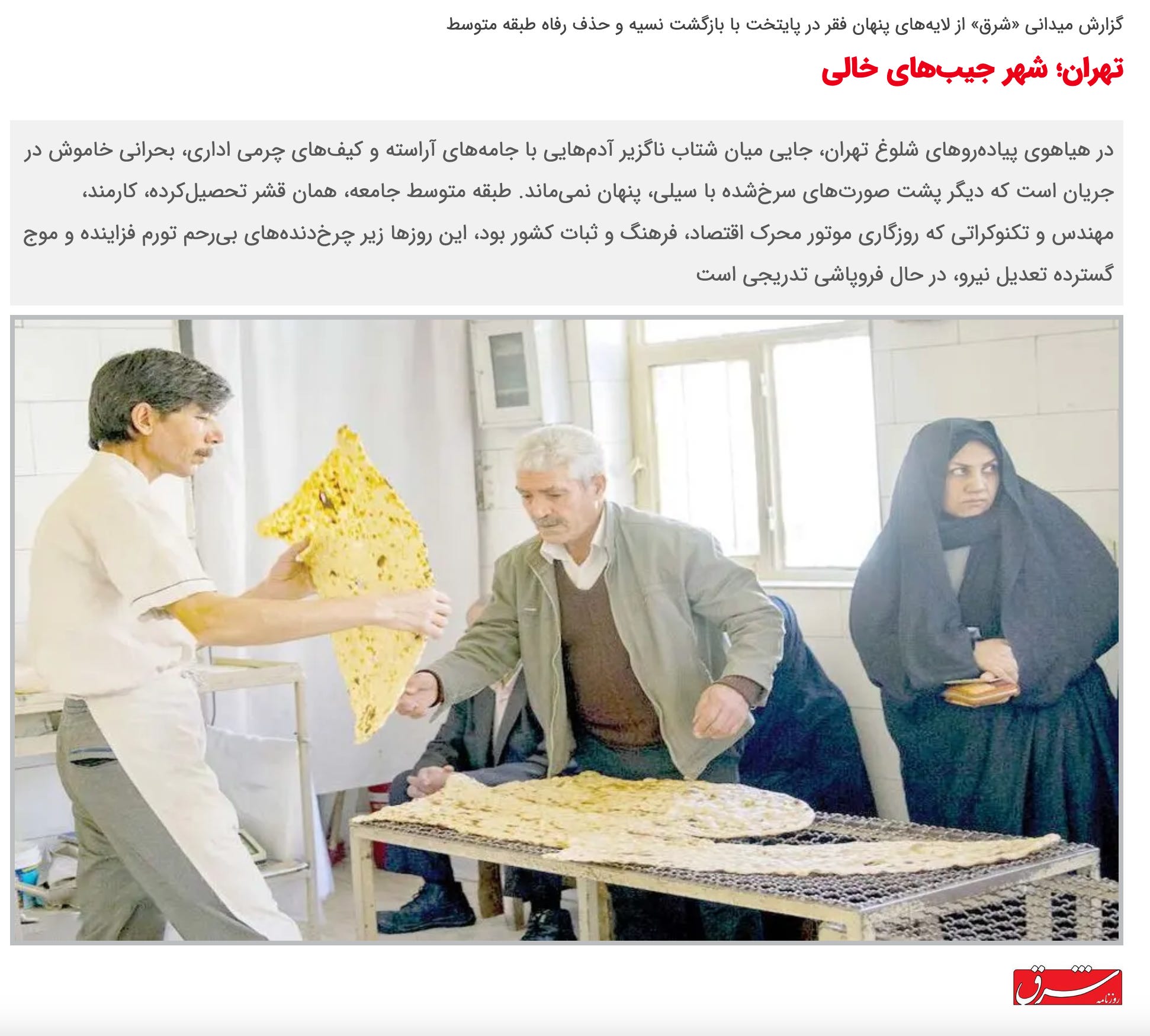
Tehran: A City of Empty Pockets by Reyhane Joulaei published on May 30, 2026 [9th of Khordad, 1405]
In the bustle of Tehran’s crowded sidewalks, somewhere amid the unavoidable rush of well-dressed people with leather office bags, a silent crisis is unfolding that can no longer be hidden behind faces reddened by a slap. The middle class, that same educated, employed, engineer and technocrat stratum that was once the driving engine of the country’s economy, culture and stability, is these days in the process of gradual collapse under the merciless gears of rising inflation and widespread waves of layoffs. The shopping basket of this class, which was once a symbol of relative prosperity, has now been reduced to basic, survival-oriented items, and worse than that, an old but forgotten phenomenon called “hesab-e daftari va nesiyeh” [an informal “buy now pay later” system based often on the relationship of trust between customers and shopkeepers in a neighborhood. In the translation, I use “credit ledgers”] has returned in a modern and a more painful form.
A salary that doesn’t last to the end of the month
To understand the situation of the middle class, there is no need to examine the complex statistical charts of the Central Bank; it is enough to sit and talk with couples who for years ran their lives with careful planning, but today find themselves in a complete dead end to make ends meet.
One of Sharq‘s sources in central Tehran offers a clear picture of this economic fall. He and his wife are both employed and educated and have lived under one roof for years. In a tone mixed with exhaustion and longing, he speaks of the past years when their method of managing their expenses worked: one person’s salary was entirely spent on rent and part of loan installments, and the other’s salary covered daily expenses, food and household comfort.
According to him, they lived this way for years, and although they had no meaningful savings, with a little frugality, proper prioritization and living within their means, they made their money last to the end of the month and did not taste the bitter experience of absolute poverty. Now, however, the equation has completely changed. Today, two full salaries are not enough to cover one month’s expenses for this two-person family. The reason is clear: on one hand, the price of all basic and non-basic goods is growing rapidly on a weekly and daily basis, and on the other, their income has remained fixed. This employee says: “Our workplaces in recent months have been hit by a widespread and merciless wave of layoffs. In the current insecure job environment, the fact that we have managed to keep our jobs and not join the ranks of the unemployed is something we thank God for a thousand times a day.” According to him, this very fear of losing even this trickle of income has caused them to give up any thought of requesting a raise, objecting to frozen wages, or bargaining for benefits. Accepting the existing conditions is the price of job survival. The result of this situation is that two civil servant salaries practically only last until the second week of the month. After two weeks, the bank account empties and they are left with two weeks to get through until the next payday. During this time, they must either reach out to others and borrow money, or get by with exhausting hardship and austerity. It has reached the point where this employed couple has completely given up using their personal car or taxis to get around the city. They walk long distances to metro stations and prefer to use the metro, which costs very little, because in the final two weeks of the month, there is not even money for a few liters of on their bank card for some liters of gas.
Shared credit tabs
This bitter account is not limited to these individuals alone. On the other side of the city, Maryam, a young woman who years ago migrated from a provincial town to Tehran hoping for education and a better future, and who has since found work, has a similar story but from a different angle. She shares a home with two other young women and says that a few weeks ago, for the first time in her life, she was forced to go to the neighborhood supermarket and take a can of tomato paste and a bottle of cooking oil on credit , a difficult and hard to believe experience for her. In the management system of this rented home, so that the financial burden of purchases does not fall on one person’s shoulders, and so that the supermarket owner does not object to the high volume of credit requests, the housemates decided to divide the list of household necessities among themselves. Maryam brings the oil and tomato paste on credit, another housemate takes a few packs of bread and cheese on credit from a different shop, and the third gets beans on credit. This modern division of labor is the survival strategy of three educated young women in the metropolis of Tehran. Maryam explains that even before the recent wave of inflation, they barely managed to cover rent and food purchases with their salaries, but with the sudden surge in rents in the new year and wages remaining unchanged, they have officially entered a crisis. The situation worsened when one of the three, right after the Nowrouz holidays, was laid off and fired from her workplace. Now the burden of her food costs has temporarily been divided between Maryam and the other housemate, until she can find a new job, which so far, given the severe stagnation of the job market and the wave of layoffs, has yielded nothing. This model of communal living, which was once an opportunity for independence and progress for educated young people in the capital, has now become an emergency rescue network whose members lean on each other solely to avoid drowning in a whirlpool of expenses.
The return of the ledger
The geography of buying on credit is no longer confined to the traditional and low-income neighborhoods of the south of the city; [our] investigations show that east, west, north and south Tehran are equally confronting the phenomenon of the return of credit ledgers in supermarkets. One veteran shopkeeper in east Tehran who manages a local supermarket says that even before the new year, people came to buy on credit, but since the beginning of this year, this has become a serious and daily problem for tradespeople. What is shocking in this shopkeeper’s words is the identity of those seeking credit. He says: “Giving credit [to customers] always existed, but you could tell from a person’s appearance that they were not in good financial shape. Now, however, people are stretching out their hands for credit who have been loyal customers of the shop for years, people who previously made large, quality purchases and never had any financial discussion with the shopkeeper. Now these same people, with immense shame and embarrassment and eyes fixed on the ground, resort to well-intentioned lies to preserve their dignity. Phrases like ‘I forgot my card at home,’ ‘the banking network is down,’ or ‘I’ll settle up tomorrow’ are the refrain of a middle class that has no money. They take their shopping, disappear for a few days out of embarrassment, and finally at the end of the month, when they receive their salary, they clear their account or they wait and hope that something might come through.” This shopkeeper emphasizes that if you saw these people in the street, given their well-dressed appearance and respectful behavior, you would never believe they were stuck for 500,000 tomans’ worth of basic daily groceries. The appearance is middle class, but the pocket and the bank card are empty of money to cover bread and cheese. Based on this shopkeeper’s experience, the credit shopping basket of the middle class has completely transformed, shifting from comfort goods toward survival-oriented items such as beans, bread, eggs and canned goods. Every day the number of these customers grows, and the seller clearly understands that these visits stem from outright poverty and the disappearance of the ability to pay cash.
Stealing tuna
Inflation has not only activated the credit-buying sector, but has also brought with it wider social harms, such as the growth of petty thefts from shops. This east Tehran shopkeeper recounts that the figures for theft of small food items have risen sharply. Among these, tuna cans, due to their small size and relatively high price, have the largest share in shop thefts; people hide them in their pockets or under their clothes and leave, and no one notices their absence until the shop’s inventory is checked. He continues: “I understand people’s circumstances. When I see someone is genuinely in need and takes bread or a can, I don’t crack down and I look the other way. But the number of these thefts got so high that economically it was no longer worth it for me either. I was forced to collect all the tuna cans and put them on the shelf behind me, out of customers’ reach. But I still put the breads outside the shop so that if someone is truly hungry and has no money, they can take one.” He goes on: “A few days ago a young man, with a completely tidy and student-like appearance, came into the shop and, with hesitation and a stammer of shame, requested two packs of bread and three eggs on credit. The young man could not even raise his head, and in a trembling voice offered to leave his bank card or ID card as a guarantee with the shopkeeper until he brought the money at the start of the month. I told him, go, son, there’s no need for documents. If you have it, come at the beginning of the month, and if you don’t, consider it a gift. But my question is: as a small local shopkeeper who is himself under the weight of inflation and srent, how many people can I treat this way?”
Asking for half a loaf
The situation in the capital’s bakery trade is no different from the supermarkets. One baker at a bakery in central Tehran speaks of a new phenomenon. He says that with the official rise in bread prices, some customers, who are clearly from the employed and civil servant class come in and request “half a loaf” or a piece of bread, because they do not have the money for a full loaf of sangak [the kind of bread pictured above]. Others resort to different methods; for example, they take five loaves but when paying by card or settling up, they say they took four, so they pay a smaller amount. This baker also points to a change in the behavior of charitable donors. In the past, charitable city residents would, as the expression goes, “donate the oven” so that all the neighborhood’s people could take free bread; but now donors leave sums of money with the bakery to be given only to those who cannot afford to buy bread and are requesting credit. That is, the charity distribution system has also become targeted and directed at the naked poverty of the middle and lower classes, so that the buyer’s dignity is preserved in the neighborhood.
Buying fruit by the piece
Another part of this field report concerns the produce markets and fruit shops of various areas of Tehran — a place where the change in the middle class’s consumption behavior shows itself in its most naked form. A fruit seller near Motahhari Street, where the presence of many private companies and offices draws a large number of employed and middle-class customers to this shop, offers a precise picture of this transformation. He says that buying fruit by the kilo or by the box has become but a memory for a large portion of this class.
According to this veteran shopkeeper: “In the past, employees and middle-class families, when they came to the shop after working hours, would buy at least one or two kilos of each fruit and their basket was full. Today, however, the shop’s digital scale more often shows weights under half a kilogram. Customers in pressed suits with office bags come in and say, ‘Please weigh me three apples, two oranges and two bananas.’ For example, I would say this batch is good, take more but using the excuse that there are few people at home and the fruit would go bad, they settle for just a few pieces. After a few days I realized there simply was no capacity to buy more.”
Impoverished employees
He points to the phenomenon of price-checking and abandoning baskets, saying: “Many customers first ask the price per kilo of fruit, work on their phones a little — as if doing calculations — take a turn around the shop, and in the end leave without buying anything. Prices rise so fast that a fixed civil servant salary cannot keep up with them. Even the phenomenon of taking fruit on credit has started. A long-standing customer whom I’ve known for years comes in and says I have unexpected guests and I’m short of cash, write down these few items of fruit and I’ll settle up at the end of the month.”
Another fruit seller in west Tehran points to increased demand for “mixed and second-grade fruit” from this economic class. He explains: “Previously, middle-class customers always looked for sorted and premium fruit, but now I’ve set up a section in the corner of the shop for slightly blemished or smaller fruit that is cheaper. What’s interesting is that the customers of this section are no longer necessarily the poor; rather, people with an employed and educated appearance spend long minutes sorting through the cheaper fruit to find the sound ones.”
When the engine of society shuts down
The consequences of this economic downfall go beyond changes in diet or the shrinking of the daily shopping basket. Sociologists warn that the elimination or severe weakening of the middle class means the disappearance of social balance and damage to the country’s cultural development. The middle class has always been an intermediary between the lower strata and the state, guaranteeing the stability of society through knowledge, expertise, and civic demands,. When this class is forced to submit to supermarket credit ledgers for bread, eggs and a few pieces of fruit, they will have no energy left to think about development, their children’s education, buying books, going to the cinema, or social participation.
Today, the credit ledgers of Tehran’s supermarkets, bakeries and fruit shops are a perfect mirror of an economy that is barely holding on to its respectable, capable and educated layers. A class that once had aspirations of progress, saving to buy a home, and improving quality of life, is today caught up in the geometry of daily purchasing and surviving through the final two weeks of the month. This slow, dignified, and profoundly painful fall at the heart of the capital is a serious warning to policymakers who are looking for simple and ineffective solutions such as support packages and meager subsidy credits.

See for example Niloufar Hamedi’s latest piece also in Shargh newspaper: https://www.sharghdaily.com/fa/tiny/news-1106820
Thank you for your important work Naghmeh joon, please don't stop :)