
The Little Sister Facing the Big Brother
What power does everyday peace have when Big Brother is not on its side?

Can a society survive if its citizens lose the ability to live alongside people they oppose?
This is increasingly not a philosophical question for people in Iran but one as vital (or even more vital) than “daily bread,” argues Dr. Maryam Nasr-Esfahani, a feminist philosopher and ethicist, and a member of the faculty at the Research Center for Human Sciences and Cultural Studies in Tehran.1
While Iran in the Western press is once again shunted into a limited set of topics such as geopolitics, conflict, and regime survivability with a smattering of economic desperation thrown in for good measure, Dr. Nasr-Esfahani begins her talk (given in the fantastically named “The Weight of the World” bookstore) in Tehran with the following words:
“This talk is not about war and peace in a military context. It makes no claims about that. Besides, we fundamentally have no agency in that story.”
What follows though is not a portrait of darkness but a reflection on polarization, reconciliation, and possibilities of a democratic life. Her central metaphor, and the title of her speech, confronts the “Big Brother” of power, surveillance, and ideological conformity with the “Little Sister,” i.e. those who quietly preserve social peace through everyday acts of dignity, empathy, and solidarity.
Although rooted in contemporary Iran, this essay speaks far beyond it as it reflects on how societies fracture and how they heal through our ability to recognize the humanity of those with whom we profoundly disagree.
I am grateful to Dr. Nasr-Esfahani for providing me with the text of her speech, which has not been published elsewhere, and giving me permission to post it here.2 This translation is produced as part of an effort to engage with a wide spectrum of perspectives and analyses published inside Iran. I invite you to read them, incorporate them into your understanding of Iranian politics, and help distribute them widely.
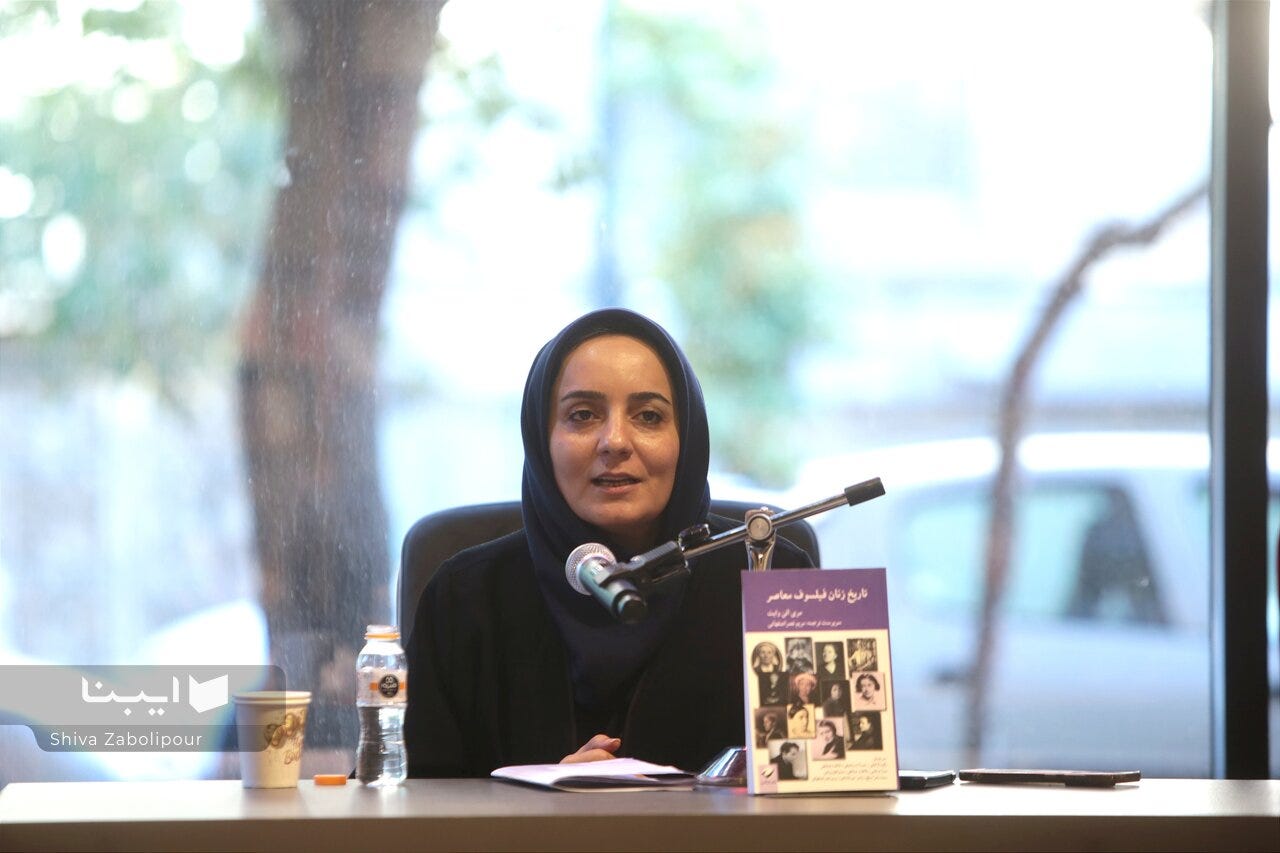
This is an abridged text of Dr. Maryam Nasr-Esfahani’s speech given on May 26, 2026 at Vazn-e Donya [the weight of the world] bookstore in Tehran, organized by Siyasatnameh magazine and Saray-e Ulum Ensani [House of Humanities]. To read the entire text in Persian click here.
“The Little Sister Facing the Big Brother” by Maryam Nasr-Esfahani3
This talk is not about war and peace in a military context. It makes no claims about that. Besides, we fundamentally have no agency in that story.
In scholarship on “practical wisdom,”4 Muslim philosophers place collective acts of worship under the topic of “kindness” [محبت] in society. Today, which happens to be the Day of Arafah [the apex of the Hajj], these kinds of gatherings for dialogue and mutual understanding about the complex post-war conditions in [Iranian] society can serve that very function of creating kindness, which is a necessity today.
Why did I start with kindness versus hatred [نفرت]? Allow me to bring a few quotes from official and unofficial media that point to the hatred-filled state of current relations.
A hardline presenter on Channel Two of Iranian state television, reacting to a comparison of internet conditions in Iran with the testing of 5G internet in Afghanistan and the start of international credit cards in Syria, said: “If these things matter so much, go and live there. Go buy wide tape from Amazon in Syria with a credit card and tape your windows for when the bombing starts.”
A well-known reformist figures, referring to intellectuals who had spoken about the horrific economic conditions ahead, said that if they do not have the courage to defend the Islamic Republic they should “shut up.”
On the other side, a university professor outside Iran, referring to the nightly street gatherings in condemnation of the war, which had taken on a carnival-like atmosphere in which wedding ceremonies were also taking place, wrote on his Facebook page:
“Like stray dogs and cats mating in a corner of the street, with a dowry of one copy of the Holy Quran and one Shahed drone. They’ve even named it ‘Union with the Guardianship.’ A decent person gets married in a registry office, not by the side of the road under a streetlamp.”
Or this, from a well-known analytical news website:
“Imagine not knowing which house around you contains a zombie that alien beings want to eliminate at any cost. Now you’re worried that maybe the neighbor next door is also a zombie and we’re going to be killed because of them. And then these activated zombies also roam the streets every night... this is no longer a fictional horror story; it is the reality of our lives today.”
And these are just cases from media. A sharper language circulates among the people: in the metro, taxis and bus stops, in neighborhoods, shops, and even since last Dey [December/January referencing the protests and the brutal crackdown], within families. The polarization of society has seeped into the home.
We have fallen into a kind of invisible, banal sectarianism [فرقهگرایی نامری یا روزمره]. During the painful events of Dey, we saw that this everyday sectarianism can easily be exploited and transformed into hard and violent sectarianism. Orders come from outside the country to take to the streets and seize military centers, and a group of people who feel like second-class citizens take to the streets and what happened, happened…
The reconciliation I want to talk about concerns the relationships full of anger and hatred that exist within society. To quote Javadi-Yeganeh [a sociologist at the University of Tehran]: based on national surveys, society has split into two groups, neither numerically larger than the other. But each considers itself to be in the right and considers the other to be mercenaries. Reconciliation in this society is more essential than daily bread.
We expect the initiative for reconciliation to come from the authorities. But what is their understanding of it?
A philosophy professor on X: “As a philosophy teacher I address those on the side of the revolutionary discourse: let us open our arms to those who have stepped off the train of the revolution. With kindness, let us open our arms for the return of the ‘Mahsas.’” [Mahsas here refers to the participants and the supporters of the Women, Life, Freedom movement or the Mahsa movement named after Mahsa Amini.]
Then a sociology professor responded: “Why don’t we ask the ‘Mahsas’: what have you sacrificed for Iran? Why don’t you open your arms to the bereaved mothers of martyred veterans? Why don’t you sit at the Zahra lamentation gatherings? They [the martyrs] gave everything for Iran; why don’t you set aside your pride and admit your mistakes toward these authentic and historically great forces?”
I am shocked. Do they know who Mahsa was? Mahsa and the Mahsas who are no longer alive.
This is our rulers’ understanding of reconciliation. Disagreement in our society still has no legitimacy and is called “sedition.” The statesmen’s understanding of “consensus” [وفاق] — the slogan with which they won the majority vote5 — is apparently of the same nature. Reconciliation to them means: let us get on board too. It means continuation of the status quo without grumbling, and acceptance of things as they are.
In this view, the authorities are the older brother of the family, the wisest of all, who must take care of everyone, and to whose judgment the rest must submit. Orwell’s Big Brother governs through intense surveillance and control: personal relationships, food, clothing and, crucially, language, in order to eliminate critical thinking. Today, with digital spaces and the media waves directed at Iran from outside the country, we understand this better. Big Brother predicts and directs behavior through data. Under the name of “benevolence and security,” he destroys the most basic principles of individual freedom.
This view sees society as a body with a commanding head and obedient limbs. It does not tolerate disagreement, diagnosing it as deviation and sickness that must be treated, or, when incurable, amputated. Farabi regards his ideal city as a healthy body led by the philosopher-head, and uses the expression “uprooting weeds” for dealing with incorrigible disorder. In this view, we are defined in opposition to the other, even if we live in the same country, and even if we consider our own neighbor a “zombie.”
Modernity offered a different vision: society not as a single body with one brain, but as a body politic, a constructed community of individuals who, based on a social contract, have decided to live together. We have still not reached this consensus.
John Paul Lederach introduces two fundamental dimensions for lasting peace: vertical peace and horizontal peace.6 Vertical peace concerns power relations between state and people, elites and masses. Horizontal peace concerns relations between people themselves: neighbor with neighbor, colleague with colleague, brother with sister. Lederach emphasizes that without horizontal peace, vertical peace cannot last. Even the best political agreements collapse if human relations are not repaired.
In our society, after a grinding war with two military phases and one domestic phase, Big Brother is finally thinking about making peace among the big brothers. He wants all the limbs to speak with one voice.
But the Little Sister in her child’s school, in the street, the apartment, and the workplace, confronts a different, hatred-filled reality every day. She sees the family quarrels, the ostracism of the veiled student in her classroom, the lying and hypocrisy of colleagues who submit to anything to survive, and the ideological litmus tests that push those who think differently to the edge of dismissal.
We Little Sisters, at the lowest parts of the pyramid, are worried. The apex is caught up in a fierce war that in two rounds took thousands of innocent lives and by encouraging urban warfare destroyed thousands of young lives in Iran. Meanwhile, the volatile social and economic conditions keep us in a state of constant alarm.
What should we do? Keep quiet? Should we just watch how humiliation causes hatred and hatred creates violence? Covert sectarianism has become so powerful that any expression of opinion brings a flood of insults. Going along with one faction, or saying nothing, might be easier.
But I think the choice for many of us is not comfort. That is why we have gathered here. I want to invite us to talk about the effort of the Little Sister, the effort toward horizontal reconciliation, which is difficult, long, full of labels, and without any medal or honor.
Theoretically I draw on Roger Mac Ginty, specialist in “everyday peace.”7 But practically, the experience of the women’s movement in Iran from the Constitutional Revolution to the present day offers a good model for thinking about everyday reconciliation.
What power does everyday peace have when Big Brother is not on its side?
A few days ago, my husband and I saw a serious accident on the highway in which one of the parties was a woman without a headscarf. I said: what if the police don’t help her because of her hijab? He laughed: “Don’t worry. This police officer’s own wife and family probably wear hijab the same way.” That is where the power of everyday peace lies.
Everyday peace includes the actions, ways of thinking, and strategies that ordinary people in polarized societies employ to coexist. Mac Ginty focuses not on diplomacy but on individual behaviors, friendship networks, and shared environments: the bus, the bakery, the apartment stairwell. He introduces three strategies:
Strategic civility — this is not mere courtesy; it is a great “no” to the logic of Big Brother. The little sister says to the opposing other: “However much the structures of power try to make you appear as a ‘traitor’ or a ‘zombie,’ I recognize you as a human being with rights and dignity.” Strategic civility is the brake that prevents society from falling into naked violence. It is embodied by the one who, despite political difference, is not afraid of having her patriotism confiscated, and writes about the suffering of the children of Minab just as she wrote about those killed in Dey. Sometimes it is as small as a smile in response to a gaze full of hatred. Sometimes it is the presence of unveiled women at the nightly gatherings — an act of bridge-building that costs nothing and means everything.
Resistance through normalization — disrupting structures that want to keep us in permanent crisis. Big Brother needs a “permanent state of exception” to justify his surveillance. The power structure wants to make everything political — your clothing, your shopping, the music in your earphones. The little sister’s response is the deliberate depoliticization of spaces. This resistance insists on everyday life even when they want to force her to shut down her online shop because it is wartime, or mock her for buying a VPN configuration to post pictures of herself going to cafes. The little sister wears colorful clothes and seeks out ways to gather cheaply and with empathy: novel reading circles, film watching, any collective idea. This peace does not issue manifestos or organize large gatherings. It passes under Big Brother’s surveillance radars precisely because it is quiet. It creates the image of living with the “other” in a secure future; what Lederach calls “moral imagination.” The little sister practices it by breaking the isolation of the veiled girl in her class, by befriending a colleague who does not think like her, by talking with the opposing neighbor about the building’s garden.
Micro-circuits of solidarity — the effort to stitch together the torn body. Big Brother blocks large circuits of solidarity such as parties, NGOs, independent gatherings so that society cannot organize voluntarily. The little sister responds by building micro-circuits woven into the fabric of neighborhoods and everyday relations: networks for helping people who have been harmed, regardless of their beliefs. When the power structure draws the blade of polarization and tears the fabric of society, the little sister on the ground, with threads and needles of micro-solidarity, stitches the wounds. These circuits are so small and human that no software can classify them as a threat but they are the greatest antidote against social collapse.
Horizontal peace needs a 20 to 50-year horizon. Big Brother resolves crises with deadlines and suppression. The little sister, with everyday patience, weaves the ground of the future. Mac Ginty attacks top-down engineered peace as opportunistic, mechanical, and unsustainable; it smells not of peace but of domination.
The little sister’s insistence on keeping life normal is not indifference or carelessness. It is deep philosophical resistance. When she still wears colorful clothes despite the heavy shadows of crisis, walks in parks with friends of different types, finds cheap entertainment, keeps everyday humor alive, she is making peace. The one who buys an expensive VPN configuration and writes about her daily routines, or sells her handmade goods, is promoting life.
Big Brother sees society as a single body with one brain, and every dissenting voice as a threat. The little sister sees society as a contractual body where different individuals who, despite their differences, have agreed to build a common peaceful destiny. In this body, difference is not deviation but the natural reality of collective life. Reconciliation is not submission but conscious cooperation for the collective good.
This cooperation is not commanded and has no intention of making everyone the same. It comes from within everyday conversations, from friendships with different people, from small acts of forgiveness. No one should be eliminated because they are different. We must be able to live together.
Everyday peace is the last tree we can make a vow at to preserve the life and beauty of society, and yet it can also be the first tree that multiplies peace and contributes to the consolidation of lasting peace.
During the war, Prof. Alireza Doostdar translated a short lyrical essay by her, which I posted on this site under the title “On Ordinary Life.” If you missed it, you can read it here.
Her talk was covered by Iran Books News Agency here. [In Persian]
Author’s note: Family metaphors are among the oldest metaphors used to refer to power relations, because the family is the first place where we experience power dynamics and being under authority. Disagreement over whether such analogies are legitimate dates back to the time of Plato and Aristotle. In Politics, Aristotle argued that because civic relations exist among free and equal men, it is not appropriate to use these metaphors. Nevertheless, even today—and in contemporary Iran—we continue to use family metaphors to describe power relations, a practice that has been the subject of serious feminist critiques.
Jean-Paul Ledrac’s use of the metaphors “little sister” and “big brother” is not exempt from these criticisms. At the same time, because these relationships are familiar to audiences, and because George Orwell’s “Big Brother” is widely known, these metaphors were used in the lecture to convey the main idea more quickly and effectively within a limited amount of time.
Aristotelian phronesis or knowledge of what is good and what is bad.
Reference to the campaign promise of Masoud Pezeshkian during the presidential election campaign of summer 2024.
A look inside the true and deep Iran, not the one described by so called leaders, daily journalists, and X attention grabbers. I'm grateful for your discernment, your acts of bravery and the lovingness with which you choose to see reality.