
Today’s War, Tomorrow’s Inflation
The Iranian economist, Mohammad Maljoo on the ceasefire and the main cost of war that lies ahead

On March 24, 2026, President Trump announced that the US put forth a 15-point ceasefire plan to the Iranian government. “President Trump does not bluff, and he is prepared to unleash hell,” Karoline Leavitt said the next day, if Iran rejects the proposal. Iran rejected the proposal. Even a week before such a proposal had been announced, Iran’s foreign minister, Seyyed Abbas Araghchi in an press conference in Iran had said: “When we say we don’t want a ceasefire, it’s not because, for example, we’re looking to continue the war but it’s because this time the war should end in a way that our enemies don’t think of repeating these attacks and invasions again.”
According to the independent news agency HRANA, by March 25, 2026, the Iranian civilian toll of this war has reached 1,464 people (including at least 217 children), military fatalities at 1,167 people with 669 fatalities unclassified (i.e. unclear if civilian or military.) They also report that “the Israeli Minister of Defense, regarding the country’s operations against Iran, stated that so far, more than 15,000 bombs have been dropped on Iran. This number is four times the amount used in the 12-day war.”
Meanwhile Iran is still in an internet shutdown, with those who want to connect having to jump through many hoops, and/or paying a high cost to break through the Islamic Republic of Iran’s communications shutdown using black market methods.
Yesterday, the economist Dr. Mohammad Maljoo was able to post multiple pieces on his telegram account, one of which used talk of ceasefire to “call for rethinking the concept of ‘resilience’,” a term often used by the Islamic Republic to celebrate Iran’s ability to withstand US and Israeli bombings and attacks. Maljoo’s rethinking expands the horizon past the short term and looks at the medium and longer term ways in which the war is undoubtedly going to reshape the structure of Iran’s fragile economy.
What follows is Dr Leila Faghfouri Azar’s translation of the text. Dr Faghfouri Azar is a Lecturer and Research Fellow in Legal Theory at the University of Amsterdam. The translation is produced as part of a collaborative effort to engage with perspectives and analyses published inside Iran. I invite you to read them, incorporate them into your understanding of Iranian politics, and help distribute them widely.
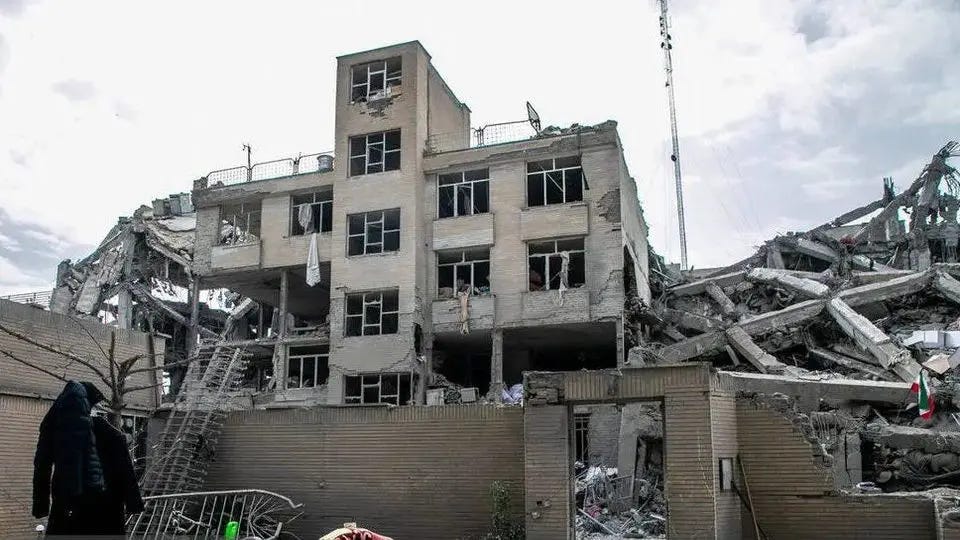
Today’s war, tomorrow’s inflation
If the ceasefire decision is left to the military alone, it will inevitably be based on a narrow, short-term view of reality. From a military perspective, only two main factors stand out: military resilience against attack and social resilience to war damages. What remains overshadowed are deeper economic and institutional dynamics, which not only shape the capacity to sustain war today but also the quality of peace in the postwar future.
The problem is not merely that war damages the economy. War reshapes the structure of the economy as well. Iran’s economy, which is already confronted by structural constraints, war intensifies a vicious cycle: reduced production, rising public spending, and a weakening capacity for social reproduction1. This cycle stems not just from physical destruction but also reflects disrupted expectations, chronic uncertainty, and accelerated capital flight.
In such a situation, the government’s budget becomes the main site of the emergence of crisis. On the one hand, war and support spending surge sharply. On the other hand, the pillars of government revenue, including taxes and exports, shrink and become more volatile. This gap pushes the government towards ever more costly forms of finance: borrowing from the central bank, squeezing the banking system, or using future resources in advance. The result is a far sharper rise in liquidity than before and, as a consequence, inflation at levels not seen in Iran’s modern history.
Yet inflation does not remain only an outcome of this process; it becomes a mechanism that reproduces this very crisis. High inflation in the years ahead will push the economy deeper into a self-reinforcing cycle of instability.
This setting calls for rethinking the concept of “resilience.” Resilience is not just the ability to endure pressure now. It also refers to a society’s capacity to absorb shocks and rebuild itself over the medium and long term horizons. A society that endures war in the short run but then faces destabilising inflation, collapsing purchasing power, and rising uncertainty cannot claim sustained resilience. It has only delayed the crisis.
This picture reveals a key analytical gap in military decision-making: a mismatch in time horizons. Battlefield success or failure is usually judged in the short term, whereas economic consequences, particularly inflation, emerge later and over the medium term. This may invite a strategic mistake: prolonging war on the basis of immediate signals while overlooking the main costs that still lie ahead.
Deciding on a ceasefire should therefore be seen as a question of “intertemporal optimisation:”2 a decision that requires balancing the costs of continuing the war against the economic and social costs that follow. This means that ending the war should not hinge solely on current military attrition. It must also weigh the risk that the economy may cross critical and irreversible thresholds after the war.
From this vantage point, a ceasefire does not remain a mere military move. It is a political and economic choice with profound distributional effects. It determines how, when, and on whose shoulders the costs of war will fall.
Therefore, involving economists, social policymakers, and representatives of diverse social groups in this process is not merely ornamental, but a necessary condition for making a decision that determines the timing of a ceasefire not only on the basis of military and social resilience, but also on society’s capabilities for viable postwar futures.
Here social reproduction refers to refers to processes through which economic and social inequalities, class structures, and behaviors are reproduced across generations.
مسئلهٔ بهینهسازی بینزمانی