
Understanding Pro-War Sentiments Inside Iran
A longer read to sit with this weekend

I often get asked why a visible segment of Iranians abroad support the US/Israeli war on Iran. For me, that’s not the enduring question. The question is: Why did some Iranians inside Iran support the war? Why do some continue supporting it and what can we understand about social and political dynamics inside Iran if we focus on that?
The extent and nature of the US/Israeli attacks have made the divisions between the pro and anti war segments of Iranian society feel like a chasm that cannot be bridged.1 BBC Persian recently released a video of testimonials highlighting how attitudes towards the war had wrought tensions inside families. One man noted that this division had led him to stay away from his family around the time of Nowrouz, the single most important holiday in Iran.
As more scholars, thinkers, and writers inside Iran connect to the internet using incredibly expensive proxy configurations, we’ve seen more engagement with these questions. For them, the domestic support for war is not just an intellectual puzzle but at the heart of Iran’s future once the bombs stop falling. The puzzle starts at one word: istisal.
As I’ve written elsewhere, istisal translates into desperation or helplessness though in its current usage in Iran, the meaning is far more layered and comprehensive. It was the predominant way that people described their dire conditions leading up to the December/January protests, and then their sense of grief and despair after the government killed thousands of protestors after Jan. 8. It has now become the focal point for understanding pro-war sentiments in Iran in the lead up, and into, the war.
For today’s weekend read, I have connected two texts. In the first, posted by the sociologist and researcher, Dr. Hesam Salamat on his instagram and Telegram channels, istisal is framed as a political issue that has “penetrated to the very marrow of each of us.” His use and conceptualization of it is based within discussions of the ongoing war, but is pulling from its pre-war connotations.2
That pre-war connotation is reflected in the second piece, a newspaper article from Payam-e Ma, published on February 22, 2026, titled “Society in the Vortex of Istisal.” The issues laid out in this piece from 6 days before the war have only been exacerbated. In thinking about the long term effects of this war, we should also consider how it has destroyed, I hope temporarily, non-violent solutions to Iran’s deep and systemic problems.
Because istisal is now a concept that carries a specific historical, social, economic, and political connotation, I have left it untranslated but feel free to think: desperation or helplessness every time you read it below.
This post is part of a collaborative effort to engage with perspectives and analyses from inside Iran. I invite you to read them, incorporate them into your understanding of Iranian politics, and help distribute them widely.
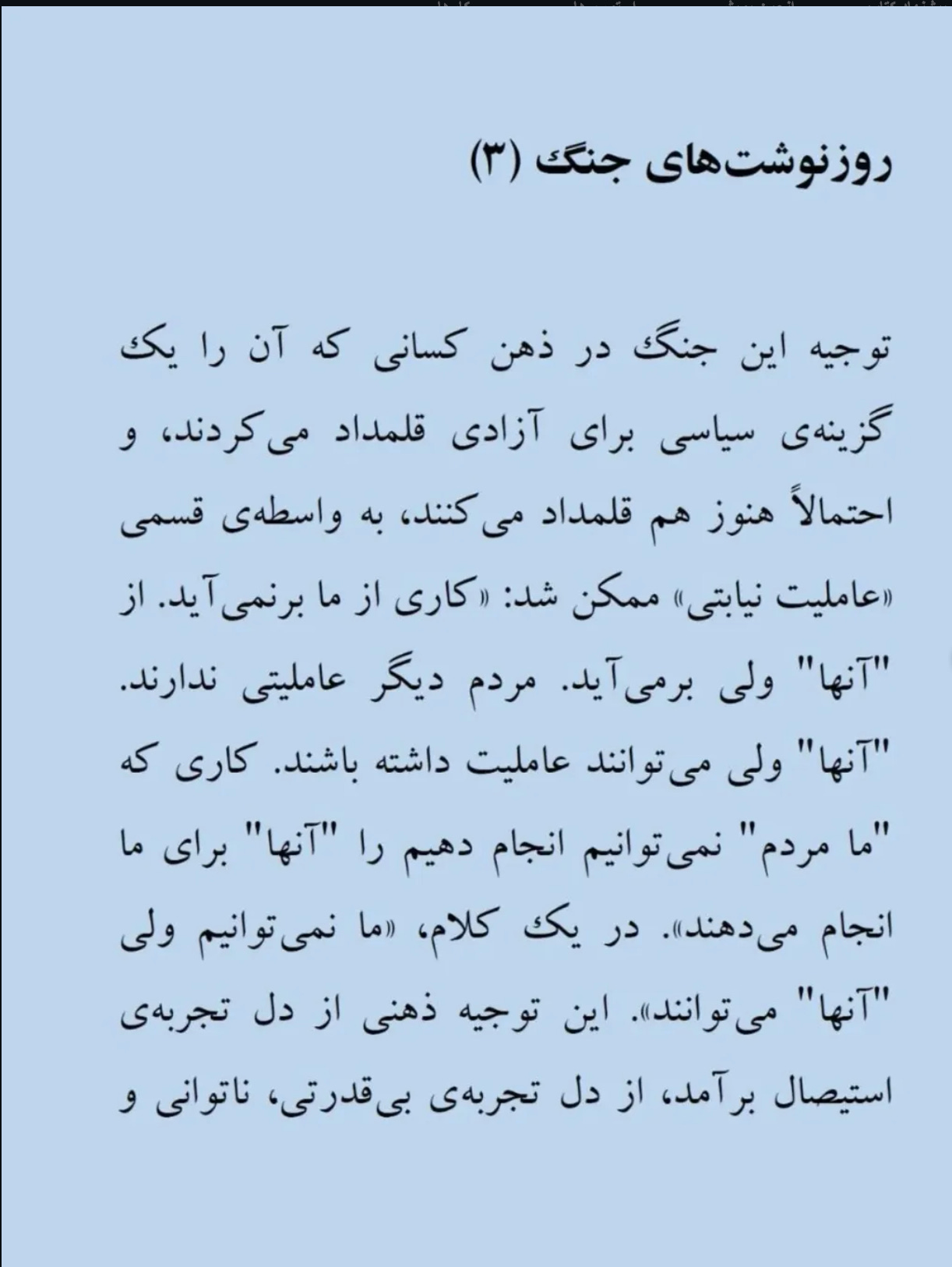
“War Meditation 3” by Hesam Salamat, April 1, 2026
The justification of this war in the minds of those who considered it a political option for freedom, and likely still do, became possible through a kind of “proxy agency:” “There is nothing we can do. But ‘they’ can. The people no longer have agency. But ‘they’ can have agency. What ‘we the people’ cannot do, ‘they’ will do for us.” In short: “We cannot, but ‘they’ can.”
This mental justification emerged from the experience of istisal, from the experience of powerlessness, incapacity, and ineffectiveness. The issue of istisal today is a political issue. Overcoming istisal and reclaiming the capacities and agency of the people is equally a political matter. But the problem cannot be solved with a simple “we can.” The experience of istisal has penetrated to the very marrow of each of us in different ways for each person. All of us have lived the reality of istisal. All the “it didn’t work,” “we failed,” “we were left behind,” “we reached a dead end,” and “we couldn’t” have been lived through again and again to their fullest extent, and have become part of our collective memory as “memories of istisal.”
We need an immensely widespread movement, the birth of a passionate collective spirit, precisely in this moment of decay and death, one that, through mobilizing all these wounded bodies, troubled souls, and denied lives, calls for reclaiming the people’s capacities and power. The rising of Iran from the depths of its present exhaustion and breathlessness depends on the will for freedom. It is the uprising of a “nation” to rediscover its “self.”
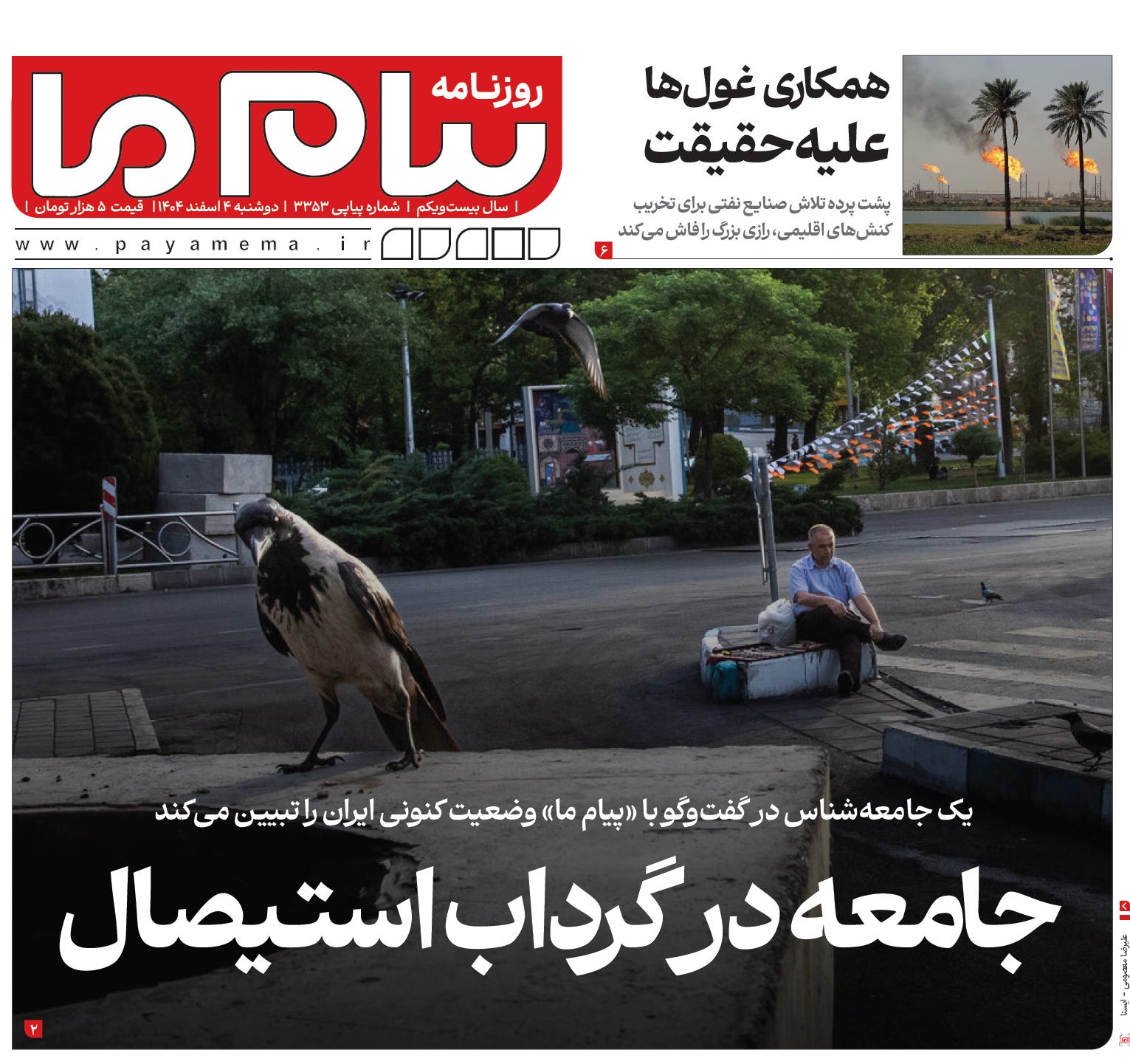
“Society in the Vortex of Istisal,” by Yasir Mokhtari in Payam-e Ma newspaper, 4 Esfand 1404 (February 22, 2026).
These days, Iranian society has entered a kind of “social istisal.” This condition, which had existed in various forms for a long time, has intensified with the events of Dey 1404. This situation brings a kind of inaction, despair, and social isolation that can lead to citizens’ indifference toward the condition of the country and society.
Social istisal is a state in which a large segment of society feels it has lost the ability to influence its own destiny, and that individual or collective efforts do not lead to improvement. The roots of the concept of social istisal lie in the theory of “learned istisal,” first introduced by the American psychologist Martin Seligman in the 1960s. He showed that when individuals repeatedly face uncontrollable situations, they gradually come to believe they have no control over outcomes and give up trying. Later, sociologists extended this idea to the collective level and used it to explain feelings of powerlessness and istisal on a social scale.
Istisal is closely related to the idea of “social anomie” from Émile Durkheim, in which weakened norms and institutional distrust intensify feelings of powerlessness. Robert Merton also shows that the gap between social goals and the means to achieve them can lead to collective istisal. The consequences of this condition include reduced civic participation, increased social indifference, and erosion of social capital.
In recent years, numerous studies have addressed issues related to social istisal. Some research conducted since 2017 has reported findings such as alienation, despair, distrust, and feelings of istisal among social groups. For example, the study “Hope and Hopelessness in Iranian Society: A Case Study of Students at Tehran Universities,” published in 2023 in the journal Iranian Cultural Research, reported a lack of collective hope and a tendency toward migration. Another study titled “Structural Challenges and Social Anomie in Iran,” published on the ninth of Dey this year in ASA Degisi, using the concept of anomie, shows that the weakening of shared norms, structural inequalities, and the gap between social expectations and economic realities have led to increased public distrust and a sense of collective powerlessness in Iran; a situation that can reduce social participation and erode social cohesion.
The simultaneity of structural crises
Hossein Imani Jajarmi, a sociologist, in an interview with Payam-e Ma about the causes of the emergence and intensification of this current social istisal, considers the starting point of his analysis to be simultaneous attention to major economic, social, and political variables. He says: “Iranian society in recent years has faced the simultaneous occurrence of several structural crises: economic stagnation or very low growth, widespread unemployment—especially among the young and educated—chronic inflation, continuous decline in purchasing power, and the effects of sanctions. The combination of these conditions has made daily life difficult for a large portion of the population and has taken away the possibility of long-term planning from individuals, households, and institutions.”
He emphasizes: “When people cannot predict their economic future and do not see a clear prospect for improvement, the feeling of uncertainty gradually turns into a collective experience.”
According to this sociologist, the absence of a clear economic outlook is largely tied to ongoing international restrictions and the shadow of sanctions: “In such an environment, even domestic policies are less able to create hope for rapid improvement, and this contributes to the formation of a kind of general perception of ‘deadlock.’ This perception is not merely subjective, but rooted in people’s everyday lived experience.”
He goes on to point to the political dimension of this istisal and says: “Low participation in the presidential election two years ago and increasing dissatisfaction with the performance of executive institutions are signs of weakened social capital and public trust. When citizens feel that promises are not fulfilled and that there is no effective mechanism to influence major decisions, the gap between society and the power structure widens. This gap manifests itself in distrust, withdrawal from political participation, and a sense of individual ineffectiveness.”
Imani considers the generational gap to be one of the key factors intensifying this situation and explains: “The new generation has grown up with a different lived experience: broad access to social media and the free flow of information, smaller families, apartment living, and weakened traditional extended family ties have all created different expectations and values. This generation wants to be heard and to participate more in determining its own fate. Formal mechanisms have not yet fully adapted to these changes. The result of this mismatch is a sense of exclusion and deadlock among part of the youth.”
Consequences of living in a state of istisal
A faculty member at the University of Tehran, referring to the psychological and social consequences of living in a state of istisal and suspension, says: “A society cannot live for long with chronic anxiety and a sense of insecurity without this condition affecting individual and collective behavior. The increase in certain risky behaviors, the decline of social hope, and the erosion of trust-based relationships are among the likely consequences of such conditions. When this experience becomes shared among millions, it can no longer be explained merely through individual solutions or psychological counseling; it must be elevated to the level of the ‘collective spirit’ and social conscience.”
Referring to protest events in recent years, he describes the overall trend of developments as concerning and says: “Since the late 2000s, each wave of protest has been accompanied by higher levels of tension and violence. One of the main reasons for this trend is the weakness of formal channels for expressing demands and for effective dialogue between society and the government. Additionally, the limited circulation of political elites and the restricted participation of various social groups in decision-making processes have led parts of society to feel excluded from the sphere of politics.”
According to this sociologist, many current issues are tied to political decisions, while these decisions are often made without broad participation and public dialogue: “The way out of this cycle is a serious reconsideration of the concepts of participation, citizenship, and the distribution of power. The more people are involved in managing public affairs, the more rational, transparent, and aligned with public interests decisions will be, and consequently, social commitment to those decisions will increase.”
Regarding how to repair the gap between people and the state, he explains: “Criticism of current policies does not necessarily mean indifference toward the country’s fate. Many citizens may disagree with certain policies yet still feel a sense of belonging and responsibility toward their country. Even if political agreements or economic improvements occur in the future, repairing the trust gap requires a conscious and long-term plan.”
Strengthening civil institutions and expanding social dialogue
Imani recalls the experience of other countries in overcoming similar situations and says: “Societies that have faced deep political divides have usually managed to rebuild trust through strengthening civil institutions, expanding social dialogue, and using governance knowledge.”
In his view, governance is a specialized field that requires the use of scientific and expert capacities along with broad citizen participation, in such a way that no group feels excluded and everyone considers themselves part of the collective destiny.
Referring to studies on quality of life, he notes: “Iranian society, in periods when it has benefited from stronger expert management and more constructive interaction with the world, has shown progress in human development indicators. This experience shows that improving quality of life and increasing social satisfaction is possible, provided that policies are oriented toward public welfare, reducing inequalities, and making effective use of domestic and international capacities.”
This sociologist emphasizes: “There is no simple or immediate solution to the current situation. However, initiating a broad social dialogue can be an important step. Yet the polarization of society and the weakness of civil platforms have made this dialogue difficult and have pushed many into silence. Nevertheless, overcoming the sense of collective istisal will not be possible without strengthening civil institutions, expanding real citizen participation, and gradually rebuilding social trust. This is a time-consuming process, but only through it can the shadow of uncertainty be reduced and a more stable outlook for the future be created.”
The US/Israeli attacks are targeting and destroying storied and important places such as Pasteur Institute, “a leading global center for infectious disease research, microbiology and vaccine development” since 1920, Mehrabad airport, opened in 1938 and the site of immense historical importance for generations of Iranians, and cultural heritage sites in Tehran, Isfahan, and numerous other places. Over 3500 people have been killed. Over 150,000 residential and commercial units have been demolished. Over 700 schools hit. The list goes on.
I highly recommend reading Dr. Salamat’s open letter to Bahareh Hedayat, which I published under the title On the Catastrophe That is Shut Up to get a sense of his worldview.
Thank you Naghmeh
Merci 🙏🏾