
Which Iran is America dealing with?
You'd know if you could, for the love of all that is holy, stop recycling tired old frameworks

“A Jungle of Power” is what The Economist wrote above its April 19th, 2026 article, with the subtitle: “With talks set to resume, rivalries among Iran’s leaders could stymie a truce.”
I’m sorry, but the late 90s called and want their headlines back. So did the early 2000s and the 2010s.
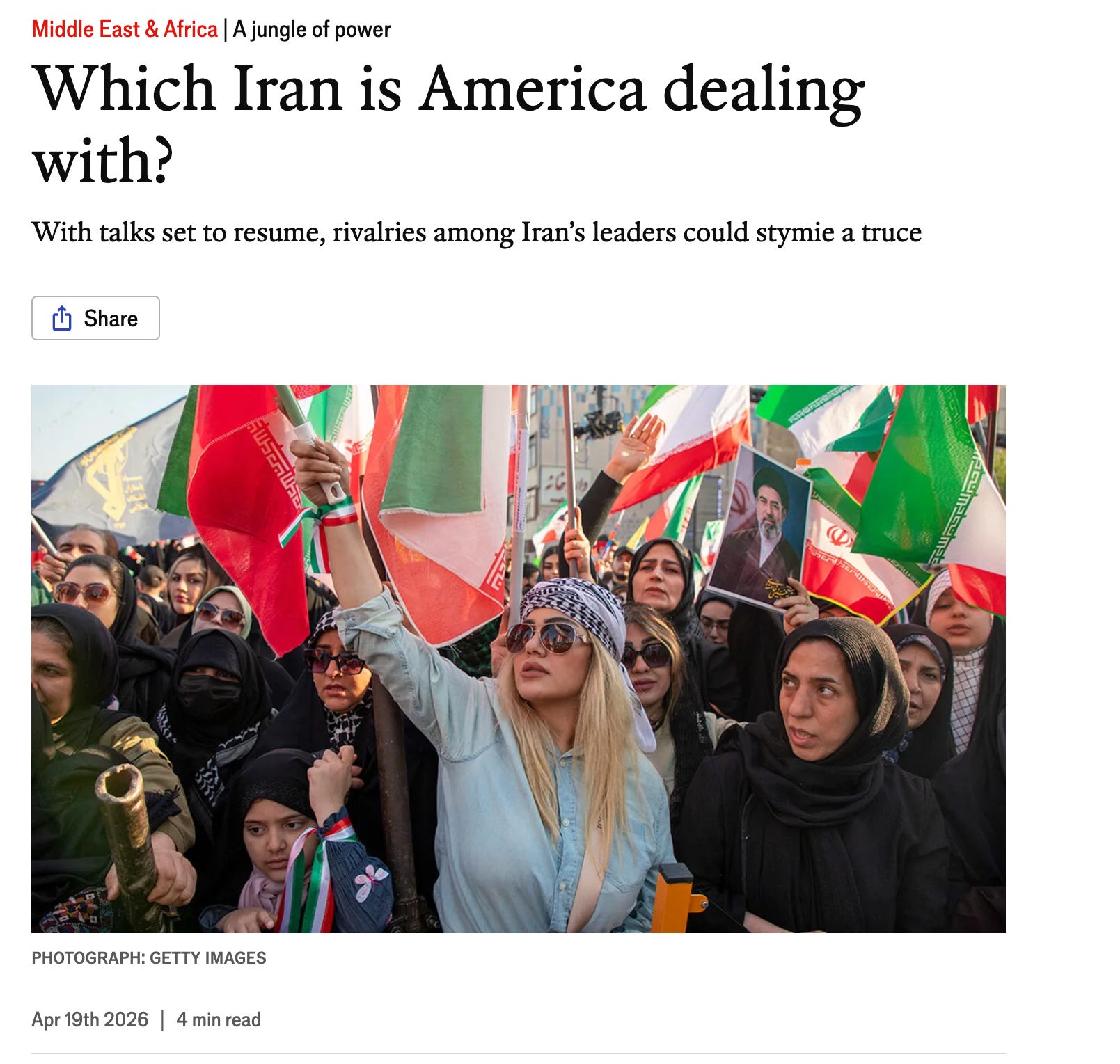
There seems to be a widespread understanding in and outside Iran that the US/Israeli war on Iran that began on February 28 was a turning point both in Iranian history and Iran’s regional and global relations. It’s a war that has set off a chain of events that continues. Yet it was a war whose consequences, and even its shape, could be and were to some extent foreseen. Post-revolutionary Iran was and is a multi-nodal, decentralized political system where, if you were interested in the facts and not wishful thinking, there was little doubt that it would not fall just because Ali Khamenei was taken out. The “Supreme Leader” fell, and the edifice did not come crashing down as pundits for decades had speculated it would, because it’s a political system built to protect the system itself and not just one person, even if that one person has the name “Supreme” attached to him. Ironically, of course, this was never part of his or his son’s title in the constitution or in Persian anyway. Rahbar and valiye faqih, the Persian monikers for this political office, translate into “leader” and “guardian jurist,” clearly far less useful terms for the English-language press than “Supreme Leader.”
If anyone is supreme in this scenario, it’s these pundits who constantly are wrong and yet somehow see no need to course-correct, let alone hold themselves or be held accountable. It reminds me of how, some years ago at a US think tank, I said the problem with policy analysis here is that something happens in Iran, the analyst says something, they’re wrong, then next time again, the same media, same think tanks, the same platforms ask them again for their analysis. Rinse, recycle, repeat. I was told I had hurt some feelings and an apology would be appreciated.
If this war, which is not over yet, was a turning point, should it not also be an opportunity for pundits, their editors, and the press to just take a breath and ask: maybe we need to tweak how we talk about Iran? It’s not a big tweak. Just change the frameworks and models used in the 1990s for several decades that have not produced correct insights. Just acknowledge history. Is it too much to ask?
Take, for example, the current stampede to read the negotiations’ tea leaves through Iranian infighting and disagreement. As one analysis put it: “Regime factionalism affects external behavior. The Iranian system is beset with factionalism. Decision-making requires consensus; therefore, the number and complexity of these factions, combined with the individual reluctance and inability to make decisions, make it very difficult for the system to change course or to make significant decisions.”
Wait, sorry, this was from 2009.
“The Domestic Politics of Iran’s Nuclear Debate: Leadership Divided?”
No, sorry, that’s from 2014.
I could go on with articles from the 1990s and onwards, but I won’t. You get the gist.
The issue is not, in any shape or form, whether there is disagreement in Iranian decision-making. To say otherwise is to deny reality. But the Iranian political system is not one that tries to hide its political differences. Disagreement is built into the political system itself, as are attempts at consensus decision-making.
The third headline in The Economist’s “A Jungle of Power” jumble is “Which Iran Is America Dealing With?” This notion that a “healthy” Iranian political system is one with a united front is a fiction created by outside pundits in order to keep their plug-and-play analyses going. It’s an ironic fiction, since disagreements over the direction of policy are valorized in other places, such as in the US and in Israel. You don’t send over 70 people to negotiate in Islamabad if you think people with various stakes and opinions are a sign of weakness. (Though I will admit, I was a bit taken aback when I learned the US negotiating team was 300 people. I got asked by journalists multiple times how I understand why 70 people were sent to Islamabad by Iran. Not even once was I asked about the 300-member US team, but I digress.)
The issue at hand is the meanings we assign to the sometimes intense disagreements in the Iranian decision-making bodies. In the current decade’s game of let’s talk about infighting and factionalism amongst Iran’s political elite, the intended or not result is to assign or predict blame for a possible failure to reach a deal and the restart of the war. If the negotiations come to naught, then it was the infighting that made it happen. It was because, to quote the US president, “the infighting is between the ‘Hardliners,’ who have been losing BADLY on the battlefield, and the ‘Moderates,’ who are not very moderate at all (but gaining respect!), is CRAZY [sic].”
In other words, this framework allows us to ignore the realpolitik of how this war was started, why this war was started, and the ways in which the nature of this war has limited the possibilities of negotiating a new deal, a deal that the US did away with in 2018, by focusing on a familiar punditry bogeyman: Iranian infighting and factionalism.
It is enriching to hear the views of Iranian historians such as Naghmeh Sohrabi and Vali Nasr. It is incredibly unfortunate that we are only seriously consulting them now that reality is not conforming to these preconceived notions. It is the lack of curiosity and, above all, indifference that has turned the war in Afghanistan into a 20-year disaster. Moreover, beneath this prevails the old and dusty idea that a reality can be imposed without examining the underlying conditions. Thank you!
Whenever I read US analysis of Russia and Ukraine I have exactly the same feeling of rinse, repeat, recycle. Great read thank you.