
How Parastoo Ahmadi’s Concert Became a Tale of Obscenity in Iran
Translations of 4 perspectives from Iran

On December 11, 2024 [21 Azar 1403], Parastoo Ahmadi, a twenty-seven-year-old singer, released the Karvansara Concert (Caravanserai Concert), on her Youtube channel. She stood on a stage with three musicians in the middle of the courtyard of a disused caravanserai, situated between Tehran and Qom, singing for 27 minutes without any audience present. The Iranian social media and print media exploded with people sharing the video across various channels. Parastoo and the musicians were arrested three days after and then released on bail. The caravanserai was closed, and two government officials were fired. On June 18, 2026, more than two years later, Parastoo and eight other people in the concert team were convicted for offending public decency and were sentenced to three punishments: banned from any artistic activities for two years, banned from leaving the country for two years, and flogging of 74 lashes. Their sentences have once again thrown the concert and Parastoo Ahmadi back in the news.
Due to the ways in which this case has reignited debates about women’s rights and their bodies in the aftermath of the Women, Life, Freedom movement in Iran, the role of art in the Islamic Republic, notions of decency, and the severity of the Islamic Republic’s response to this two-year-old case (in the context of the state’s ongoing escalation of violence towards the population in the midst of war and post-war negotiations), today’s substack includes 4 different perspectives on this topic from Iran. While much of the coverage has focused on the severe sentences and women’s solo singing in Iran, as the pieces below demonstrate, the issue is far more layered.
In the first piece, I asked Rahaa, the director of an art institute in Tehran (whose heartbreaking diary of living in Tehran during the latest US/Israeli war on Iran was published by Boston Review)1 for her reaction to the Parastoo Ahmadi case. Her analysis focuses on the limits and possibilities of art, and art by women in Iran today. This piece has not been published elsewhere.
The second piece by Mohsen Borhani, a well regarded lawyer and legal scholar in Iram, was published on December 17, 2024, in Etemad Newspaper, three days after Parastoo Ahmadi’s arrest. Borhani’s articlec is distinct from other legal writings on this issue as it discusses the complexity of the Iranian legal system and the minute details on applicability of the Islamic Penal Code to the case.
The third piece is a translation of a thread on X social media site by Aboozar Zaman, one of the defense lawyers in the Parastoo Ahmadi case, which summarizes what happened at court, how the verdict was reached, and the sentence issued.
The fourth piece is a translation of a widely shared Instagram story by Tahmineh Monzavi, the photographer of the Karvansara Concert, who was also convicted in the case.
The last 3 pieces were curated by Prof. Zeinab Azarbadegan, assistant professor of History at Yale University who also translated all four texts. Her more extensive analysis and commentary is also included at the end of this post. This post is produced as part of a collaborative effort to engage with perspectives and analyses published inside Iran. I invite you to read them, incorporate them into your understanding of Iranian politics, and help distribute them widely.
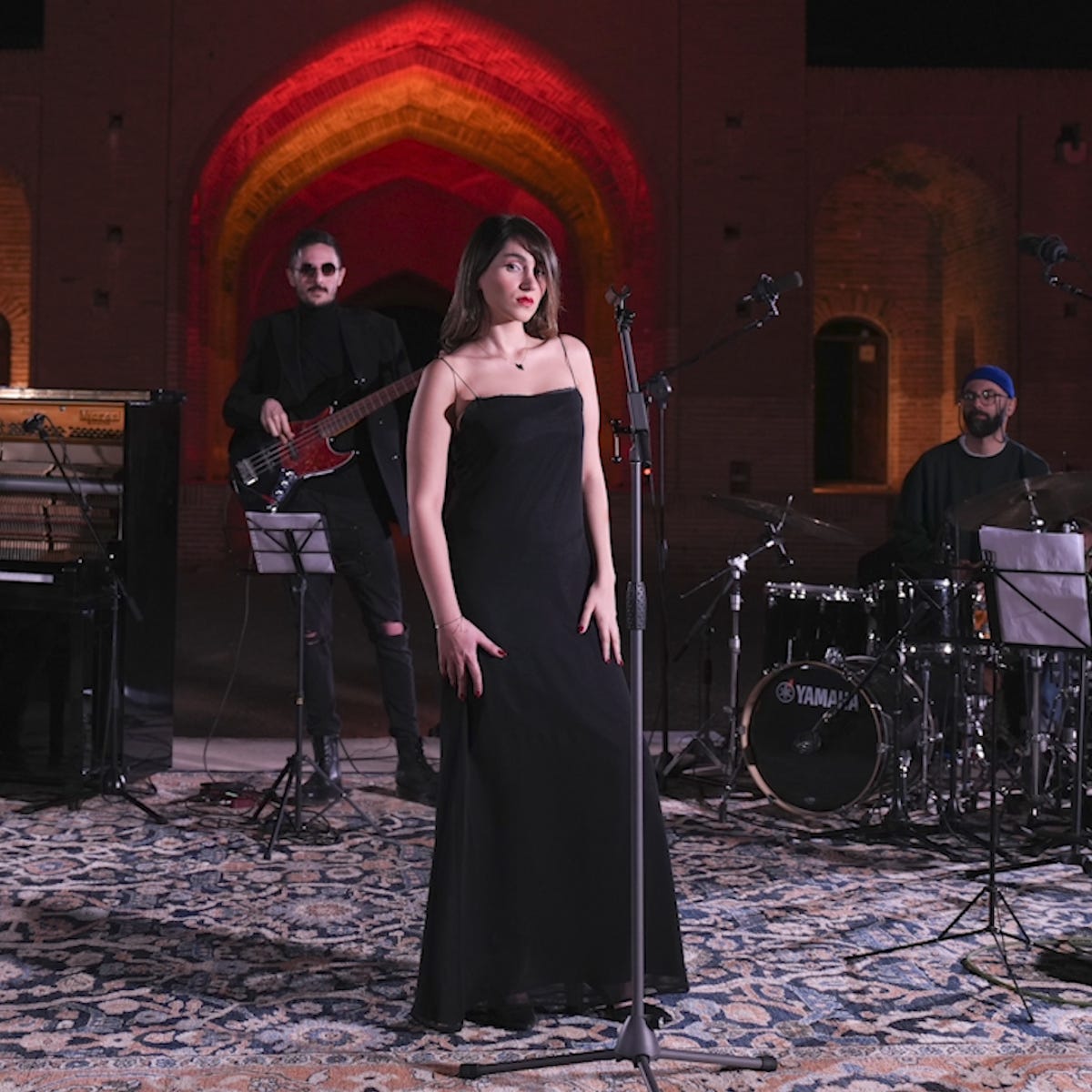
1.Parastoo Ahmadi
by Rahaa [pseudonym of the director of an art institute in Iran]
She is made for the stage. She knows singing postures well and she is courageous. She has no qualms to express herself in the language of singing, utilizing her body language to express herself well. She is flirtatious and art cannot exist without flirting and coquetry. Parastoo Ahmadi knows gestures well and is good at performance and [being on] stage. Maybe this is intrinsic to her and she has not learned it from anywhere or [maybe] she has polished it so much in her own privacy that she doesn’t show any anxiety or lack of mastery while she is on the fretful and fearful stage of the caravanserai, committing “an unlawful act.” There has been no opportunity, in these woeful circumstances of no performance by women in Iran, for an artist to learn, to see, to emulate or to criticize, to model after, to be compared with [others], and to attempt improving. Parastoo Ahmadi is courageous despite the circumstances and whatever means she has put up in her performance. Parastoo understands the performance on stage better than most people who are on it.
There were rumors on social media a few days after her performance and subsiding of the collective shock at such an impressive performance in an enchanting and unbelievable setting; that “they have done it themselves2, how is it possible to have such high-quality camerawork and stage lighting and no one would find out. Wasn’t there Googoosh3 that [former president Akbar Hashemi] Rafsanjani’s son helped out of Iran? This one must have inevitably colluded with them too.”
Maybe, or maybe not. The arrest of the team and their quick release did not alleviate the doubts, rather it made it worse.
All of this does not diminish Parastoo Ahmadi’s courageousness, audacity, and volition; sometimes even selling yourself for what you want and is a “must” for you, is a difficult and praise-worthy task. Parastoo Ahmadi has carried an extra burden too: preparing herself for the public arena without the existence of any public arena means paying a high price that clearly she is still paying.
Although she is an artist and she used her art to express herself – how great would it be if we could only see her art from an art critical angle – but it is arduous to be a Middle Eastern artist and perform art for art’s sake and for the enjoyment you get for expressing yourself. In the Middle East, any artist in any act, whether she wants it or not, must carry the solidarity flag of a group of people (and in Parastoo’s case a large group). Otherwise, people will hardly be receptive to her. Without doubt, Parastoo was well aware of this Middle Eastern complexity while concentrating on her amazing performance, where everything – from the performance to wardrobe, gestures, and accompanying team – demonstrates she has accepted leadership of a large and popular movement, and of paying its consequences. She has redrawn the boundaries of expression under political suffocation.
Now, however, as the horrific war of America and Israel with Iran has stopped for the time being, it is the time to handle the internal situation. The disciplining and punishing of the country! As, in this war weary state, economically providing for the devasted people cannot properly keep totalitarianism in its place in the same way as repressive judicial actions. Now the remaining group of the government (state), those that have come out alive of the war, have cleared the dust from the closets of the criminal cases and have chosen a roughneck case [ZA: I kept the original to keep what Rahaa intended as both something significant but also rebellious] to make halal the sustenance stolen from people’s mouth. This case can continue to the end of the end of times in such a way that no one would even think of [committing] such audacity. Especially as caravanserais and heritage sites are not properly under inspection of the Cultural Heritage [Ministry] and are going through complete ruination. This is a good opportunity to spend the Iranian people’s money that is being released, to move it from one pocket to another and repurpose places such as heritage sites without considering their public ownership to gaudy and substandard theatres for performing music and arts. Their ownership would transfer from the public and go to those who will send Gheysar instead of Parastoo to the stage. [Gheysar is an LA based singer who returned to Iran and was allowed to perform in one of the major Tehran night gatherings during the 40-day war.]
But it cannot be easily forgotten that Parastoo took the initiative, took a risk, created a role-model. If we consider reform a better path from revolution in countries repressed by their governments, her act is a successful attempt at reform.
2.Women Singing and the Question of the Rule of Law
Mohsen Borhani (December 17, 2024, Etemad Newspaper)
One of the issues that demands contemplation and scrutiny from jurisprudential and legal perspectives is women singing and performing in public. For years, women have not been able to perform in this arena, as this sector of art by women has faced prohibition in Iran. Usually, the basis of prohibition in this case is cited to be the application of the Sharia. No license is granted for holding a concert with a woman singing based on the interpretation of prohibited behavior. Considering these applications and prohibitions, if a woman proceeds to sing, there is a possibility that her religiously prohibited behavior, lacking a legal license, would fall under some articles of the Penal Code. Therefore, it is important to deliberate on this case from jurisprudential and Sharia perspectives.
Contrary to many people’s perception, the prohibition on women’s singing voices is not a matter of jurisprudential consensus and incontrovertibility. There is no consensus in this matter by any means. On the matter of women singing, there are two different fatwas among jurists:
The first group considers hearing and listening to songs sung by women as fundamentally prohibited. This group of jurists imagines an identity between the women’s singing voice and ghina, thus issuing the fatwa on the prohibition of listening to women singing based on some Sharia sources.
The second group repudiates this identity between the women’s singing voice and ghina and believes that listening to women singing is not prohibited merely because it is done by a woman. Rather, if the song is an instance of ghina, then it is prohibited. But if the song sung by the woman is not an instance of ghina, it is not prohibited.
From this perspective on prohibition, there is no difference between men and women because if men sing in a way that is considered an instance of ghina, listening to that song is also prohibited. In this summary, the author is not in a position to judge between the two fatwas, but it is important to note that the second outlook is not an anomalous fatwa; rather, it is a widely known fatwa among jurists.
Taking into account the disagreement in the fatwas in this case, the question is why the decision-makers and issuing authorities, in creating and maintaining restrictions on women, follow the first fatwa. Which Sharia ruling is employed to place restrictions on women in society when there is a disagreement in fatwas on a case, and yet the basis of such restriction is referred to as the application of Sharia?
This plurality of different fatwas creates a suitable, and unfortunately neglected, capacity to approve the permissibility of women singing in Iran. It is true that the people who religiously emulate the first group of jurists should not be listening to songs sung by women from the Sharia perspective; but such listening carries no prohibition for those who emulate the jurists from the second group. This group of people has been deprived of something permissible without reason. Even more strange is the fact that women of this land have been deprived of art education and performing arts, which in its own right is definitely worthy of criticism.
In view of the introduction above, regarding the issue that has impacted the media landscape lately [namely Parastoo Ahmadi’s concert], it is important to offer a legal analysis with precision, so that no one goes beyond the bounds of the law.
Firstly, from a legal perspective, holding a concert, either actually or virtually, does not fall under any articles of the Penal Code. Basically, not obtaining a license and holding a concert without the permission of the appropriate authorities is not a crime. Therefore, neither the singer nor others have committed any crimes. In the Iranian legal system, there is no such crime defined by the name of “holding a concert without a license.”
Secondly, considering the jurisprudential introduction above, it cannot be argued that women singing is an instance of a “religiously impermissible action,” where, following such religious impermissibility, an individual is subject to Article 638 of the Islamic Penal Code. This is because the singer and the organizers can claim that they religiously emulate the jurists who do not consider singing by women religiously impermissible.
Article 638 states, “Anyone who publicly and in public presence and places, as well as passages, pretends to commit a religiously impermissible action will be subject to imprisonment for ten days to two months or up to 74 lashes in addition to the penalty of the action…” Considering the religious permissibility of women singing, there is no need to consider the beginning of the article, as the issue at hand is religious permissibility. The rest of this article also does not address women singing: “…and in case [a person] commits an act where the essence of that action is not subject to penalty but it has offended public decency, [the person] is only subject to imprisonment for ten days to two months or up to 74 lashes.” This is because the basis for offending public decency is judged according to custom, where the basis of custom is the average person in society. Currently, Iranian custom does not consider women singing an offense against public decency. There is at least uncertainty in this case, and a person cannot be convicted in the presence of doubt.
Following the same analysis, Point 3 of Article 640 of the Penal Code also cannot be applied. This is without even considering the fact that Point 3 only includes “objects,” and humans and their voices are not examples of an “object”: “…1. Anyone who for trading and distributing purposes shows and puts on public display, or creates or keeps, anything in general (including texts, sketches, gravures, paintings, images, newspapers, advertisements, labels, videos, film rolls) that offends public decency and morality… 3. Anyone who in any way publishes or puts on public display any of the aforementioned objects…”
Thirdly, women singing cannot be considered an instance of “providing for vice and corruption” so as to apply Article 639 to it. This article states, “Individuals described below are sentenced to imprisonment for one to ten years. In regard to Point A, in addition to the prescribed penalty, the respective place will be closed upon the Court’s decision… B – The person who encourages the public toward vice and corruption and provides the circumstances for it.” It was proved above that the action of women singing is religiously permissible, and a religiously permissible action cannot, by definition, be counted as vice and corruption.
It is fundamentally not possible to consider the act of singing and holding concerts without a legal license a crime, considering the aforementioned discussion. Rather, it is a behavior for which there is no criminal prohibition.
Perhaps the singer or some organizers of the concert did not observe the appropriate dress code and appeared in the concert without the Sharia-mandated hijab, or committed actions that are subject to one of the articles of the Penal Code. In that instance, their conviction would be legally sanctioned due to those behaviors and not due to singing and holding a concert.
The law must have the final say, both theoretically and practically. Restrictions and prohibitions should not be imposed on a large number of citizens unless those prohibitions are strongly rooted in either the Sharia or the law.
The imposition of prohibition and exclusion on women, and the deprivation of women from certain artistic arenas, should be reevaluated and reconsidered. The capacity created by the multiplicity of fatwas in this case should be utilized so that not only Iranian society, but the whole world, may see and praise the performance of Iranian women and girls.
3.Tale of an Ibtizal [Obscenity]: the Court Session Examining the Karvansara Concert Case
Aboozar Zaman (June 20, 2026, Thread on X)
1/ On June 9 (19 Khordad), I attended the court as the lawyer of three musicians in the music group for the concert by Ms. Parastoo Ahmadi, [part of a group of] 5 lawyers and 9 accused. The defense as usual started with the material and moral elements of the crime, the responsibility of each individual, and their aims and intentions.
2/ The judge seemed reasonable, logical, and argumentative. The discussion had heated up. The judge would make his comments and each of the lawyers would in some way defend their clients and show their opposition. At the end, the whole discussion focused on ibtizal (obscenity) and indecent images.
3/ However we could, we tried to explain that the images of the artist sitting next to us at court were not indecent images and that the content was not obscene. The judge insisted that image of a woman without the Sharia-mandated hijab is an indecent image.
4/ It had gotten to a point where we were discussing how much a woman’s body must be showing for it to be considered obscene and I was truly ashamed of why we should have this discussion in this day and age. I only saw art, beauty, and courage in that performance, but we had to argue over the extent of an artist’s hijab and the amount of her clothes.
5/ We had to talk about a custom which was different from what the judge had in mind. The sentence was issued. 74 lashes, a two-year ban on leaving the country, and a two-year ban on any artistic activity. The judge issued the heaviest sentence possible.
6/ These days, I keep remembering the faces of the artists present in the court and think why should there be a relationship between art, the artist, ibtizal, and flogging?
4.Tahmineh Monzavi (June 18, 2026, Instagram Story)
It was around 10 days ago. Qom. She kept turning looking at the clock on the wall. The defense lawyers were giving it their all with strong evidence. The argument on the limits of ibtizal was so heated that the lawyer read the definition of the word ibtizal from Dehkhoda [dictionary.]
Ibtizal
Definition and description:
Consuming something too much. Having clothes, meaning wearing clothes for work, daily. Contently using clothes and other than that. Desecrating and despising clothes || Losing and not keeping something, antonym of protection || Galloping of a horse
Exactly this simple, complex, and meaningless. The entangled words kept repeating themselves in my head. The session lasted for three hours and someone from the first row [in the court] with widely open slanted eyes kept turning her head, this time trying to be reassuring. From the lyrics of the songs, [such as] “From the Blood of Youth of the Homeland,” we had reached ibtizal and we were swinging like a pendulum between words that were not just. At the same time, I kept reminding myself of the beauty of the Karvansara, so I could endure those moments.
Now the result of all that beauty is a 2-year ban from art, not being able to leave the country, and 74 lashes for each of us.
Analysis by Prof. Zeinab Azarbadegan
As the news cycle is preoccupied with US-Iran war, ceasefire, and negotiations, Iranians have been dealing with the aftereffects of a court sentence regarding a case that started two years ago: The sentences given to Parastoo Ahmadi and her musical team for the Karvansara Concert.
The Karvansara Concert was released on YouTube amid increasing state repression of artists, especially singers in 2024. For example, less than a month after the concert, Mehdi Yarrahi, another prominent singer during the ‘Women, Life, Freedom’ protests, also received a punishment of 74 lashes amid public outrage. The sentence for the Karvansara Concert, however, is much more severe than what Yarrahi faced in 2024 despite the similarity in the penalty. As Dadban (a lawyers’ association inside Iran established to help people arrested for political reasons) has pointed out, the sentence not only affects Parastoo Ahmadi, the singer, but also eight other people involved in various capacities in organization of the concert, including the musicians, photographers, cameramen, stage managers, etc.
The coverage of the news around the Concert has also evolved. While in 2024, media inside Iran widely reported the concert and its aftermath, there has been a near total silence on the topic in mainstream media, due to a number of reasons, including the ongoing negotiations between Iran and the US to end the US-Israeli War on Iran.
People on social media have also pointed out the hypocrisy of the Islamic Republic’s treatment of Ahmadi and her crew by comparing their sentence to two other cases: first, the rape trial of the actor and former footballer, Pejman Jamshidi, where he was sentenced to 99 lashes—a punishment for extra marital sex and not rape. This is a mere 25 more lashes than the one affecting the Karvansara Concert organizers; second, the state media’s broadcasting of Julia Boutros, a Lebanese female singer, singing songs such as Ahibaii (My Loved Ones) in one of the nightly rallies in the streets of Tehran that have been going on since the start of the 40-day war. Ahibaii is based on a letter written by Hassan Nasrullah, the late Hezbollah leader, to Hezbollah soldiers during the 2006 Israeli War on Lebanon. This broadcast occurred as Iranian negotiators have linked the end of war in Iran to its end on all fronts, especially in Lebanon. It also happened a few days after the Karvansara Concert sentence was issued, further highlighting state hypocrisy.
I picked the three pieces translated above for the following reasons:
In the first one, Borhani elaborates on the difference between fiqh (jurisprudence), Sharia (divine law), and custom (‘orf) in defining qanun (state law). He points out one of the fundamental issues in trying to establish a legal system based on Shi’i jurisprudential practice is that jurists can issue contradictory fatwas (decrees) to each other, where all these fatwas are equally valid interpretations of Sharia. The question then becomes how to legislate state-wide laws based on Sharia, when multiple valid and contradictory interpretations of it exist? He then uses one of the bases of Islamic jurisprudence to delegitimize the decisions of the state to ban singing by women in public; that is the idea that no one is allowed to render impermissible what has been deemed permissible by God. So, if by some interpretations of Sharia something is considered permissible, a state-wide law should follow that interpretation rather than the stricter one that has rendered it impermissible. Criminal law in Iran is not only based on Sharia. In many cases it is customary. Borhani discusses the applicable laws based on custom, concluding that contemporary Iranian customs have no issue with the Karvansara Concert.
The second piece, Zaman’s thread on X, is a clear example of istisal, where what constitutes contemporary Iranian customs is reduced to a discussion of what is obscene and indecent in Parastoo Ahmadi’s clothing. Here a clear conflict is demonstrated between the judge’s definition of Iranian custom and the defendants and the defense lawyers’ definition of it.
The photographer of the concert, Monzavi highlights the disorienting experience of being in court as a defendant in such a case and how words have been rendered meaningless and actions misconstrued in the judicial system. The overwhelming focus on the definition of one word, ibtizal, which is usually translated as obscenity, demonstrates not only the malleability of what constitutes “custom,” but the instability of meaning of words and their definitions.
Finally, Rahaa’s piece, going beyond legal procedure, grapples with the role of the artist and artistic expression under political repression. She highlights the larger context of war, suppression of civil society, and art-washing of rampant corruption and hypocrisy among the remaining members of the Iranian state that will be further facilitated by the deal made between Iran and the US.
On a separate note, I published a piece in Bidoun about my grappling with Marjane Satrapi's Persepolis and how over the past decades, I've navigated my initial “shock of recognition along with an uncomfortable feeling of being misrepresented” when teaching the book. You can read it here.
https://www.bostonreview.net/articles/the-catastrophe-that-has-befallen-all-of-us/
Here and below them/themselves refers to the government or Iranian version of the deep state.
Googoosh, arguably the most famous female singer and performer in pre-revolutionary Iran, was only able to leave the country in 2000 to perform abroad for the first time after 21 years.