
January 1979 to January 2026
The editorial that shut down Ham-Mihan newspaper in Iran

On January 19, 2026 when the internet shutdown was still ongoing in Iran for the most part, Ham-Mihan newspaper was banned on orders of the government. The Press Supervisory Board cited two articles for the closing of the newspaper: An article by Elahe Mohammadi (best known in Iran and outside for their singular reporting for Ham-Mihan newspaper of Mahsa Amini’s funeral in Saqqez for which they were imprisoned for 17 months) titled “When the Sanctity of Medical Care Broke,” published on Jan 71 (the day before widespread protests, killings, and total internet blackout), and an editorial by the newspaper’s editor in chief, Mohammad Javad Rouh, published on Jan 15.
Aside from the two pieces cited as official reasons for the ban, the newspaper had been courageously publishing numerous pieces about the protests and their aftermath including reports from cemeteries and the Kahrizak Forensic Center, and on the fate of the thousands of arrested and injured citizens. At the end of their Instagram post about the newspaper shut down, Elahe Mohammadi wrote: “Hard days have gone by and everyone is dumbfounded; a country is in mourning, a country is choked up, a country’s heart is heavy.”
The text below is the aforementioned editorial by Mohammad Javad Rouh. He is a journalist who has served as the editor in chief of several reformist publications, all eventually banned. In 2013 he was imprisoned for 2 weeks as part of a broad press crackdown.2 The editorial uses the departure of the last Iranian monarch on January 16, 1979 to analyze the rise of support for the Pahlavi monarchy in the most recent protests, a question on the minds of many Iran observers both inside and outside the country.
The piece is translated by a colleague as part of a group effort to engage more actively with a wide spectrum of analyses and thought published inside Iran. You can access the Persian original here.
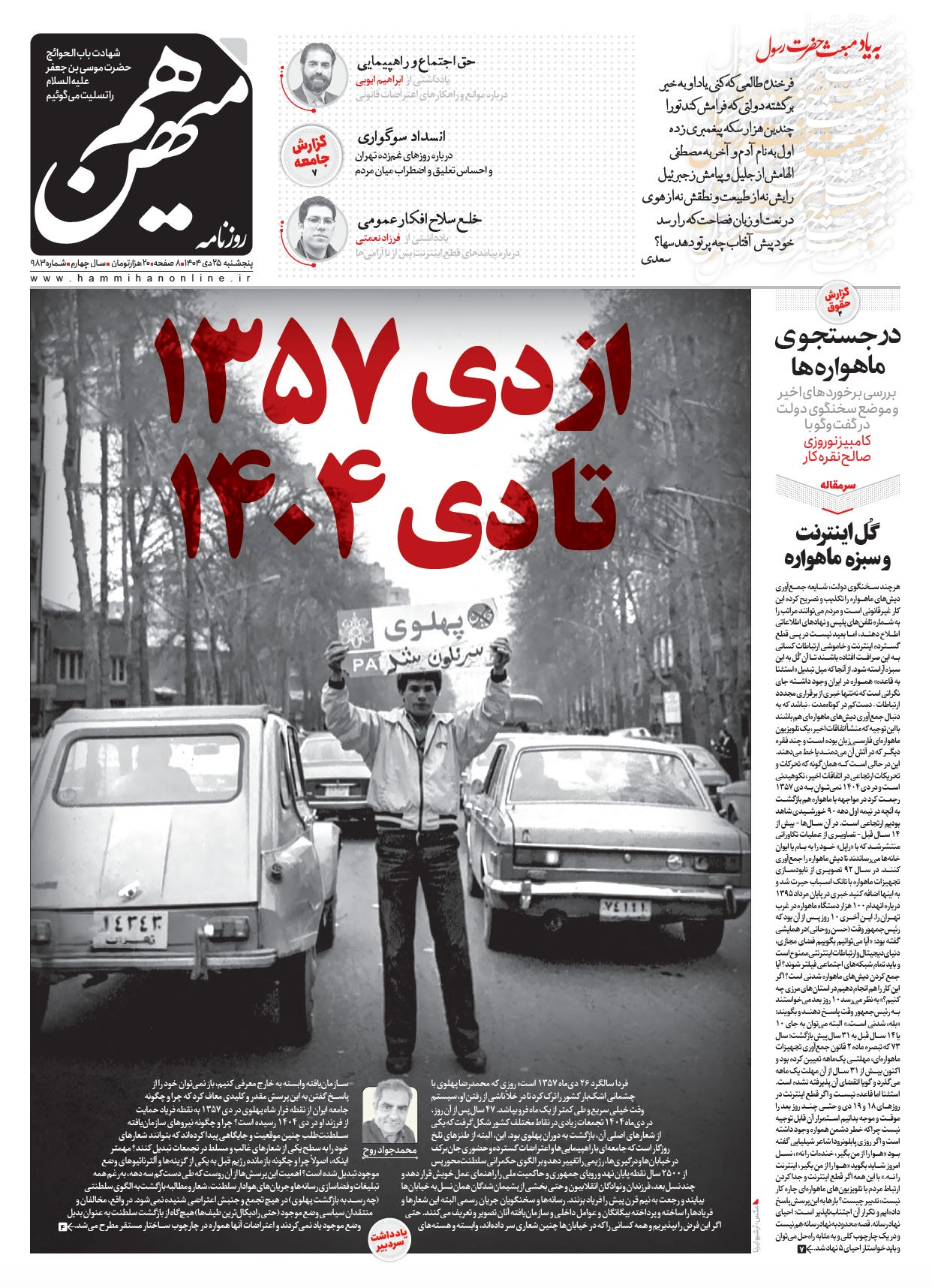
From Dey 1357 to Dey 1404 [January 1979 to January 2026]
Ham-Mihan Editorial
Mohammad Javad Rouh
January 15, 2026
Tomorrow is the anniversary of 26 Dey 1357 [January 16, 1979], the day Mohammad-Reza Pahlavi left the country with tearful eyes, leaving a vacuum in the wake of his departure that led the governing order to collapse rapidly, within less than a month.
Forty-seven years later, in Dey 1404 [January 2026], numerous protest gatherings took place across different parts of the country, one of whose main slogans was a return to the Pahlavi era. This, of course, is one of the bitter ironies of history: a society overthrew a regime through massive demonstrations, protests, and life-risking street mobilizations, erasing the monarchical model of governance, ending 2,500 years of monarchy, and adopting the dream of a republic and national sovereignty as its guiding principles, only for the children and grandchildren of the revolutionaries and even some of the regretful members of that same generation to take to the streets several generations later, calling for a return to half a century ago.
Of course, official media and spokespeople portray these slogans and cries as manufactured by foreigners and their organized internal agents. Even if we accept this assumption and consider everyone who has chanted such slogans in the streets to be affiliated with and organized by foreign-linked cells, we still cannot absolve ourselves of answering a more fundamental question: how did society get from the Shah’s escape in Dey 1357 to a point where, in Dey 1404, there are chants supporting his son? Why and how did organized monarchist forces acquire a position from which they can raise their demands to the level of a dominant protest slogan? More importantly, how did the remnant of the previous regime turn into an alternative for the existing order?
These questions are important because at least for three decades, despite all the propaganda by monarchist currents and their media, the slogan and demand for a return to the monarchist model (never mind the return of Pahlavi) were never heard in any gathering or protest movement. In fact, the political opponents and critics of the existing situation (even the most radical among them) never invoked a return to monarchy as an alternative. Their protests were always articulated within the framework of the reigning structure.
The events at Kuy-e Daneshgah [University of Tehran dormitories] in 1378 [1999] and the post-election movement of 1388 [2009] had explicitly political demands and content, but they did not contain even the slightest trace of monarchism. On the contrary, they were defined entirely within the framework of the existing system, and their demands extended at most to changes within governing and security institutions (such as the state broadcasting organization or the police), or to calls for annulling election results or condemning repression against protesters.
Even in Dey 1396 [January 2018], when slogans recalling the founder of the Pahlavi regime were heard, it was clear that these were marginal, minority slogans that had little standing even among protesters opposed to the political system as a whole. Likewise, Reza Pahlavi himself never carried significant weight or credibility even within the opposition abroad. Republican, nationalist, and even constitutionalist forces showed little inclination toward him or his circle and repeatedly subjected the record of the Pahlavis to criticism. Today, too, the former Shah’s son enjoys no substantially greater standing among opposition political forces. Even in recent days, figures from various opposition currents have criticized and rejected his capacity as a political figure—let alone as the leader of a broad social movement.
Nevertheless, at the level of society at large (at least among a significant portion of those who have taken to the streets in recent days), it is clear that the idea of a return to monarchy has become markedly more prominent compared to previous protests. At the international level as well, it appears that in the absence of an alternative force inside the country, and given the fragmentation of the opposition abroad, the most serious option available as a counterpart for dialogue and negotiations aimed at advancing the global radical right’s policies against Iran’s political system is the remnant of the Pahlavi monarchy.
Although street demonstrations cannot be taken as the sole criterion for analysis—since they do not encompass the silent majority of those who have entered the scene, nor those who oppose monarchist slogans and demands—at the same time, the growing prominence and dominance of monarchist slogans in recent gatherings cannot be ignored. Nor can the key question be left unanswered: why did we arrive from Dey 1357 to Dey 1404?
It seems that the answer lies in the strengthening of a sense, among a significant segment of society and the elites, of government weakness and the absence of a horizon within the existing structure. This feeling has intensified in recent years, especially after the United States’ withdrawal from the JCPOA, as a result of rising inflation and the deterioration of the infrastructures supporting citizens’ ordinary life. Global developments over the past two years—from the Middle East to Latin America—have further exacerbated this sense.
By contrast, a perception has taken shape among some segments of society and elites that whatever the Pahlavi regime was—and however much its opponents accused it of corruption, dependency, despotism, and plundering national resources—it at least possessed one feature: the decision-maker was clear, and whether rightly or wrongly, he was capable of making decisions. In fact, Mohammad-Reza Pahlavi moved toward collapse precisely when, for various internal and external reasons (as well as physical and psychological ones), he lost his capacity to make decisions, adopted contradictory policies, and gradually fell into indecision. This condition, on the one hand, fractured and weakened the system, and on the other, granted revolutionary forces greater strength, cohesion, and self-confidence.
In current conditions too, the Iranian state has for years suffered from a crisis of decision-making or of implementing decisions. A perception has formed among a substantial portion of society that the government lacks both the power and authority to make decisions and to alter the prevailing course. With the strengthening of external parameters, this perception has gradually expanded to encompass the system as a whole, leading a significant range of observers and citizens to conclude that the system has reached a dead end and that even if it wished to change course, it no longer has the opportunity or capacity to do so—a reality that manifested itself in the failure of recent negotiations with the United States and the twelve-day foreign attack.
Under such circumstances, the ground is created both for organized forces aligned with monarchists to ride the wave of public discontent and steer protests and gatherings toward demands framed around slogans for returning to the pre-1357 order, and—more importantly—for large segments of protesters who, under normal conditions, might have no inclination toward or even awareness of the realities of the Pahlavi era (especially among younger and adolescent generations) to adopt such slogans purely out of obstinacy and opposition to the existing structure. This point has been noted in recent days even by some observers, including a former commander of CENTCOM.
It is clear that without serious changes in current policies and without the emergence of the necessary will on the part of the political system, this situation can lead both to the strengthening and consolidation of the opposition and even to other countries taking decisive action regarding Iran. If this pattern of indecision continues, others will make decisions in place of the Iranian state and nation, and even elements at the level of Pahlavi will find an opportunity to articulate dreams and claims of restoring the state—dreams that some portion of the population will also take up as slogans.
The article is a report on a widely publicized incident where security forces had entered a hospital in Malekshahi town in Ilam where protesters who had been shot and injured had been taken. Clashes had ensued between the families and patients, and the security forces who attempted to forcefully take the injured protestors. Ham-Mihan’s own website is no longer functioning but you can read the article in Persian here: https://ensafnews.com/627118/%D9%88%D9%82%D8%AA%DB%8C-%D8%AD%D8%B1%DB%8C%D9%85-%D8%AF%D8%B1%D9%85%D8%A7%D9%86-%D8%B4%DA%A9%D8%B3%D8%AA-%D8%B1%D9%88%D8%A7%DB%8C%D8%AA-%D8%B4%D8%A7%D9%87%D8%AF%D8%A7%D9%86-%D8%B9%DB%8C%D9%86%DB%8C/
https://cpj.org/2013/03/iran-arrests-another-journalist-in-campaign-agains/
Thank you, I read about it yesterday I believe. Really troubling information...