
Why Reza Pahlavi?
An Iranian Sociologist lays out his reasons for why Pahlavi is the best option for a transitional period out of the Islamic Republic

Right or wrong, if there’s one winner to emerge out of the bloody events of January 2026 in Iran, it’s the son of Iran’s deposed Shah, Reza Pahlavi. What then are some of the arguments given for his leadership among those living in Iran? In today’s post, I have summarized and translated an hour and forty-minute explanation by the sociologist Sajjad Fatahi posted a month ago on his YouTube channel Iran Mana [Everlasting Iran]. (Don’t worry, it’s a summary and a short read but you can always watch the whole thing if you are so inclined and know Persian.)
Sajjad Fatahi is a sociologist and author of Before the Future: An Introduction to the Analysis and Design of the Transitional Period and Iran and the Problem of Stability. During the Rouhani presidency, he was a “cultural-social researcher” at the “Center for Strategic Studies” think tank in Iran.
The video titled “Why Reza Pahlavi,” lays out Fatahi’s argument for what he sees as the qualities needed for a transitional leader out of the Islamic Republic, why the transition period needs to be focused on one individual as opposed to a wider council, and why Reza Pahlavi is the best choice in his given scenario.
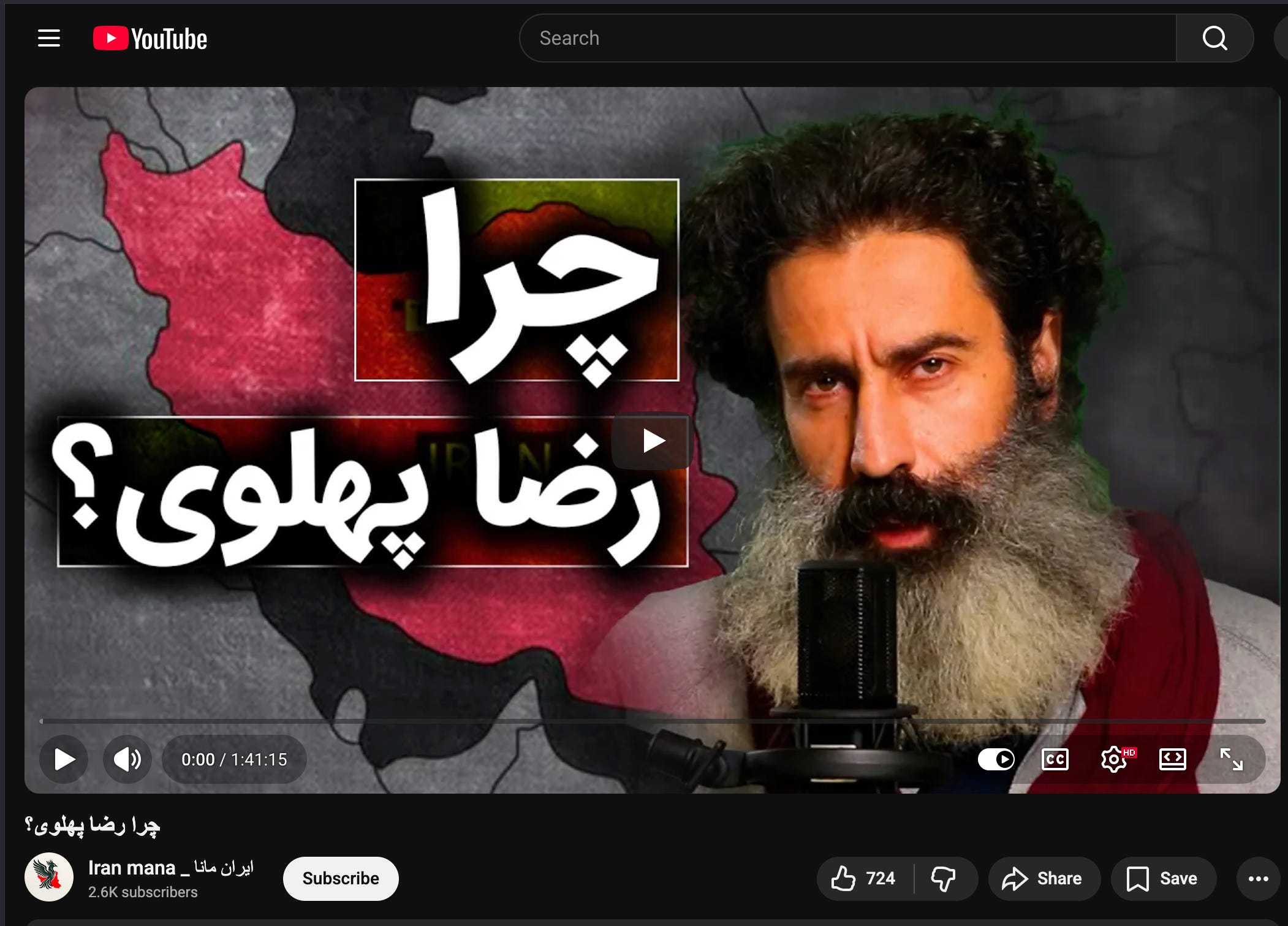
I did not choose to focus on Fatahi’s ideas because I believe he reflects what “all Iranians” believe. Nor do I think Pahlavi supporters inside Iran are necessarily articulating their support in this way. But Fatahi stands out as an ardent supporter of Pahlavi in several significant ways: First and foremost, he bucks the trend of Pahlavi supporters by engaging with those who, at times vehemently, disagree with his viewpoint. His disagreements so far have not devolved into name-calling. Second, it is noticeable that he does not call Pahlavi a prince but continually addresses him as Mr. Reza Pahlavi indicating, to me at least, that his project goes beyond the restoration of this particular dynasty. Third and relatedly, Fatahi is singularly focused on the issue of transition. His arguments in this video for example remain focused on why Pahlavi is the best option to lead a transitional period that he believes is inevitable and not, as other Pahlavi supporters particularly outside of Iran insist, as the future dynastic leader of Iran.
The story of the Pahlavi restorationists, particularly how they organize outside of Iran, the background of some of his main advisors in reformist politics in Iran, and the massive online campaigns of intimidation they carry out towards anyone who questions Pahlavi’s right to the leadership of the “transition period” or the throne, is complex and a story for another time. Nahal Toosi’s important recent piece in “Politico” is one of the few mainstream US articles to say out loud what many know: The online (and increasingly offline as experienced by Christiane Amanpour) threats of rape, death, slinging of profanity, intimidation, or other tactics towards anyone who criticizes Pahlavi or questions his claim of being the only leader for Iran is not just a reflection of the state of online discourse. It’s an intentional strategy hatched by a new set of advisors Pahlavi has gathered around himself. As she notes: “A former U.S. official, meanwhile, said of Pahlavi’s aides: ‘They scare me.’”1
But the fact of the matter remains that the conditions that make him an increasingly popular figure among diaspora are not the same as those that shape his support inside Iran and need to be understood on their own terms.
This summary and translation is produced as part of an effort to engage with a wide spectrum of perspectives and analyses published inside Iran. I invite you to read them, incorporate them into your understanding of Iranian politics, and help distribute them widely.
***
Why Reza Pahlavi?
In an Instagram post from about three years ago that is still there on my page, I first said that ultimately the last weapon will be taken up the nation itself. By “last weapon,” I meant that when we create conditions in which a society cannot bring about change—when their voices are blocked or ignored, when their efforts at reform are invisible or actively obstructed—that society will eventually respond. Even if all avenues for protest are closed, even if leadership is suppressed and every channel for collective action is blocked, society will internally generate a leader. The emphasis on leadership is deliberate because in most movements and transformations, although different segments of society play roles, leadership still holds a central place, especially in countries like Iran with its specific political culture, where organized party activity has not expanded due to structural and historical reasons. Societies in these circumstances ultimately bring forth those individuals around whom they can organize to create meaningful change.
What happened over the past few decades has, first and foremost, a political cause. The political structure itself—by restricting party activities, limiting well-known figures, and suppressing social movements—eliminated potential leadership options one by one. Leaders were discredited, placed under house arrest, withdrew from political activity, or made decisions under pressure that eroded public trust. Some were removed from political life entirely. Others were caught between compromise and survival, and society lost confidence in their ability to guide the nation during times of crisis.
Another reason is social. A deep sense of distrust and collective exhaustion has developed within Iranian society. The roots of this largely lie in political system actions, but political actors have also contributed. For instance, during the Reform era, figures such as Mr. [Mohammad] Khatami; later, Mr. [Hasan] Rouhani; and more recently, Mr. [Maoud] Pezeshkian, through their specific styles of political action, weakened public trust. Many lost legitimacy in the eyes of the public as figures capable of navigating critical crises.
Economic and security factors further amplify this. Fear of collapse and insecurity has created a dual effect. On one hand, society senses the dangers of moving toward breakdown, unpredictable conditions, and fragmentation. On the other hand, the pressures of living under the current system have become unbearable, generating an impulse to act. Economically, society may feel it has nothing left to lose. Yet uncertainty creates fear: fear of fragmentation, secession, or worsening conditions. This combination pushes society to seek a focal figure who can consolidate stability and manage risk. Past disagreements, criticisms, or factional divides are temporarily set aside in such circumstances. Society begins searching among the available options, reassessing potential leaders, and looking for someone around whom it can rally to navigate a dangerous transition.
Media and international factors are also critical. Iranian society recognizes that Iran’s transition is not purely internal; it has an external dimension. In its collective consciousness, society considers that the individual assuming leadership must be known internationally—someone with a clear identity, someone foreign officials have met, heard of, or can recognize, making it easier to engage in international dialogue.
These factors over decades have led Iranian society to converge on a single option for leading the transition period and the era that may follow the current system: Reza Pahlavi.
When we talk about the Iranian nation and society, naturally there may be many other individuals within that society who ultimately decide not to delegate their will to a single person during a transitional period, or who may remain opposed or neutral [towards Pahlavi]. What I mean is that it should not be assumed that when we speak of Iranian society, we are ignoring the various groups and factions that might oppose such a decision. Rather, we are speaking about a broader whole that could ultimately form a highly cohesive, overwhelming majority. That group might constitute 30 or 40 percent of Iranian society, but that organized 30–40 percent could ultimately carry along the other 60 percent—who may be spread across different spheres, have different motivations and perspectives, and have been unable to unite around a single issue, individual, or idea.
The process by which Mr. Reza Pahlavi ultimately becomes a consensus option for a significant portion of Iranian society is, in my view, only strengthening as time goes on. As I mentioned, this trend had already become evident around three or four years ago, i.e. we have been moving along a path shaped by sociological factors and dynamics, in which this individual ultimately becomes the final choice, whether one likes it or not.
There are two models for a transitional period [that would follow the collapse of a political system, here the Islamic Republic of Iran]: a collective, council-based model and an individual-centered model.
In a council-based model, a core body—what might be called a “national trust nucleus”—is formed. This council would include individuals trusted by significant segments of society, consolidating Iran’s existing social capital. Its responsibilities would include managing the transition to preserve social cohesion, maintain minimum living standards, ensure national security, and prepare for key decisions such as determining the future political system and drafting a new constitution.
Conditions for a council-based model include:
• Minimum trust among elites and recognition among representatives of various political currents.
• Existence of nationally recognized figures with relatively equal social capital.
• Secure communication and organizational infrastructure to allow pre-transition coordination.
• Sufficient time for the council to form before a crisis.
Currently, these conditions do not exist in Iran. Trust among elites is insufficient, social capital is unevenly distributed, secure spaces for interaction are blocked, and time is limited. Waiting until collapse occurs to form a council would be too risky and endanger national interests.
If the society lacks conditions to realize a council-based model, an individual-centered model becomes unavoidable. In an individual-centered model, the leader must be a trustee of the nation, someone who can guide the people safely through an extremely sensitive historical period. Crises of speed, coordination, and symbolic representation make this imperative. Major decisions must be made quickly; many actors with shared intentions are fragmented and require a central coordinator; and both domestic and international observers need clarity on who represents Iran.
The individual in this model must have specific characteristics:
1. Broad nationwide recognition, across both politically engaged and general citizens.
2. Symbolic capital beyond factional divisions, standing above ideological divides.
3. Capacity for international engagement, ensuring the global community can understand their positions and intentions.
4. No direct record of repression or crisis-making.
5. Acceptance of limited and temporary authority.
6. Ability to work with institutions rather than replace them, stabilizing governance and ensuring continuity.
As noted earlier, looking at the Iranian political landscape, many potential leaders face constraints. Figures inside the country are often inaccessible, unable to act openly, or too intertwined with the current political structure. Traditional opposition figures have limited social bases and are not broadly recognized. Intellectual and civil society figures, while possessing moral credibility, often lack crisis-management experience and capacity for international engagement.
Considering all these factors, Iranian society has, according to this analysis, converged on a single option that meets many of these criteria and claims the role for himself: Reza Pahlavi.
The individual-centered model carries the risk of drifting toward authoritarianism. If a council-based model were possible, it would be the lower-risk, rational choice. However, feasibility matters: without the conditions to form a council, discussion becomes merely utopian. This is not a moral judgment but an assessment of practical tools to guide Iran toward stability, preserve national cohesion, and improve social, economic, and environmental conditions.
Each of us may prefer a particular model. I, for example, might prefer a council-based model and believe that it has a better chance of being realized within Iranian society. I might feel that a council model carries fewer risks for Iran, that it would be more efficient, or that it might be closer to the ideals of democracy and freedom. However, when the necessary social and political conditions do not exist, that means such a model simply will not materialize. And if you invest in it under those circumstances, you are investing in a losing option. In a situation where we need internal cohesion within Iranian society, either you end up being sidelined from the sphere of socio-political movements, or you lose the cohesive space that we need for a healthy transition as you move through the transitional period. Perhaps the more effective course of action is to accept that a leader-centered model is the pragmatic choice, and then work to address and mitigate its shortcomings—so that we do not fall into the trap of the bitter experiences that may have existed over the past century.
Examining the political landscape, Reza Pahlavi aligns most closely with these criteria. His non-factional symbolic capital stems from decades of activity and legitimacy inherited from the monarchy. He is widely recognized internationally, and his historical actions show no direct involvement in repression, leaving him credible for transitional leadership.
Mr. Reza Pahlavi is essentially the only option for leadership and management in a leader-centered model during the transitional period. He is the only prominent individual in the social and political space of Iran who envisions such a role for himself, meaning he himself has declared it. Additionally, it seems that the various necessary characteristics we’ve discussed align to some extent with him and put him ahead of other options. When I really look at the social-political landscape of Iran, I don’t see anyone who can potentially compete with him. It’s not that such a figure might not emerge and be recognized in the future, but in the current situation, when we look at Iran’s political space, I don’t see anyone else.
https://www.politico.com/news/magazine/2026/02/24/reza-pahlavi-iran-trump-00793877
Please check out my latest article, I think it’s relevant to yours! Please restack if you find it interesting https://mahnazhatami.substack.com/p/shahanshah-the-vertical-that-holds?r=6a6pnp&utm_medium=ios