

On January 29, 2026, Mir-Hossein Mousavi, the reformist candidate in Iran’s 2009 presidential election who, along with his wife Zahra Rahnavard, has been under house arrest since 2011, published a statement condemning the January killings of protesters, called for the current rulers of Iran to step down and for a constitutional referendum, and rejected foreign intervention. You can read the full text, translated by Reza Akbari, over at The Guarded Domains.
Two days later, Bahareh Hedayat, a prominent activist and a key member of the One Million Signatures campaign for women’s rights—one of the most important civil society initiatives ever conducted in the history of post-revolutionary Iran—responded to Mousavi in an Instagram post. Hedayat, who has spent close to two decades in and out of the Islamic Republic’s prisons, had already rejected the reform of the Islamic Republic as a viable political path for Iran in the aftermath of the Women, Life, Freedom movement, calling the “overthrow” of the Islamic regime a “logical” step following months of unrest.1
What struck many of her activist colleagues, friends, and observers of Iran about her recent Instagram response though was the tone with which she addressed Mousavi. The viral post begins with: “Shut up, old man. Shut up.” Outside of media such as “X” (in which “shut up” is one of the more polite ways to address people you disagree with), Hedayat’s harshly worded response to another political detainee in the Islamic Republic stood out for its crossing of the line of both norms of civil discourse and customs of Iranian politeness. On her account page and in other media, the post found both supporters and detractors.
On February 2, 2026, the sociologist Hesam Salamat wrote an open letter to Bahareh Hedayat on his Telegram channel in response to her post. Salamat is a well-known researcher and translator in Iran who was imprisoned for two months after the 2009 protests in Iran. His most recent book is a co-translation of Council Democracy: Towards a Democratic Socialist Politics, edited by James Muldoon, which examines “the return to public assemblies and direct democratic methods” to interrogate “the relevance of council democracy for contemporary democratic practices.” In his letter to Hedayat, Salamat takes issue with her language, not as an empty call for civility, but because, as he writes, “your writing…destroys language itself and erodes the very possibilities of language. These days, language may be the only tool, or the only medium, we have left.” His response stands out for a clear articulation of what is being lost in Iranian oppositional discourse as the language of dissent becomes increasingly belligerent and exclusionary.
These three texts (Mousavi, Hedayat,Salamat) read together provide a multi-generational insight into the spectrum of thought inside Iran both on the content of opposition and the limitations of its current form. What follows is my translation of the Hedayat and Salamat texts, produced as part of a collaborative effort to engage with a wide spectrum of perspectives published inside Iran. I invite you to read them, incorporate them into your understanding of Iranian politics inside the country, and distribute them widely.
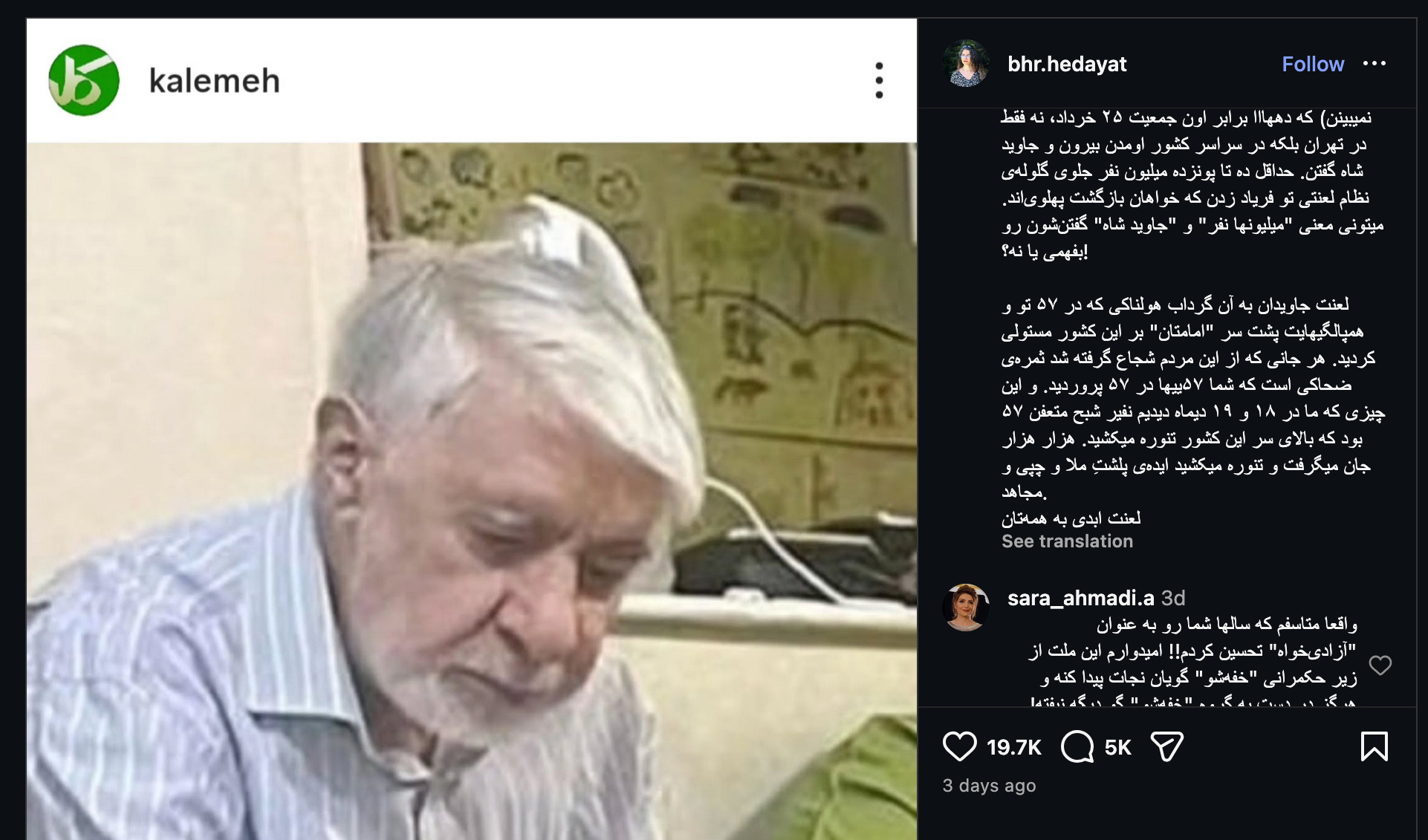
Bahareh Hedayat’s Instagram Post from Jan 31, 2026
Shut up, old man. Shut up. “You” are setting conditions for passing through this situation?! You?! You—with that Israel-hostility of yours, with that rent-based left-leaning economy, with your support for nuclear policy, and with your support for killing to prop up the “Islamic system”—how exactly were you different from Ali Khamenei?
Aren’t you ashamed? Go commune with that photo of the “vigilant soul” [Hedayat is referring to Khomeini here because in 2022, in an open letter, Mousavi criticized Supreme Leader Ali Khamenei, asking if that vigilant soul (جان بیدار) was here today, what would he think?2] that still hangs on the wall of your room and leave us be.
What made you important was the several hundred-thousand-person crowd in Tehran that came out into the streets on 25 Khordad ’88 [June 15, 2009] in your support; without their backing, you had no importance—you were just one of hundreds who carried out the crimes of the 1980s and had been sent to the trash bin of history.
You aren’t here now to see (and I doubt that even if you were, you could see, because your friends are out here but they’re blind and don’t see) that the crowds today are tens of times bigger than what came out on 25 Khordad, not only in Tehran but throughout the whole country, and said “Long live the King.” At least ten to fifteen million people stood in front of your damned system’s bullets and shouted that they want the return of the Pahlavi. Can you understand the meaning of “millions of people” and their saying “Long live the King” or not?!
An eternal curse upon that terrifying maelstrom that you and your fellow gang members, standing behind “your Imam,” imposed upon this country in 1979. Every life that was taken from these brave people is because of the Zahhak that you ’79ers raised in 1979. And what we saw on the 18th and 19th of Dey [January 8 and 9, 2026] was the trumpet of the putrid specter of 1979 blaring over this country. It took thousands upon thousands of lives, and it blasted—the filthy idea of the mullah and the leftist and the Mojahed [referring to the followers of the Mujahedin Khalq Organization.]
Eternal curse upon all of you.
A Letter to Bahareh Hedayat3
February 02, 2026
Hello Bahareh,
I doubt that any of us are doing well these days. Beneath the rubble of so much atrocity and so many wounds, breathing has become harder than ever. Honestly, I feel like my lungs aren’t working properly. Maybe it’s the cigarettes. But even if I didn’t smoke, it would be the same—I’d still feel like I can’t breathe right. When I read your latest post about Mousavi’s letter, I felt even worse. I thought it might be better to write something directly to you—like an open letter that others could read as well.
I don’t want to get into a literary or moral critique of your text. I don’t want to argue about ’79, Mousavi, your comparison of him to Khamenei, the 1980s, the left, the Pahlavis, or “Long Live the King.” My issue is something else. My main problem with your writing is that it destroys language itself and erodes the very possibilities of language. These days, language may be the only tool—or the only medium—we have left. And yet it is rapidly losing its capacity for dialogue. Instead of being a field of intelligibility, a space within whose boundaries one can talk about differences and possible commonalities, it has mostly been reduced to a handful of curses, insults, “death to”s and “long live”s. Your writing roams around in this arena. The fact that it begins with “shut up” is telling enough. This command to silence, to clamp one’s mouth shut, means that language is no longer supposed to function as a mediator. When language loses its role as the very essence of communication—meaning simply that we can no longer exchange even a few words with each other—then there is nothing left to mediate between us, to place us in relation to one another. What does remain of language is reduced to a few earsplitting words and sentences useful only for wounding and producing injury, not for building a “shared world” (a world in which disagreements and agreements can be talked through).
No matter how angry you are, no matter how enraged or wounded, so much hatred is surging through your writing. The space you’ve created is saturated with hatred toward young and old alike; it seems no one but you is meant to survive it. Worse than that, you are somehow turning this widespread hatred into a political tool, extracting from it a sort of political logic, and by staging this “politics of hatred,” you are enacting for us a preview of Iran’s future order. Let me be blunt: this image of Iran’s future that you offer is genuinely depressing. Your Iran isn’t a good place to live either. Your Iran, too, smells of revulsion and revenge.
Maybe you think to yourself that this is the time for drawing hard and uncompromising boundaries; that fronts must be decisively separated; that a deep chasm must be dug between “us” and “all you damn people” so that no one can cross it. Maybe you think now is the time to throw all options other than Pahlavi to the ground and close their files once and for all. And to make that happen, one must spend the hatred circulating in the air as much as possible, turn it into bullets and fire it at this person or that. For this to happen, one must then point at every group that hasn’t pledged allegiance to Pahlavi and shout, “We hate all of you.”
But you cannot build a society with hatred. A society that is built with this level of “shut up” and “go die” is not a society at all. It doesn’t bring people together, nor does it place them in relation or connection with one another. On the contrary, it constantly subtracts them from each other, continually pits them against one another, and turns each of them into a closed, self-contained sect incapable of reaching any common ground or agreement (or even thinking that they should). And so, they must fight each other forever—which is precisely what civil war is: a war of everyone against everyone until, in the end, whoever is stronger wins the game and either takes the rest hostage, exiles them, or kills them.
But in Iran, we need a civil condition (وضع مدنی). And a civil condition means the coexistence of differences. Honestly, I’ve always thought that a civil condition begins with these simple sentences: Let’s talk. Let’s understand what we agree on or could agree on. Let’s find a way to manage our disagreements, and if we can’t find a way, then let’s not fight—or, if we must fight, let’s at least set some simple rules for that fight.
You know better than I do that despotism is our shared history, exclusion is our shared history, oppression is our shared history, and elimination, exile, and killing are our shared history. Our shared history is saturated with the infliction of wounds and collective suffering rooted in “only me,” in “you have no rights,” in “all of you shut up,” in “all of you get lost,” in “we’ll send you all to hell.” But this history must no longer be repeated. We do not have the right to repeat history by becoming what we are fighting against. We do not have the right to repeat the 1979 that you despise so much. Nothing is sadder than this: if at first in ’79 the clerics gained power and threw everyone out, then now in 2026 the monarchists (or any other group) gain power and throw the rest out with curses and damnations. We must lean on each other to stop this history from repeating itself.
Before I finish, let me quote you something I recently read by Herta Müller.4 Much of Müller’s life was spent in Romania during the Ceaușescu era, so she has a very clear understanding of dictatorship. Somewhere in her book Everyday Misery [فلاکت روزمره is the book referred to in Persian, but the sentence comes from an essay titled in English “Dignity and Empty Freedom”], she writes:
“Today, I have to admit to myself: most of what I’ve learned about freedom and dignity I’ve learned from the mechanisms of oppression. Observing these mechanisms—and of course there’s nothing else to do in a state of oppression—is like deciphering the mirror writing of freedom.”5
She isn’t saying anything complicated. In fact, what she’s saying is very simple. That sentence could just as well have been yours. In fact, I think this sentence, or ones like it, ought to come from you and people like you (and me). Those of us who lived for so many years under the sinister shadow of dictatorship should know a lot of things about the value of freedom. And even if we don’t know much about freedom, we should at least know (and I think you know this better than I do) what a filthy thing despotism is, how catastrophic “shut up” is, how dangerous it is to exile people in the name of “you damn leftists,” “you unpatriotic intellectuals,” “you cursed ’79ers,” or other things like that.
We should have learned many things from the Islamic Republic. And if we have, then perhaps we have the chance to build a better Iran.
Herta Müller is a Romanian-German novelist, poet, essayist and recipient of the 2009 Nobel Prize in Literature.
This intelligent dialogue gives me hope for the future of Iran. Thank you for translating them and making them available to us.
Thanks so much for providing these narratives and debates from inside