
The News Changes Constantly and Not at All
On burnout, Iran, and the emotional cost of paying attention.

This past week, I have found myself reading less and less of the news and yet waking up more frequently in the middle of the night.
It made me realize it’s time to take a break for a couple of weeks—from the news and from the shape of the life that the war and I have created together. I expect to be back once I’ve had a chance to regain a bit of perspective.
I know I could have simply disappeared for a couple of weeks and reappeared when things felt different. But I thought it was worth saying a few words about what it looks like to pay sustained attention to catastrophe as I, and so many friends and colleagues who work on the Middle East have done for months, if not years, and what this burnout actually feels like.
Some of it, I know, is that all too familiar-to-academics rhythm of the summer whereby even the word “August” stands for all the research and writing you had planned to do but didn’t get around to it and now the semester is going to start and you have to push it back realistically to next June but to make yourself feel better you say I’ll do it after the semester is on the way. Then you blink and it’s next summer and you’ve walked backwards down the hill a bit faster than that boulder you were pushing up to make sure you’re not crushed by it.
The deeper reason, though, is emotional fatigue from paradoxically the news constantly changing and not changing at all.
For nearly six months, the war involving Iran has continued to spiral. The headlines change, but the underlying reality does not. I find myself intellectually exhausted by the endless stream of analysis and emotionally exhausted by the feeling that every development is somehow both urgent and familiar.
I’m tired, in other words, of a war that, even when it disappears from the front page of Western newspapers, remains woven into the fabric of everyday life for millions of Iranians. I’m also tired of wondering what, if anything, I can do that makes even the smallest dent. And I wonder what right I have to step away when I sit here looking out at my garden and tending to my tomato plants.
(I am very fond of my tomato plants.)
Many of the people I write about—and many of the journalists and scholars whose work I rely on—don't have the same freedom to step away, even briefly, from this reality that shapes every part of their lives. Their lives and livelihoods are bound up with events that continue whether they have the energy for them or not. I don't know what to do with that fact. It simply sits there, refusing to become any less true.
What worries me is not the exhaustion itself. It’s that I now find myself oscillating between anger and indifference. Earlier in the war, anger still carried momentum. It propelled me to translate, to write, to explain, because everything felt as though it mattered. Now it feels as though I hear the same experts making the same predictions: The United States is stuck. The United States will bomb. The United States has bombed. Oil is up before the weekend. Oil is down on Monday. The Iranian government is the same, is different, is weaker, will survive, will not survive. Meanwhile, the economic devastation produced by sanctions, corruption, mismanagement, and war simply grows deeper.
I keep asking friends who understand these things far better than I do: How do people live like this? How are they functioning? How do they survive?
The answer, inevitably, is that they simply do. They do through the same force of will that sends pensioners into the streets day after day, despite the heat, despite repression, despite a state that has emerged from this war feeling even more emboldened to imprison and execute its own citizens.
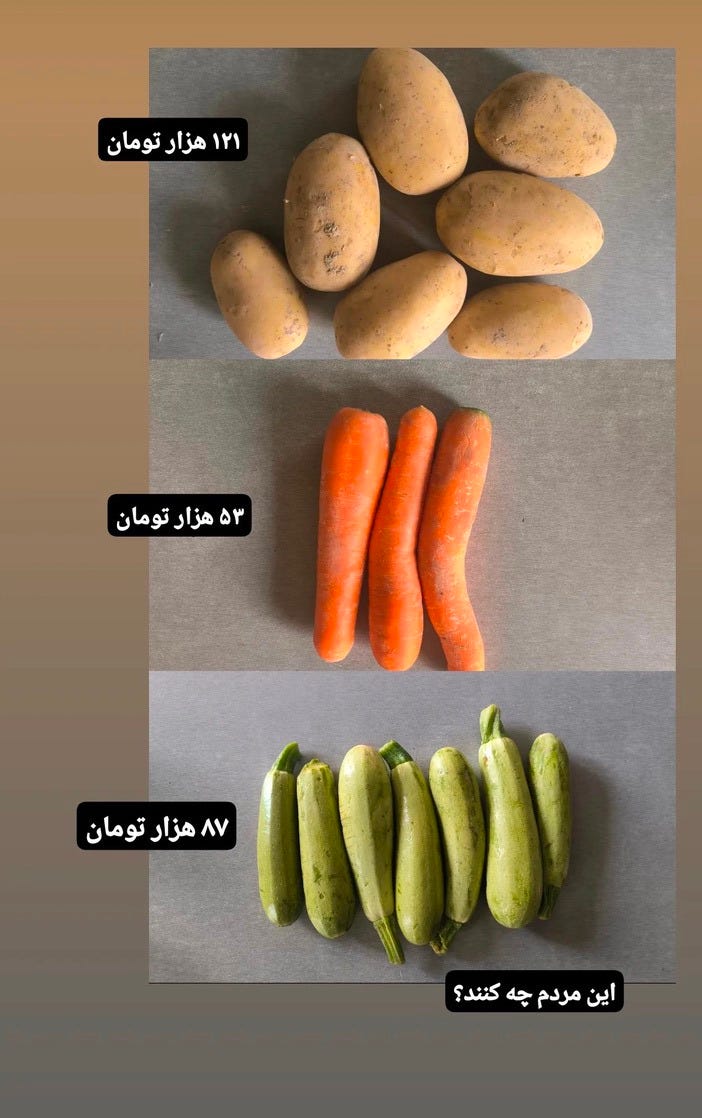
Someone in Iran recently posted the image below. It shows the prices of just three basic items. I won’t convert them into dollars because currency conversion cannot capture what hyperinflation, collapsing purchasing power, and years of lost income actually feel like. In the low-right corner of the image is a simple question: “What are people to do?” That question keeps rattling in my head. But instead of trying to think through an answer, it made feel paralyzed. Or more accurately, made me stop reading the news because it all felt..it felt like I’d just seen it before.
I want to care when I do this work. I don’t want a creeping sense of futility to shape what I write. If I’m going to continue writing about Iran, I want to do so from a place of curiosity, moral clarity, and genuine engagement, not because I feel incapable of looking away for even a day.
I hope that when I return, I do so with more clarity, more energy, and with the same sense of purpose that brought me here in the first place. In the meantime, if you miss me, go back and read some of my writings and translations in the archive or read some of the books I recommended or watch some of the films on this list. And in the meantime if you have any book recommendations for me, something joyous and hopeful preferably, please leave them in the comments.
I’ll see you soon.
Naghmeh
Dear Naghmeh Sohrabi,
As someone who has been following all that you have been sharing please know that not only has it been but is really interesting and most informative and very much appreciated.
Your most recent comment "The deeper reason, though, is emotional fatigue from paradoxically the news constantly changing and not changing at all" which is completely understood.
Enjoy your break and your tomatoes,
In admiration,
Mrs SR - UK based