
"The Noose Is the Last Link in Poverty's Chain"
Inside the hunger strike at Qizil Hisar prison and what it reveals about executions, poverty, and the Islamic Republic's politics of punishment.

No food. No drink. Sewn lips.
Since July 13, 2026, the prisoners in unit 2 of Qizil Hisar prison, many of whom are on death row for drug related charges, have been on a hunger strike. Not to get better food nor any particular benefit that would improve their conditions. They have been protesting against the unending stream of executions carried out by the Islamic Republic of Iran.
In a video below smuggled out from inside the prison on the first day of the strikes, the prisoners are seen holding signs that say “no to executions” and “don’t execute,” as a voice over announces that the strikes will continue until the government puts an end to them and appeals to the Iranian people to be the voice of “us captives in chains.”
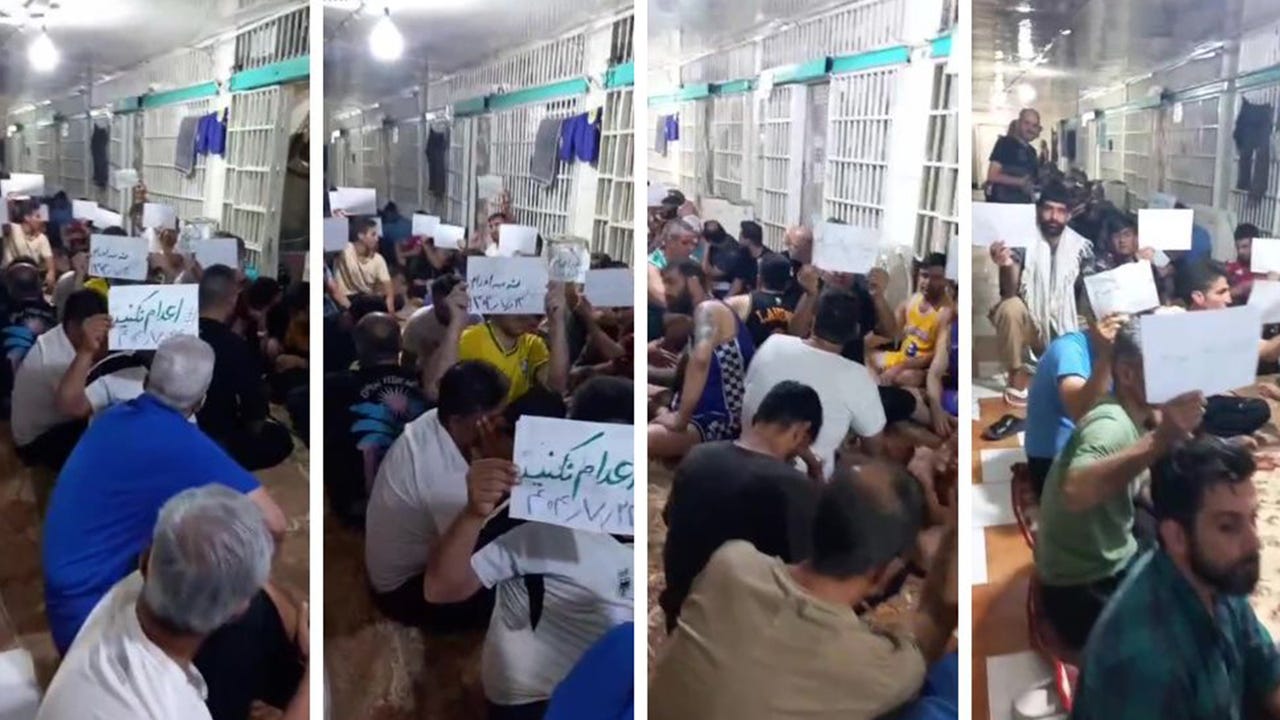
The protests began when the authorities transferred 6 inmates to solitary confinement, signaling that they are next in line for execution. Of countries in the world that publicize their statistics (China notoriously does not), Iran ranks first in drug related executions. In 2024 and 2025, it carried out 79% of drug related executions in the world.
This is not the first hunger strike of the inmates in Qizil Hisar’s unit 2. In October 2025, they went on a seven-day strike to protest executions and Iran’s draconian approach to drug related offenses. That strike ended when the government promised a 6 month moratorium on these executions as it reviewed their case files and presumably reformed its laws. With the resumption of executions and no reform in sight, these prisoners went on both a food and dry strike (i.e. no drink nor food).
While the Western media is finally covering this 2 week plus strike, the coverage is mainly focused on the surge in executions in Iran.
For today’s post, a bit of a reversal. Below is a translation of a piece published on the telegram channel and instagram of Sarkhat [Headline], which “covers the headlines and news of workers, teachers, women, students, ethnic groups, and the environment.” This piece places the strike and the executions in a political economy matrix, while directly challenging the Islamic Republic’s wartime boast that it is a defender of Iran, a boast that is repeated by those who keep celebrating the Islamic Republic as the world’s reigning champion of anti-imperialism.
After the translation, I have delved more deeply into some of the issues raised by the piece and linked it both to the ongoing pensioner protests in Iran and the executions at dawn today in Isfahan of two young men arrested during the January protests.
The Noose is the Last Link in Poverty’s Chain
July 27, 2026
In the days when the Islamic Republic speaks of “defending the homeland” and “confronting the foreign enemy,” for the past fourteen days in Qezel Hesar prison more than a thousand five hundred prisoners — mainly those convicted in drug-related cases — have deliberately taken their lives into their own hands to stop the execution machine. This is not merely a contradiction; it is a portrait of a government that speaks of war beyond its borders while waging a relentless war within its borders against those dispossessed.
This paradox continues precisely at a time when the Islamic Republic, after the war, has simultaneously intensified the security atmosphere and unprecedentedly increased executions. In 2025 alone, at least 1,639 people were executed, the highest recorded figure in several decades. That means, on average, more than four people were hanged every day. At the same time, the number of executed political prisoners, detained protesters, drug-case convicts, and Kurdish and Baluch citizens has also increased dramatically.
This is not just statistics; it is a design by a government that in order to preserve itself, has turned death into the politics of everyday life.
The Islamic Republic does not wage war only at the borders. Its real war has been underway for years within the country; a war against the working class, against the poor, against protesters, and against every human being unwilling to submit. The very same government that speaks of “national security” abroad, at home is buying its own security with a noose and answering economic and social crises with execution.
It is enough to look at the faces of those are striking. They are neither the purveyors of grand smuggling networks nor those who profit billions from the drug economy; rather, it is drivers, workers, the unemployed, those on the margins, fuel-carriers, porters (kulbaran), and young people whose share of this system has been nothing but poverty, hopelessness, and prison.
Profit remains for those who have power and capital; the hangman’s rope for the poor.
Today, the largest protest against execution is not taking place in city squares, but behind the walls of Qezel Hesar prison. A place where prisoners through food and dry hunger strikes, by sewing their lips, cry out that you cannot silence the right to live with the hangman’s rope. When a human being stakes hunger and thirst against their own life so that perhaps another death might be stopped, it means the government has closed even the last remaining avenues to seek justice.
More than 1500 people have gone without food for days. A number have sewn their own lips shut. Six prisoners are in solitary confinement waiting for the execution sentences to be carried out. Families stand outside the prison doors, and the answer they receive is threats, violence, and crackdowns. This is today’s image of Qezel Hesar.
A year ago, these same prisoners went on strike. They were promised that executions related to drug offenses would be stopped. They were promised that the law would be reformed. They were promised. But the noose never stopped working; only the silence grew heavier, and the gallows grew taller.
At the same time as the the security atmosphere and economic crises grew, the number of executions increased. First they impose poverty on people, then they punish those same victims in the name of law. This cycle continues; a cycle in which the most deprived layers of society are exposed to the harshest punishments more than anyone else.
Behind every execution sentence is not merely a case number; it is a life, a mother, a child, a family, and a future that never gets the chance to be built. A society that wakes up every day to news of executions is slowly made to get accustomed to the sight of death. This may be more horrifying than the hangman’s rope itself.
Qezel Hesar today is not merely the name of a prison. Qezel Hesar is a mirror of a society in which poverty becomes a crime, deprivation is punished, and death takes the place of justice.
This prisoners strike is not merely an attempt to save the lives of a few individuals; it is a cry against the normalization of execution, against the normalization of death, and against the silencing of the voices of those who have nothing left to give but their own lives.
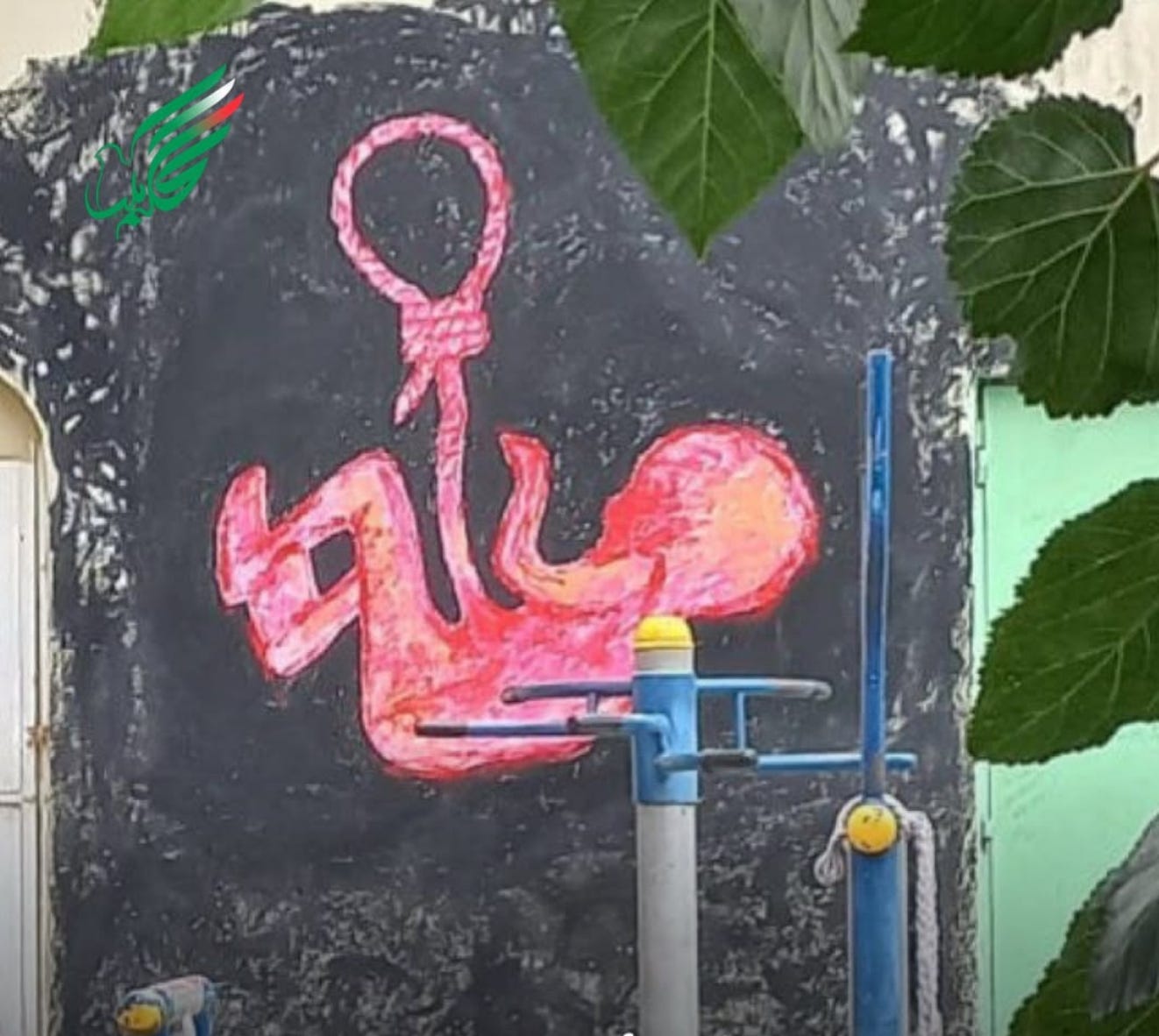
The Islamic Republic has justified its harsh drug laws as a necessity to combat drug smuggling on its border with Afghanistan, where opium production increased dramatically during the Soviet invasion in the 1980s and again in 2001 and the US declaration of the war on terror.1
But even taking into account these external factors, the fact that addiction and drug trafficking have not only not abated but have been on the rise for the past 50 years along with the fact that the Islamic Republic at various points, most notably during Khatami’s 2 presidential terms, attempted to reform its harsh sentences, only to revert back points to a deeper reality: the drug crisis in Iran is also shaped by internal conditions such as poverty, inequality, unemployment, and social exclusion that create the circumstances in which addiction and drug trafficking take root. Despite this, the Islamic Republic has repeatedly chosen executions over confronting these underlying problems, treating a social crisis as a criminal one and punishing its consequences rather than addressing its causes.
Iran’s socio-economic crisis was not created by the war but as Hadi Kahalzadeh has shown, war “accelerated [its] poverty crisis.” Sanctions have also played an important role in this but as Ida Nikou has written, in response to sanctions, the Islamic Republic “[r]ather than meeting its obligations through stable public funding, … has leaned on privatization, debt-for-asset swaps and productive use’ (Movaledsazi) schemes that transfer public assets into private hands.”
This all converges in the fate of Iran’s pensioners, a group of people who whether they are seen in English language media or not, have been protesting the Islamic Republic’s dismal economic situation continuously: before the war, during the war, and now.
But why?
To steal from a friend’s simple explanation: If you are on a pension, your income remains the same even as inflation sky rockets. Or, to give a deeper explanation, as Nikou notes: “Instead of paying down its debt to Social Security in cash, the government has increasingly transferred shares in state-owned firms, effectively forcing the pension system to finance benefits through dividends, asset sales and investment returns. This policy shifts risk onto retirees by tying their livelihoods to market performance and inflation rather than stable entitlements.”2
On Sunday, Social Security pensioners joined the striking prisoners in centering a stop to executions in their slogans. In Tehran, Arak, Ahvaz, Shush, Dezful, Rasht, and other cities, they held signs and shouted slogan against the continuing deterioration of living conditions. In addition to slogans such as “Enough warmongering; our tables are empty" and “assembly and protest are our fundamental rights,” the pensioners shouted “We swear on the blood of our companions/Until the dissolution of execution sentences/We will stand until the end.” (You can—and should—watch them in Rasht here.)
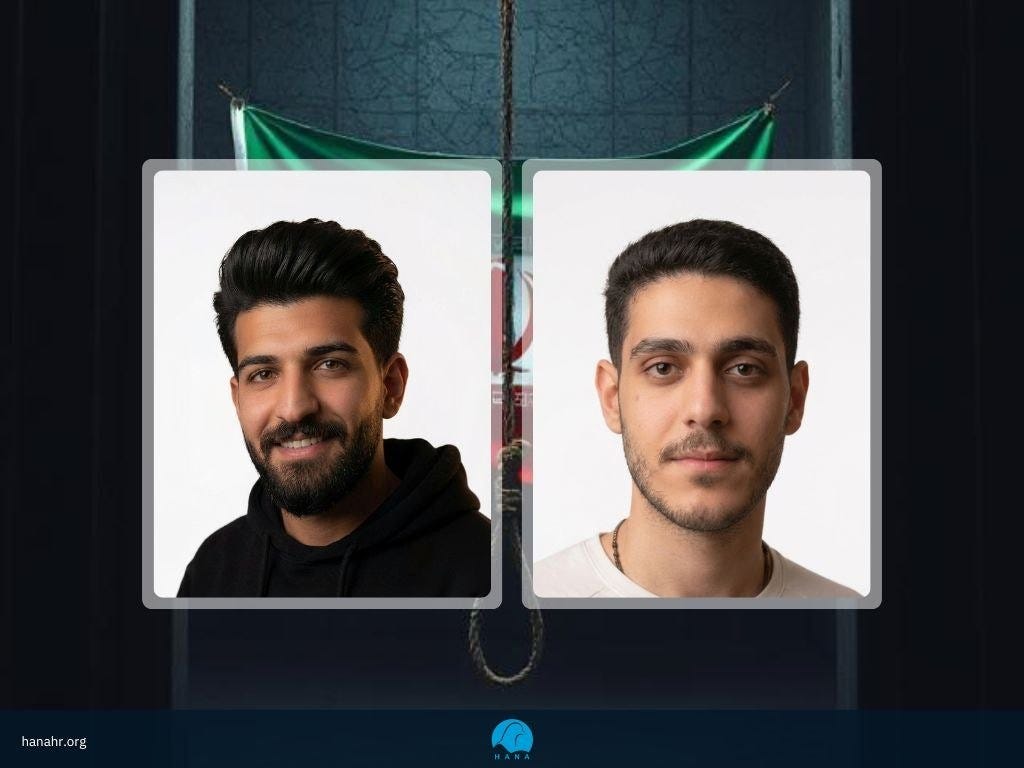
For most people whose interest in Iran is related to big Events, such as war or mass protests in streets, when they think of executions in Iran, they think of “political” executions such as that of the two young men hanged in city of Isfahan. Amirhossein Safari Hosseinabadi and Abolfazl Sepahi Badjiani had been arrested in the aftermath of the January protests also known as bloody Dey and along with 10 other men were sentenced to death for killing security personnel on January 8.
This morning at dawn, as the Islamic Republic prepared its makeshift gallows for a public hanging, a crowd of people gathered in protest. Grainy and dark videos circulating on social media tell of a crowd booing at the execution site, shouting bi-sharaf [shameless] presumably at the security forces, and violence directed at the gathered crowd.
Executions and economic hardship are not separate stories. They are both symptoms of the same governing logic: one that has consistently preferred coercion over confronting the structural causes of Iran’s social crises. War and sanctions are an important part of that story. But state violence, executions, economic mismanagement, and corruption are not their inevitable consequence. They are political choices.
It is tempting, particularly in the midst of a war that is aimless, senseless, and endless, for every other issue to disappear from view. But the pensioners’ protests suggest otherwise. Their lives have been shaped not only by bombs and sanctions, but by decades of shrinking pensions, rising inequality, and a state that has repeatedly answered social crises with repression rather than reform. We should be capable of opposing military attacks on Iran while refusing to ignore the violence the Islamic Republic continues to direct at its own people. These are not competing moral claims. We should stop treating them as such.
نه به اعدام
No to Executions
If you found this useful and want to read click below:
Tehran: A City of Empty Pockets

Before we get to this important report on the back-breaking economic consequences of the most recent war, a quick mea culpa.
And
Against the People–Imperialism Binary

One June 1, 2026, the Iranian researcher, writer, and activist, Yashar Darolshafa, was beaten and arrested in Tehran. Darolshafa is a well-known leftist scholar, labor activist, and political prisoner who was first arrested during the Green movement in 2009. Since then he has been jailed multiple times. The reasons for his most recent arrest and his whe…
Also don’t forget to subscribe to the Crown Center’s Substack where you can read a newly published analysis of the war and its consequences from Iran, US, Israel, and Gulf perspectives, and much more. Click Here.
For a fantastic account of Iran’s Drug policy, read Golnar Nikpour’s Middle East Brief published by Crown Center Middle East: https://www.brandeis.edu/crown/publications/middle-east-briefs/pdfs/101-200/meb119.pdf
https://www.merip.org/2026/01/governing-crisis-sanctions-austerity-and-social-unrest-in-iran/